Authored with Simran Parkhe, Nati Alayev, Sarah Stephenson
Introduction
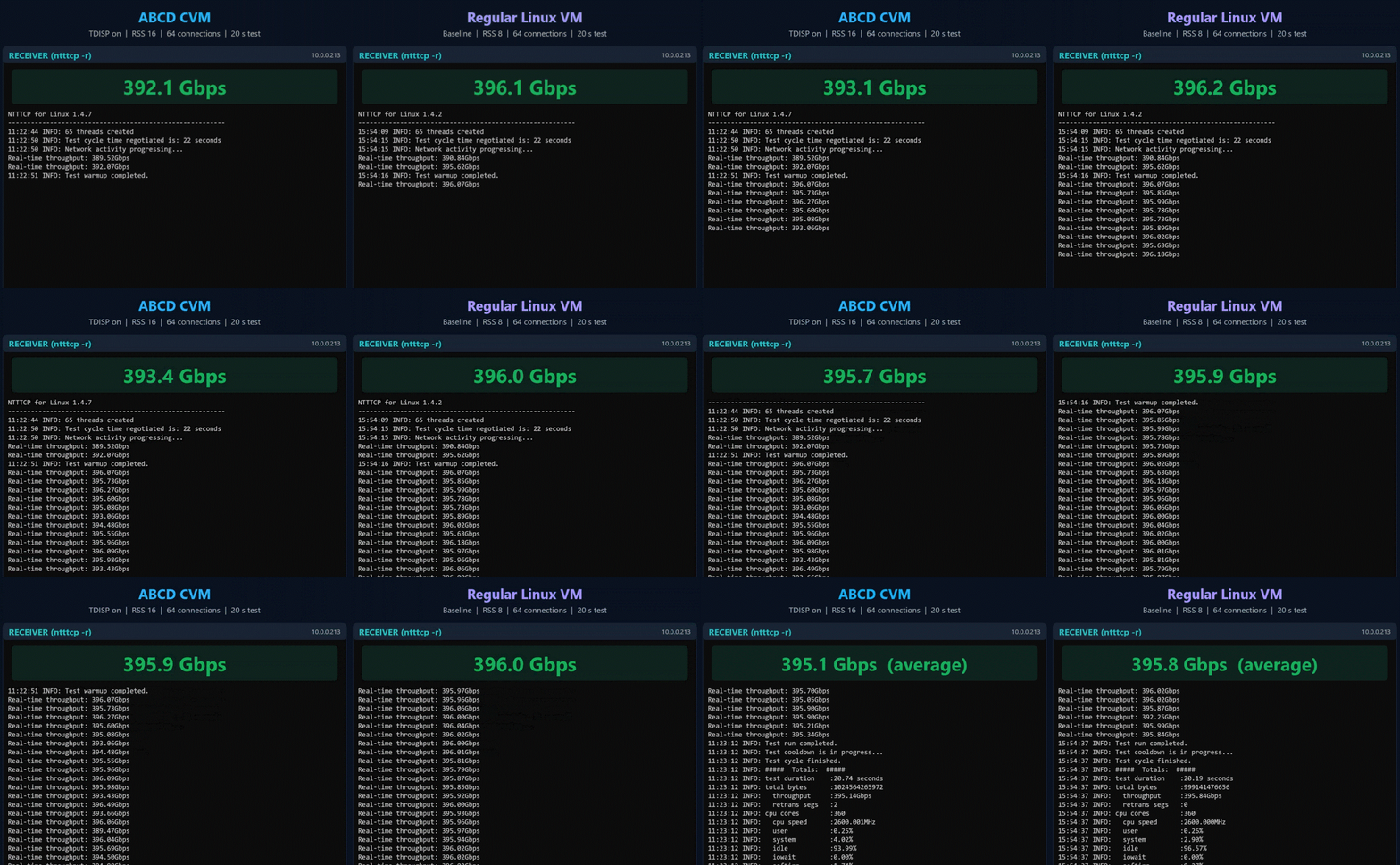
Today at Ignite, we presented an industry-first demonstration of TEE Device Interface Security Protocol (TDISP) with Azure Boost, showcasing up to 400 Gbps of network bandwidth. We also released improvements across our Intel-based portfolio to help enterprises strengthen workload resiliency and improve total cost of ownership for mission-critical workloads.
Azure Boost Confidential Device: True Accelerated Networking
Azure Boost Confidential Device is a new capability in Azure Boost that supports TDISP. Innovations in 6th Gen Intel® Xeon® processors enable us to extend the confidential trust boundary beyond the CPU to devices verified through attestation, such as Azure Boost.
It establishes an attested secure channel and binds device configuration and access policies to the VM’s launch measurement. This helps ensure that only verified devices can access sensitive workloads, protecting data in use. It accelerates network performance by removing bounce buffering – an intermediate data-copying step that added latency and consumed CPU resources.
Demonstration
Enhancements in DCesv6, ECesv6, DCedsv6, and ECedsv6
Thanks to feedback from our customers, we’ve been hard at work improving our existing products with additional capabilities aimed at strengthening workload isolation, accelerating data movement across compute, storage, and networking, enabling faster recovery from emergency events, and expanding options for containers.
-
Confidential AKS nodes are now generally available
-
Host-level virtualization optimizations have accelerated database operations
-
Improved support for database workloads with SQL Server in CVM and PostgreSQL on CVM
-
NVMe remote storage support is now available for faster I/O to attached remote disks
-
Accelerated networking with MANA powered by Azure Boost is available in preview
-
Local sealing support for faster recovery during outages is available in preview
Confidential AKS nodes are now generally available for Azure Container Linux, and in preview for Ubuntu 26.04, this extends Intel TDX protection to containerized workloads. Platform teams can evaluate this protection without changing applications or the familiar AKS operating model.
For mission critical database workloads, Microsoft and Intel collaborated on end-to-end optimizations that reduce virtualization overhead and improve I/O efficiency for database workloads. These under-the-hood changes include posted interrupts, timer optimizations, and DMA enhancements. These now-available optimizations deliver major improvements to database operations in both SQL Server and PostgreSQL.
Customers can upgrade the remote storage path from synthetic SCSI to NVMe, reducing protocol overhead and accelerating I/O to attached remote disks. Separately, we made further refinements to NVMe local storage: in testing, peak 4K random-read throughput rose 26% and now achieves 2.4 million IOPS.
Accelerated networking is available in early preview; this exposes an SR-IOV virtual function to the guest for an improved data path. This capability, enabled by MANA, reduces latency and bypasses the synthetic NIC path for higher throughput.
Finally – we’ve introduced local sealing for improved resiliency for confidential workloads. This enables confidential VMs to restore encrypted state and restart securely during datacenter outages, without the dependency on attestation and key-management services.
These features are supported across Ubuntu Pro, Ubuntu Server, Red Hat Enterprise Linux, Windows Server 2025, and Windows 10 and 11 Client.

 Microsoft