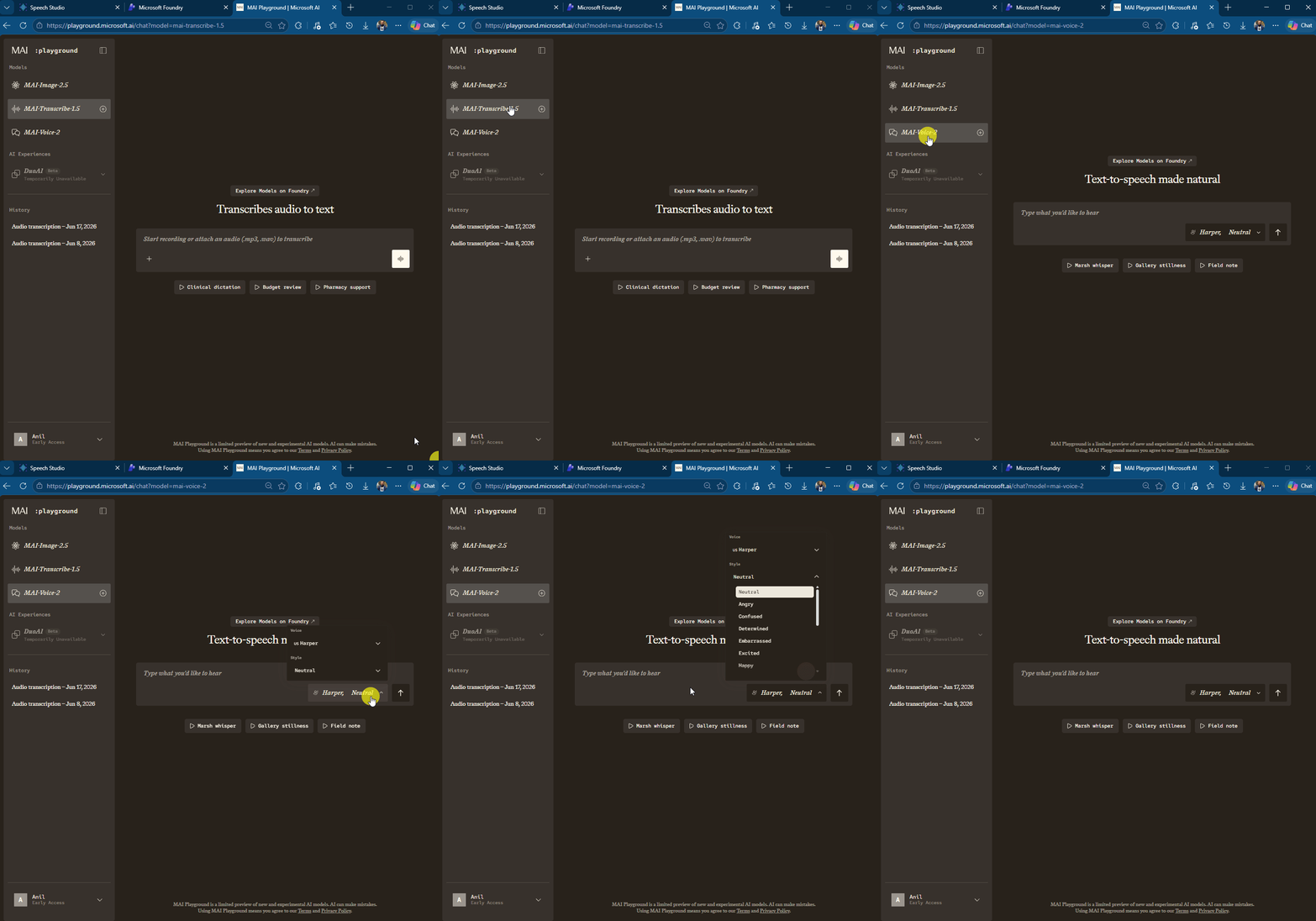
Building with voice starts with a simple question: what should the system produce? If the answer is a live conversation, transcript, translation, caption, or synthetic voice, the best architecture changes quickly. This guide compares Azure OpenAI, Voice Live API, Azure Speech in Foundry Tools, and MAI speech models so you can choose the right path with fewer surprises.
Choose the right speech and voice model in Microsoft Foundry
The practical approach to selecting the right model is simple: do not ask which speech model is best. Ask what the speech system must guarantee. Once you know whether the job is conversation, translation, transcription, diarization, synthesis, or managed voice-agent orchestration, the model choice becomes much clearer.
Choosing the wrong speech model usually does not fail in a benchmark. It fails in production: a customer interrupts and the agent keeps talking, a meeting transcript has no speaker labels, a translation workflow adds too much delay, or a text-to-speech pipeline sounds good but cannot use the voice your product needs.
Microsoft Foundry now gives builders several speech and voice paths across Azure OpenAI, Voice Live API, Azure Speech in Foundry Tools, and Microsoft AI (MAI) speech models. This guide helps you choose the right surface for the job before you commit to region, quota, pricing, or architecture assumptions.
TL;DR: pick by job, not by model name
- Use Azure OpenAI Realtime API when you want direct, model-native speech-to-speech control over WebSocket, WebRTC, or SIP.
- Use Voice Live API when you want a managed voice-agent stack with speech recognition, model reasoning, text-to-speech, turn detection, interruption handling, voices, tools, and optional avatars.
- Use Azure Speech realtime or batch speech-to-text (STT) when the transcript is the artifact of record.
- Use a diarize or Azure Speech batch when speaker labels matter (Who said what).
- Use Azure Speech TTS, Custom Neural Voice, gpt-4o-mini-tts, or MAI-Voice-2 when voice quality, identity, language coverage, or long-form narration matters.
- Use mai-transcribe-1.5 when world-class, low-cost multilingual STT with phrase/entity biasing is useful and diarization is not required.
- Validate region, deployment type, lifecycle, quota, and price in your tenant before treating any model choice as final.
A quick glossary
- STT: speech-to-text, also called transcription.
- TTS: text-to-speech, also called speech synthesis.
- VAD: voice activity detection, used to decide when a speaker has started or stopped talking.
- SIP: Session Initiation Protocol, commonly used for telephony integration.
- PTU: provisioned throughput units, a reserved-capacity deployment option where supported.
Start with the user experience
The first decision is not which model is smartest. It is what the system must produce and how fast it must respond.
If a user speaks to an agent and expects the agent to listen, reason, be interrupted, and speak back in real time, you are building a speech-to-speech system. Choose between direct Azure OpenAI Realtime API and managed Voice Live API.
If a user uploads or records audio and needs a transcript, you are building STT. Use transcription APIs or Azure Speech batch, not a conversational voice model.
If text goes in and speech comes out, you are building TTS. Use a TTS surface, not a speech-to-speech model.
If speech must be translated while the speaker is still talking, you are building live speech translation. That is different from file translation to English with Whisper.
If the app can wait for a normal request/response turn, turn-based audio chat is often simpler than a realtime session.
Scenario map
Interactive experiences
| Scenario | Start with | Use when | Watch for |
|---|---|---|---|
| Turn-based audio chat | gpt-audio, gpt-audio-mini, gpt-audio-1.5 | The user records or sends audio, then waits for a response | No live barge-in; app owns turns and playback. Not ideal for real-time and latency sensitive scenarios |
| Composable voice chatbot | Azure Speech STT + Azure OpenAI or Foundry model + Azure Speech TTS | You want separate control over transcript, reasoning, and voice | More orchestration; app owns interruption and latency |
| Direct realtime voice agent | gpt-realtime, gpt-realtime-mini, gpt-realtime-1.5, gpt-realtime-2 | You want model-native speech-to-speech over WebSocket, WebRTC, or SIP. Low latency, fast results. | Persistent session; app owns session behavior |
| Managed realtime voice agent | Voice Live API | You want STT, model reasoning, TTS, turn detection, voices, tools, and avatars in one surface. Advanced features like; noise reduction, enhanced turn detection | Separate quota/pricing; requires persistent WebSocket or WebRTC session; SIP not directly supported. Not ideal for strict word for word speech |
| Live translation | gpt-realtime-translate or Azure Speech Translation | The speaker is still talking while translation happens | Use openai/v1/realtime/translations?model=gpt-realtime-translate |
| Live captions | gpt-realtime-whisper or Azure Speech realtime STT | You need source-language text during a live session, streaming transcription | Not a durable diarized transcript by itself |
Speech artifacts and workflows
| Scenario | Start with | Use when | Watch for |
|---|---|---|---|
| File transcription | gpt-4o-transcribe, gpt-4o-mini-transcribe, whisper, mai-transcribe-1.5 | Audio is uploaded or bounded | File-size limits, preview status, diarization needs |
| Diarization | gpt-4o-transcribe-diarize or Azure Speech batch | Speaker labels matter | Not a Realtime API model; long files often fit batch better |
| Domain-specific STT | Azure Speech realtime STT or custom speech | Domain terms, accents, language detection, or punctuation matter | Feature support varies by region and API |
| Text-to-speech | gpt-4o-mini-tts, tts, tts-hd, Azure Speech TTS | Input is text and output is speech | TTS capabilities vary significantly across OpenAI TTS, Azure Speech TTS, |
| Branded or expressive voice | Azure Speech neural/HD voices, Custom Neural Voice, MAI-Voice-2 | Voice identity, style, pronunciation, or long-form narration matters | Custom voice and voice prompting require access controls and consent |
| Privacy-sensitive or on-prem speech | Azure Speech batch storage and Speech containers | Data retention, local processing, or compliance dominates | Verify container support, pricing, and compliance scope |
How the main surfaces work
Azure OpenAI Realtime API: direct model-native voice
Use the Azure OpenAI Realtime API when you want low-latency speech-to-speech and your app can manage the live session. The GA WebSocket path is:
wss://{resource}.openai.azure.com/openai/v1/realtime?model={deployment}WebRTC uses /openai/v1/realtime/client_secrets and /openai/v1/realtime/calls. SIP call control uses /openai/v1/realtime/calls/{call_id}/.... Do not add date-based api-version parameters to the GA /openai/v1/realtime path. The Realtime API supports up to 32,000 input tokens and 4,096 output tokens.
| Connection method | Use case | Latency | Best for |
|---|---|---|---|
| WebRTC | Client-side applications | ~100 ms | Web apps, mobile apps, browser-based experiences |
| WebSocket | Server-to-server | ~200 ms | Backend services, batch processing, custom middleware |
| SIP | Telephony integration | Varies | Call centers, IVR systems, phone-based applications |
Choose realtime path when you need tight control over audio buffering, session state, function calls, and telephony. Choose Voice Live instead when you want Azure Speech voices, semantic turn detection, custom speech, custom voice, avatar output, or broader model selection without wiring those pieces yourself.
Voice Live API: managed voice agents
Voice Live API is the managed speech-to-speech surface in Azure Speech in Foundry Tools. It combines STT, model reasoning, TTS, turn detection, interruption handling, noise suppression, echo cancellation, voices, avatars, and function calling behind one realtime interface.
The WebSocket endpoint shape is:
wss://{resource}.services.ai.azure.com/voice-live/realtime?api-version=2026-04-10&model={model}Older resources can use:
wss://{resource}.cognitiveservices.azure.com/voice-live/realtime?api-version=2026-04-10&model={modelVoice Live can also connect to Microsoft Foundry Agent Service with agent_id and project_id parameters. Microsoft Entra authentication is recommended. API keys are also supported.
A typical Voice Live session starts with session.update:
{
  "type": "session.update",
  "session": {
    "instructions": "You are a concise customer support voice agent.",
    "modalities": ["text", "audio"],
    "turn_detection": {
      "type": "azure_semantic_vad",
      "silence_duration_ms": 500,
      "interrupt_response": true
    },
    "input_audio_noise_reduction": { "type": "azure_deep_noise_suppression" },
    "input_audio_echo_cancellation": { "type": "server_echo_cancellation" },
    "voice": {
      "name": "en-US-AvaNeural",
      "type": "azure-standard"
    }
  }
}
Voice Live is useful for contact centers, automotive assistants, accessibility experiences, public-service agents, learning companions, and any app where conversation quality depends on turn-taking as much as model intelligence.
Voice Live supports a broad model set: GPT-Realtime, GPT-4o, GPT-4.1, GPT-5 family models, Phi preview models, azure-realtime, Agent Service, and BYOM patterns.
Key tradeoffs:
- Voice Live has separate quota and pricing from Azure OpenAI deployment tables.
- Pricing is tiered by selected model: Pro, Basic, and Lite.
- Custom speech, custom voice, and avatar features can add training, hosting, or usage charges.
- Custom voice and avatar access can be limited or approval-gated.
- WebRTC support is preview.
- SIP is documented for Azure OpenAI Realtime API, but not directly supported in Voice Live, yet.
Azure Speech: the production speech service layer
Azure Speech in Foundry Tools is more than a model list. It is a service layer for realtime STT, batch STT, TTS, translation, custom speech, custom voice, privacy controls, and containers.
Use Azure Speech when the speech artifact matters: a durable transcript, a brand voice, a tuned recognizer, a controlled storage boundary, or a Speech SDK workflow.
For STT, Azure Speech supports realtime streaming and batch patterns. It can also support capabilities such as language detection, phrase hints, custom speech models, punctuation, capitalization, keyword spotting, pronunciation assessment, and diarization. Exact diarization limits and feature combinations should be verified in the current Speech docs for the selected API and region.
For TTS, Azure Speech is the broader production path for voice catalog depth, locale coverage, pronunciation control, and branded voice. Custom Neural Voice lets teams create a unique voice under limited-access controls.
For privacy-sensitive workloads, Azure Speech can help define the data boundary. Batch jobs can use customer-controlled Azure Storage for input and output. Speech containers can support customer-managed or on-premises processing for supported features. Validate the exact feature, container image, compliance scope, and region before making regulated production commitments.
Model and surface quick reference
| Model or surface | What it is | Best use |
|---|---|---|
| Azure Speech realtime STT | Speech service streaming STT | Live captions and tuned recognition |
| Azure Speech batch transcription | Speech service async STT | Large files, durable transcripts, timestamps, diarization workflows |
| Azure Speech Translation | Speech service translation | Speech-to-text or speech-to-speech translation workflows |
| Azure Speech TTS / Custom Neural Voice / HD voices | Speech service synthesis | Branded voices, broad locales, long-form assets |
| Speech containers | Customer-managed Speech runtime | On-premises or controlled-boundary processing where supported |
| mai-transcribe-1.5 | Microsoft AI multilingual STT | Top-tier STT with phrase/entity biasing and style options (mai-transcribe-1 is the earlier version) |
| MAI-Voice-2 | Microsoft AI expressive multilingual TTS | Long-form, expressive, or voice-prompted speech where preview terms fit. (MAI-Voice-1 is the earlier version) |
| MAI-Voice-2-Flash | Roadmap/watch item | Design production low-latency TTS around it after SKU, endpoint, price, and regions are public |
Capability Matrix
| Model name | Description | Good for | Example use cases | Input types | Output types | Limitations | Max request tokens | Pricing |
|---|---|---|---|---|---|---|---|---|
| mai-transcribe-1.5 | Microsoft AI (MAI) first-party speech-to-text model in the Azure Speech LLM Speech API (Foundry Tools) — not an Azure OpenAI model. Multilingual transcription model with entity biasing for names, brands, and industry terms; supports 43 languages and excels in noisy environments. | High-accuracy multilingual batch transcription where domain-term biasing and readable output matter; efficient long-audio STT. | Meeting/call transcription, media & podcast transcription, multilingual voice-note transcription, domain (medical/legal/brand) STT via phrase lists. | Audio file < 300 MB (WAV, MP3, FLAC; ~up to 2 hrs); optional phraseList, locales, transcribeStyle. | Text transcript (readability-optimized or verbatim). | Public preview | file-based — input limited to < 300 MB per file (~2 hrs); token limit will be published. | $0.36 / hour |
| gpt-4o-mini-tts (2025-12-15) | TTS model powered by GPT-4o mini with voice-style guidance; newer snapshot of gpt-4o-mini-tts. | Newer instruction-controlled speech (styled delivery). | Styled speech, assistant voice, narration. | Text (+ natural-language style "instructions"). | Audio (mp3, wav, opus, aac, flac, pcm). | not a transcription/chat model. | 4,096 characters | Global: text input $0.60, audio output $12.00; Data Zone: text input $0.66, audio output $13.20; Regional: text input $0.66–$0.792, audio output $13.20–$15.84 ( / 1M tokens) |
| gpt-4o-mini-tts (2025-03-20) | Small, fast, steerable text-to-speech model powered by GPT-4o mini (Azure OpenAI / OpenAI) — you can instruct not just what is said but how (tone, emotion, accent, pace). | Low-cost, expressive, controllable speech generation at scale; developer-friendly TTS with voice-style prompting; branded/styled speech assets when natural-language style instructions help. | Voiceovers and narration, spoken replies in voice agents, read-aloud/accessibility, IVR prompts, customer-service audio; branded speech-asset pipeline (style-controlled). | Text (+ natural-language style "instructions"). | Audio (mp3, wav, opus, aac, flac, pcm). | Not a transcription/chat model; no verbatim-synthesis guarantee | 4,096 characters | Global: text input $0.60, audio output $12.00; Data Zone: text input $0.66, audio output $13.20; Regional: text input $0.66–$0.792, audio output $13.20–$15.84 ( / 1M tokens) |
| gpt-audio (2025-08-28) | Audio-capable GPT chat model for turn-based spoken conversation over Chat Completions (not the full-duplex Realtime API); accepts and returns audio and/or text. | Asynchronous/turn-based voice chat and audio generation without building a realtime session. | Voice Q&A bots, audio analysis + spoken summary, spoken-language tutoring, request/response IVR; audiobook generation. | Text + audio. | Text + audio. | Not the Realtime API — no live barge-in/interruption; turn-based latency; ~20 MB audio-file limit in quickstart; use Chat Completions (not Responses) for audio chat. | 128,000 context; up to 16,384 output tokens. | Text input $2.50, text output $10.00; audio input $40.00, audio output $80.00 / 1M tokens |
| gpt-audio-mini (2025-10-06) | Smaller, ~3× cheaper sibling of gpt-audio for turn-based audio chat; trades some capability for lower cost/latency. | High-volume or cost-sensitive turn-based audio chat; simplest path for a voice-enabled chat feature — user records audio, submits it, and gets an audio answer after a normal turn (simpler than a realtime session). | Large-scale voice bots, budget audio Q&A, lightweight spoken assistants; audio generation. | Text + audio. | Text + audio. | Same non-Realtime constraints as gpt-audio; lower capability; do not use this path if users expect live interruption/barge-in; older mini snapshot | 128,000 context (gpt-audio family); ~16,384 output | Text input $0.60, text output $2.40; audio input $10.00, audio output $20.00 / 1M tokens |
| gpt-4o-audio-preview (2024-12-17) | Preview GPT-4o-family audio model for audio and text generation (turn-based, over Chat Completions). | Higher-quality turn-based audio chat. | Voice Q&A, spoken assistant responses, audio understanding, audio response generation. | Text, audio, text + audio; no image/video. | Text, audio, text + audio; no image/video. | Preview; not strict STT/TTS only; not ideal for batch transcripts, diarization, or low-latency interruption; structured outputs, fine-tuning, and predicted outputs not supported. | 128,000 context; up to 16,384 output tokens. | Global: text input $2.50, text output $10, audio input $40, audio output $80 (/1M Tokens) |
| gpt-4o-mini-audio-preview (2024-12-17) | Preview audio model for audio and text generation (smaller/lower-cost, turn-based). | Lower-cost/faster turn-based audio chat. | Audio Q&A, short voice assistant replies, app-generated spoken responses. | Text, audio, text + audio; no image/video. | Text, audio, text + audio; no image/video. | Preview; not optimized for live barge-in. | 128,000 context; up to 16,384 output tokens. | Global: text input $0.15, text output $0.60, audio input $10, audio output $20 (/1M Tokens) |
| gpt-audio-1.5 (2026-02-23) | Newer generation of the audio chat model with native audio-in/audio-out over Chat Completions; improved quality over gpt-audio. | Higher-quality turn-based multimodal (audio + text) chat and audio generation; good starting point for a voice-enabled chat feature (record → submit → audio reply after a normal turn). | Voice assistants, audio summarization, turn-based spoken translation, audio chat with tool/function calling; more natural audio output; audio generation. | Text + audio. | Text + audio. | Turn-based (not Realtime — no live barge-in); higher audio-token pricing; not for experiences that require live interruption. | 128,000 context; up to 16,384 output tokens. | Text input $2.50, text output $10.00; audio input $32.00, audio output $64.00 / 1M tokens |
| gpt-realtime (2025-08-28) | GA speech-to-speech Realtime model for low-latency, full-duplex voice over WebSocket/WebRTC/SIP (/openai/v1/realtime); native audio in and out. | Production real-time voice agents needing natural, low-latency, interruptible conversation; general direct realtime speech-to-speech. | Live customer-support voice agents, real-time assistants, telephony bots (SIP), interactive voice experiences; contact-center agents (directly or as a Voice Live model). | Audio + text (image where supported). | Audio + text. | Requires a persistent realtime session and app-side orchestration; fewer composition options than managed Voice Live; not a strict transcript/TTS tool; do not use a speech-to-speech model as the meeting source-of-record transcript. | 32,000 context; up to 4,096 output tokens. | Global: text input $4.00, cached text input $0.40, text output $16.00; audio input $32.00, cached audio input $0.40, audio output $64.00; image input $5.00, cached image input $0.50 / 1M tokens |
| gpt-realtime-mini (2025-10-06) | Cost-efficient sibling of gpt-realtime for low-latency speech-to-speech; cheaper per token. | High-volume or cost-sensitive real-time voice agents; lower-cost realtime voice experiences. | Scaled voice bots, lightweight realtime assistants, cost-sensitive live caption-and-respond flows; low-latency voice streaming. | Audio + text (image where supported). | Audio + text. | Lower capability than gpt-realtime; realtime session orchestration still required; older mini snapshot | 32,000 context; up to 4,096 output tokens | Global: text input $0.60, cached text input $0.06, text output $2.40; audio input $10.00, cached audio input $0.30, audio output $20.00; image input $0.80, cached image input $0.08/ 1M tokens |
| gpt-realtime-mini (2025-12-15) | Cost-efficient sibling of gpt-realtime for low-latency speech-to-speech; newer snapshot with quality updates. | Lower-cost realtime voice with newer quality updates. | Voice agents needing lower cost and latency; low-latency voice streaming. | Audio + text (image where supported). | Audio + text. | Requires persistent realtime session; realtime orchestration required. | 32,000 context; up to 4,096 output tokens. | gpt-realtime-mini-2025-12-15 Global: text input $0.60, cached text input $0.06, text output $2.40; audio input $10.00, cached audio input $0.30, audio output $20.00; image input $0.80, cached image input $0.08 / 1M tokens |
| gpt-realtime-1.5 (2026-02-23) | Realtime speech-to-speech model variant (production/GA) with audio/text (and image) input and audio/text output over WebRTC/WebSocket/SIP. | Production real-time voice agents needing enterprise governance (RBAC, logging, policy); newer full realtime voice experiences; newer direct realtime voice. | Enterprise voice assistants, live support, real-time translation apps, telephony agents; conversational agents, tool-driven voice flows. | Audio + text + image (input). | Audio + text. | Realtime session/orchestration required; function calling supported but (per one source) structured outputs / fine-tuning not, do not use as the source-of-record transcript. | 32,000 context; up to 4,096 output tokens. | Global: text input $4.00, cached text input $0.40, text output $16.00; audio input $32.00, cached audio input $0.40, audio output $64.00; image input $5.00, cached image input $0.50 / 1M tokens |
| gpt-realtime-2 (2026-05-07) | Speech-to-speech Realtime model with built-in reasoning (adjustable reasoning.effort) and response phases (commentary preamble vs final_answer); audio in → audio out. | Real-time voice needing stronger instruction-following/reasoning and lower perceived latency via preambles; route complex resolution here when deeper multi-step reasoning matters (e.g., escalations in a multilingual support flow); complex voice support, multi-step voice assistants. | Complex voice agents/copilots, reasoning-heavy support flows, tool-announcing voice assistants. | Audio, text, image. | Audio, text (multi-item responses with commentary + final_answer phases). | **Public preview; stricter instruction-following may need prompt rephrasing; some features may be constrained; do not use as the source-of-record transcript | 256,000 | Global: audio input $32.00, cached audio input $0.40, audio output $64.00; text input $4.00, cached text input $0.40, text output $24.00; image input $5.00, cached image input $0.50 / 1M tokens |
| gpt-realtime-translate | Purpose-built model for continuous, real-time audio translation —(Different languages) processes live streams without chunking and emits translated speech + transcript as speech unfolds. Global Standard in Foundry. | Minimal-latency live translation that keeps pace with the speaker; multilingual customer support with live translated speech plus a translated transcript. | Live multilingual events/conferences/broadcasts, cross-language support calls, multilingual voice interfaces, live media localization, international meetings; multilingual customer support (route complex resolution to gpt-realtime-2 when deeper reasoning matters). | Audio (live stream). | Translated speech (audio) + translated transcript (text) in the target language. | Realtime API only; Azure exposes no distinct specialized endpoint path (uses generic Realtime); pair with gpt-realtime-whisper for source captions (or Azure Speech realtime STT for the source transcript); for durable compliance transcripts/diarization/word-level timestamps use Azure Speech batch | 32,000 context; up to 4,096 output tokens. | $2.04 / hour; equivalently $0.034 / minute |
| gpt-realtime-whisper | Streaming transcription model that converts live audio to text in real time (Same languages); runs in parallel with speech-to-speech/translation models. Global Standard in Foundry. | Low-latency live captions/subtitles and source-language transcript during live audio; source transcript to run alongside gpt-realtime-translate in multilingual support (Azure Speech realtime STT is an alternative). | Live event captioning, compliance/quality monitoring transcripts, live-stream analytics, source captions paired with gpt-realtime-translate; live meeting captions. | Audio (live stream). | Text (streaming transcript). | Text only (not diarization/file STT); Realtime API only; for the durable meeting transcript use Azure Speech batch (large files, diarization, word-level timestamps). | 32,000 context; up to 4,096 output tokens. | $1.02 / hour; equivalently $0.017 / minute; distinct from plain whisper-1 |
| gpt-4o-transcribe (2025-03-20) | Preview GPT-4o-based speech-to-text model for high-accuracy file and request transcription via /audio/transcriptions. | Accurate prerecorded/file transcription with GPT-4o quality. | Meeting/interview transcription, media transcription, voice-note transcription, transcripts feeding downstream LLMs; captions; analysis. | Audio (+ optional text prompt). | Text transcript. | Preview; file-based (not live speech-to-speech); ~25 MB file limit; no diarization; not for deterministic word-for-word synthesis; for regulated/on-prem needs, start from the data boundary — consider Azure Speech batch (customer-controlled storage) or Speech containers. | 16,000 context / 2,000 output tokens; request also bounded by ~25 MB audio file. | Global: audio input $6.00, text input $2.50, text output $10.00; Data Zone: audio input $6.60, text input $2.75, text output $11.00; Regional: audio input $6.60–$7.92, text input $2.75–$3.30, text output $11.00–$13.20 ( / 1M tokens). Docs equivalent: $0.36 / hour |
| gpt-4o-mini-transcribe (2025-03-20) | Preview smaller, faster, lower-cost GPT-4o transcription model for file/request STT. | Budget / high-throughput file transcription where speed and cost matter. | Bulk transcription, budget live-caption input, voice-note transcription, cost-sensitive STT pipelines. | Audio (+ optional text prompt). | Text transcript. | Preview; file-based; ~25 MB file limit; lower accuracy than full gpt-4o-transcribe; no diarization. | 16,000 context / 2,000 output tokens; request also bounded by ~25 MB audio file. | Global: audio input $3.00, text input $1.25, text output $5.00; Data Zone: audio input $3.30, text input $1.375, text output $5.50; Regional: audio input $3.30–$3.96, text input $1.375–$1.65, text output $5.50–$6.60 / 1M tokens. Docs equivalent: $0.18 / hour |
| gpt-4o-mini-transcribe (2025-12-15) | Preview STT model powered by GPT-4o mini with improved transcription accuracy and robustness (newer snapshot). | Faster, lower-cost STT. | Captions, transcripts, high-volume audio files. | Audio (+ optional text prompt). | Text transcript. | Preview; ~25 MB file limit; no diarization. | 16,000 context / 2,000 output tokens; request also bounded by ~25 MB audio file. | Global: audio input $3.00, text input $1.25, text output $5.00; Data Zone: audio input $3.30, text input $1.375, text output $5.50; Regional: audio input $3.30–$3.96, text input $1.375–$1.65, text output $5.50–$6.60 / 1M tokens. Docs equivalent: $0.18 / hour |
| whisper | General-purpose STT model via Azure OpenAI for multilingual transcription and English translation (/audio/transcriptions, /audio/translations). | Robust multilingual transcription and non-English → English translation of prerecorded audio. | Multilingual transcription (~100 languages), translating foreign-language audio to English text, subtitle generation, batch STT. | Audio file. | Text (transcript; or English translation). | 25 MB file limit; no Azure OpenAI diarization; processes ~30-sec windows; legacy Standard/Regional deployment; no speaker labels; for diarization/word-level timestamps or durable/regulated transcripts, use Azure Speech batch or gpt-4o-transcribe-diarize. | 25 MB file limit per request | whisper-1: $0.36 / hour; Retail plain Whisper Global: $0.36 / hour; Regional: $0.396–$0.4752 / hour. Keep separate from gpt-realtime-whisper |
| gpt-4o-transcribe-diarize (2025-10-15) | Preview GPT-4o transcription model that adds speaker diarization — a transcript with speaker-attributed segments (Speaker 1/2…). Request/file-based. | File transcription where "who said what" matters; meeting transcript/minutes for bounded files when its limits fit. | Meeting minutes with speakers, interview/podcast transcripts, call-center QA, multi-party conversation analysis. | Audio file. | Text transcript with speaker-labeled segments (speaker metadata). | Preview; (not Realtime API; no realtime/streaming diarization); generic speaker labels; best with few, clear speakers; no prompts, logprobs, or timestamp granularities; ~25 MB file limit; for large files or word-level timestamps use Azure Speech batch instead. | ~25 MB file limit; underlying text context up to 128K but bounded by file limits. | Text input $2.50, text output $10.00; audio input $6.00, audio output N/A / 1M tokens |
| tts | Azure OpenAI's standard (preview) text-to-speech deployment name (OpenAI analog: tts-1); converts text to natural speech, optimized for speed. | General-purpose, real-time-friendly TTS at standard quality. | Voiceovers, spoken responses, narration, accessibility read-aloud; IVR prompts, short assistant replies, notifications. | Text. | Audio (mp3, opus, aac, flac, wav, pcm). | Preview; legacy path; standard (non-HD) quality; legacy Standard/Regional deployment; 4,096-char input; fewer newer style controls | 4,096 characters | $15.00 / 1M characters |
| tts-hd | HD variant (preview) of the Azure OpenAI TTS deployment (OpenAI analog: tts-1-hd) — higher-quality, more natural speech, optimized for quality, slightly higher latency. | Higher-fidelity narration / branded audio where quality outweighs latency; for true branded voice identity, language coverage, or long-form quality, consider Azure Speech Custom Neural Voice, HD voices, or MAI-Voice-2. | Audiobooks, premium voiceovers, high-quality narration, brand voice assets; polished customer-facing audio. | Text. | Audio (mp3, opus, aac, flac, wav, pcm). | Preview; slower and costlier than speed-optimized TTS; legacy Standard/Regional; 4,096-char input. | 4,096 characters | $30.00 / 1M characters |
| gpt-4o-realtime-preview (2025-06-03) | Preview GPT-4o realtime model for low-latency speech-in/speech-out conversations; superseded by the GA gpt-realtime family and on the retirement path. | Legacy/preview realtime voice agents — new work should use gpt-realtime (GA). | Live support agents, voice assistants, realtime translators, WebRTC apps, WebSocket audio flows, SIP/telephony demos. | Audio, text, image (through Realtime conversation items). | Audio + text (transcript/events). | superseded by gpt-realtime | 32,000 context; up to 4,096 output tokens. | TBD |
| gpt-4o-realtime-preview (2024-12-17) | Preview GPT-4o realtime model for low-latency speech-in/speech-out conversations (older snapshot). | Early realtime voice prototypes. | Voice agents, live assistants, WebRTC/WebSocket audio flows. | Audio, text, image (through Realtime conversation items). | Audio + text (transcript/events). | Preview/legacy-watch; older preview snapshot; not recommended for production and does not follow the standard Azure OpenAI lifecycle; superseded by gpt-realtime GA. | 16,000 context; up to 4,096 output tokens. | Global: text input $5.00, text output $20.00, audio input $40.00, audio output $80.00 |
| gpt-4o-mini-realtime-preview (2024-12-17) | Smaller preview GPT-4o realtime model for cost / lower-latency audio processing. | Lower-cost preview voice-agent experiments. | Simple voice assistants, prototypes, browser/mobile realtime audio. | Audio, text, image (through Realtime conversation items). | Audio + text (transcript/events). | 128,000 input / 4,096 output, but Realtime API docs say 32,000 input / 4,096 output | 32,000 context (operational; model table lists 128,000); up to 4,096 output tokens. | Global: text input $0.60, text output $2.40, audio input $10.00, audio output $20.00 |
| MAI-Voice-2 | Microsoft AI (MAI) expressive multilingual TTS; 18+ languages. | Long-form, expressive, or voice-prompted speech. | Long-form content, emotion/style speech, multi-speaker scenarios, approved voice prompting, branded/expressive voice assets where voice identity, style, pronunciation, or long-form narration matters. | Text; approved voice prompting/reference clips (5–60 seconds recommended). | Audio. | Preview terms; custom voice and voice prompting require access controls | 5–60 second recommended reference clips for voice prompting. | $22.00 / 1M characters. |
| MAI-Voice-2-Flash | Ultra-low-latency / low-cost TTS | Faster/lower-cost speech use cases Speech / TTS — real-time variant | Future low-latency TTS planning. | Not found. | Not found. | SKU, endpoint, price, and regions are TBA | TBA | Lower cost than MAI-Voice-2 but not announced yet |
Transcription, diarization, and captions
For files, use /audio/transcriptions rather than a speech-to-speech model. The core Azure OpenAI choices are whisper, gpt-4o-transcribe, gpt-4o-mini-transcribe, and gpt-4o-transcribe-diarize.
Use gpt-4o-transcribe when accuracy matters most, and gpt-4o-mini-transcribe when cost matters more. Use gpt-4o-transcribe-diarize when a bounded file needs speaker-aware output. It is not a Realtime API model.
Use Azure Speech batch when files are long, files exceed synchronous limits, word-level timestamps matter, or mature diarization workflows are required. This is also the right place to evaluate customer-controlled storage and retention.
Use gpt-realtime-whisper or Azure Speech realtime STT for live captions. Use Azure Speech realtime STT when the product needs phrase hints, custom speech tuning, language detection, punctuation, or other Speech service features.
Use mai-transcribe-1.5 when preview multilingual STT with phrase/entity biasing is useful and diarization is not required. Current research records 43 languages, WAV/MP3/FLAC input under 300 MB, optional language forcing, phrase lists, and a transcribeStyle choice for readable or verbatim output.
Text-to-speech and voice assets
If text goes in and speech comes out, start with a TTS surface.
Use gpt-4o-mini-tts when style instructions are important. It supports instructions for accent, emotion, intonation, speed, and similar output qualities. OpenAI docs list voices such as alloy, ash, ballad, coral, echo, fable, nova, onyx, sage, shimmer, verse, marin, and cedar.
Use legacy tts and tts-hd only with care.
Use Azure Speech TTS or Custom Neural Voice when voice identity, broad locale support, pronunciation control, or brand voice matters. Use Voice Live when speech output is part of a realtime agent. Use MAI-Voice-2 when expressive quality, long-form content, emotion/style, multi-speaker scenarios, or approved voice prompting matter more than ultra-low latency.
MAI-Voice-2 has 18+ languages and 5-60 second recommended reference clips.
For enterprise design, validate five things in the target tenant: region, deployment type, lifecycle, quota, and price. For Azure Speech features, also validate privacy posture, storage ownership, container support, and compliance scope.
Practical architecture patterns
Multilingual customer support
Use gpt-realtime-translate for live translated speech and translated transcript. Run gpt-realtime-whisper or Azure Speech realtime STT when you also need the original source transcript. Route complex resolution to gpt-realtime-2 when deeper reasoning matters. Use Azure Speech batch for durable compliance transcripts, diarization, or word-level timestamps.
Choose Voice Live when the agent needs managed turn detection, noise suppression, echo cancellation, Azure Speech voices, custom voice, function calling, or avatar output in one surface.
Contact-center voice agent
Use Voice Live API with GPT-Realtime, GPT-4o, GPT-4.1, GPT-5 family, Phi, or azure-realtime models. Configure semantic VAD, barge-in, noise suppression, echo cancellation, voice output, and tool calls for account lookup or workflow actions.
Use WebSocket for server-to-server integration. Evaluate WebRTC preview for browser or mobile client audio. Validate default quota, model tier, custom voice/avatar access, and region.
Meeting transcript and summary
Do not use a speech-to-speech model as the source of record. For live captions, use gpt-realtime-whisper or Azure Speech realtime STT. For the durable transcript, use Azure Speech batch when files are large, diarization is needed, or word-level timestamps matter. Use gpt-4o-transcribe-diarize for bounded files when its limits fit.
Voice-enabled chat feature
If the user records audio, submits it, and receives an audio answer after a normal turn, start with gpt-audio-mini or gpt-audio-1.5. It is simpler than a realtime session. Do not use this path if users expect live interruption.
Branded speech asset pipeline
Use gpt-4o-mini-tts when style instructions are useful. Use Azure Speech TTS, Custom Neural Voice, HD voices, or MAI-Voice-2 when voice identity, language coverage, pronunciation control, or long-form quality matters. Validate consent, access controls, voice availability, and pricing before launch.
Regulated transcript or on-prem speech
Start from the data boundary, not the model name. Azure Speech batch can keep input and output files in customer-controlled Azure Storage. Speech containers can support customer-managed or on-premises processing for supported features. Validate container availability, feature coverage, region, pricing, and compliance scope.
Next steps
If you are choosing a speech architecture now:
- Prototype the transport first. Build the smallest WebSocket, WebRTC, Speech SDK streaming, REST transcription, TTS, container, or batch proof of concept that matches the user interaction.
- Validate availability in your tenant. Check model region, deployment type, lifecycle, quota, price, resource type, and compliance posture.
- Test the failure mode that matters. For voice agents, test interruption and noisy audio. For transcripts, test diarization and timestamps. For TTS, test pronunciation, voice identity, and long-form quality.
Source-of-truth docs
- Use the GPT Realtime API for speech and audio
- Voice Live API overview
- How to use the Voice Live API
- Voice Live language support
- Voice Live WebRTC preview
- Azure OpenAI audio generation quickstart
- Azure OpenAI REST API reference
- Azure OpenAI Whisper quickstart
- Create a batch transcription
- Speech translation overview
- MAI-Transcribe in LLM Speech API
- MAI-Voice
- Azure OpenAI pricing
Get started

 Microsoft