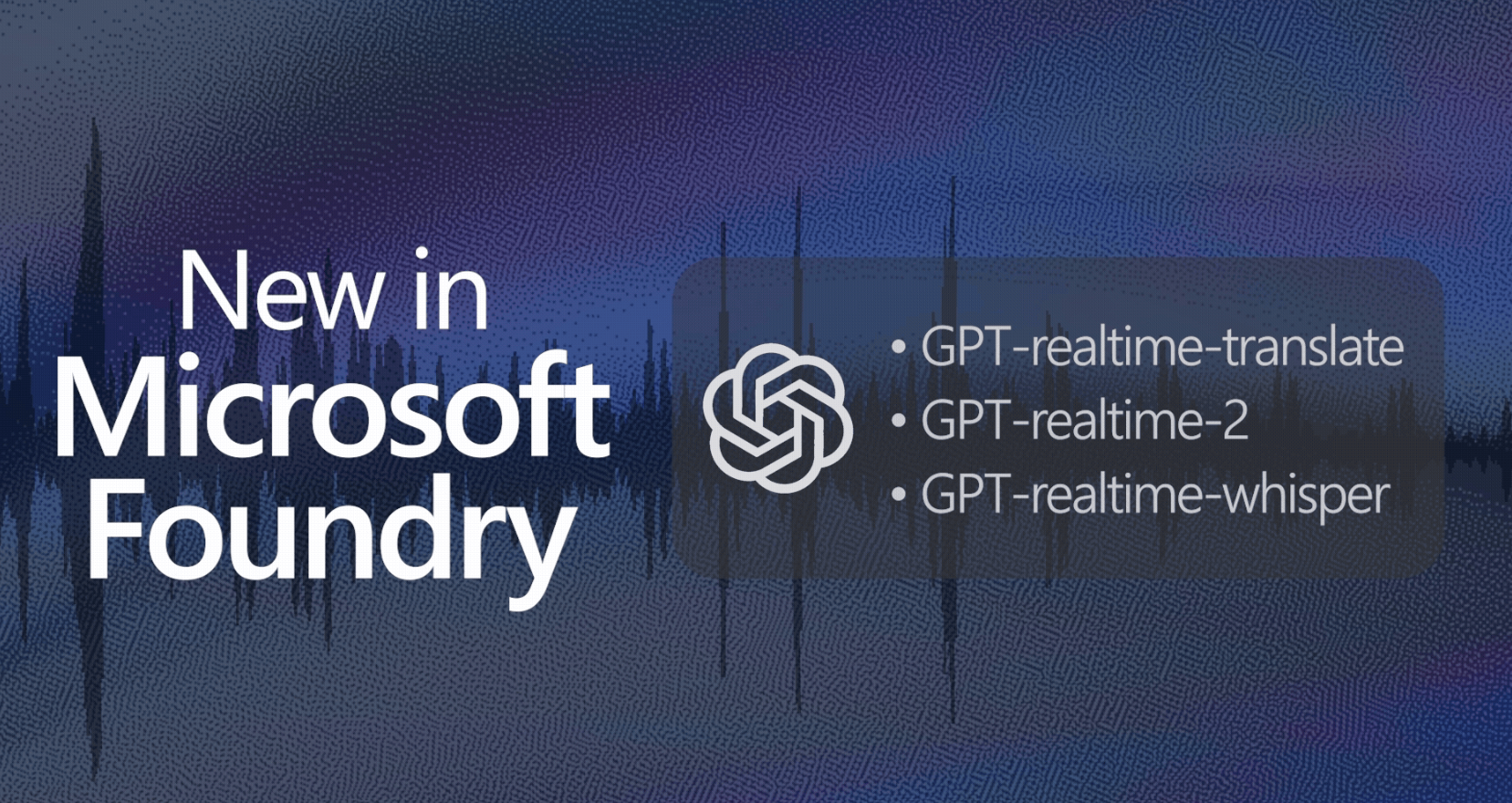
Three models. One moment. Here's what's shipping and why it matters for developers building AI voice applications.
Voice can be one of the most direct and productive interfaces for AI — enabling customer support agents that may resolve issues without a single keystroke, live multilingual communication that can take on language barriers as conversations happen, and voice assistants capable of reasoning through complex requests in real time. Developers building these experiences need models that can keep pace with increasingly demanding latency, accuracy, and language coverage requirements. OpenAI’s GPT-realtime-translate, GPT‑realtime‑2 and, GPT-realtime-whisper are now available in Microsoft Foundry — together representing a significant step forward for the realtime model lineup available to developers on the platform.
GPT-realtime-translate and GPT-realtime-whisper
GPT-realtime-translate and GPT-realtime-whisper together extend the realtime stack for live multilingual audio workflows. GPT-realtime-translate is built for continuous, real-time translation, producing translated output as speech unfolds without relying on segmented pipeline processing, while GPT-realtime-whisper provides low-latency streaming transcription of the original audio in parallel. Used together, they help developers support scenarios such as live events, cross-language customer experiences, captions, monitoring, and archival workflows that require both translated output and visibility into the source speech.
- Continuous stream processing: This new model translates live audio without segmenting or buffering allowing for more natural interactions.
- New translation and transcription capabilities: Translate between languages in real time and observe faster text to speech.
- Available via the Realtime API
GPT-realtime-2
GPT‑realtime‑2 is a generational upgrade to OpenAI's speech-to-speech model, bringing internal reasoning and an expanded context window to real-time voice applications. Where previous speech to speech models responded immediately, GPT‑realtime‑2 can work through a problem before speaking — making it well suited for voice applications that need to handle complex, multi-step queries entirely in the audio layer without routing to a separate text pipeline.
- Native reasoning capability: The newest realtime model introduces stronger reasoning capabilities. Now the model thinks internally before responding.
- Adjustable reasoning effort via {reasoning.effort}: Explicitly request the level of reasoning the model uses -- minimal, low, medium, high – to save on cost and latency.
- Audio in, audio out: No need for an intermediary text step, conversation stays fluid and natural.
- Available via the Realtime API
Use cases
These models work independently, but they're designed to complement each other in real-world pipelines:
- Live multilingual events. GPT-realtime-translate enables real-time translation of live audio, producing translated speech along with a transcript in the target language. GPT‑realtime‑whisper can be used in parallel to capture a transcription of the original speech for captions, monitoring, or archival purposes. Together, they enable multilingual live streaming with both translated experiences and visibility into the source language.
- Global customer support. Route inbound calls through GPT-realtime-translate to translate conversations in real time and provide a translated transcript for agents. Use GPT‑realtime‑whisper alongside it to capture the original conversation as text for compliance, quality review, or analytics. Then pass the interaction to an agent built with GPT‑realtime‑2 using {reasoning.effort}: high for complex issue resolution, all within a continuous audio pipeline.
- International voice assistants. Build once and deploy across languages. GPT-realtime-translate enables multilingual interaction and provides translated output with a target-language transcript, while GPT‑realtime‑whisper can optionally capture the original user input as text. GPT‑realtime‑2 manages reasoning and conversational context, supporting more complex voice interactions.
Pricing
|
Model |
Deployment |
Modality |
Pricing per 1M tokens | ||
|
Input |
Cached Input |
Output | |||
|
GPT-realtime-2 |
Global Standard |
Audio |
$32.00 |
$0.40 |
$64.00 |
|
Text |
$4.00 |
$0.40 |
$24.00 | ||
|
Image |
$5.00 |
$0.50 |
-- | ||
|
GPT-realtime-translate |
Global Standard |
Audio |
-- |
-- |
$2.04/hour |
|
GPT-realtime-whisper |
Global Standard |
Audio |
-- |
-- |
$1.02/hour |
|
GPT-realtime-2.1 |
Global Standard |
Audio |
$32.00 |
$0.40 |
$64.00 |
|
Text |
$4.00 |
$0.40 |
$24.00 | ||
|
Image |
$5.00 |
$0.50 |
-- | ||
|
GPT-realtime-2.1-mini |
Global Standard |
Audio |
$10 |
$0.30 |
$20 |
|
Text | $0.60 | $0.06 |
$2.40 | ||
|
Image |
$0.80 |
$0.08 |
-- | ||
*Pricing for GPT-realtime-translate and GPT-realtime-whisper will be done by the hour
Getting Started
Looking for ways to dive in? GPT-realtime-translate, GPT-realtime-whisper, and GPT‑realtime‑2 are in Microsoft Foundry now. Explore the model catalog and start building: https://ai.azure.com
Learn more here:
- GPT Realtime Translate overview - Microsoft Foundry | Microsoft Learn
- GPT Realtime Whisper overview - Microsoft Foundry | Microsoft Learn
- GPT Realtime 2.0 (preview) overview - Microsoft Foundry | Microsoft Learn
- Use the GPT Realtime API for speech and audio with Azure OpenAI - Microsoft Foundry | Microsoft Learn
Update 7/7/2026
Microsoft Foundry welcomes two new models to the Azure Open AI collection: GPT-realtime-2.1 and GPT-realtime-2.1-mini. These models are point upgrades to the realtime-2, with the mini model being a new variant designed for low cost scenarios.

 Microsoft


