By Mayuri Gupta, Senior Product Manager, Microsoft
Today, we are excited to announce the general availability of Microsoft Azure Red Hat OpenShift with hosted control planes. This new deployment option separates the OpenShift control plane from the worker nodes running your applications. The control plane runs as a fully managed service in a Microsoft-managed Azure subscription.
Azure Red Hat OpenShift with hosted control planes helps organizations accelerate application modernization, increase developer velocity, streamline operations, and strengthen security while maintaining the familiar OpenShift experience jointly engineered and supported by Microsoft and Red Hat. Azure Red Hat OpenShift with standard architecture remains fully supported.
The new deployment model also supports Red Hat OpenShift 5, helping customers adopt the latest Red Hat OpenShift capabilities on Azure with an integrated support experience.
Key capabilities at general availability
Smaller clusters, simpler operations
The control plane of the clusters runs in a Microsoft-managed environment, outside of customer’s Azure tenant. That means a smaller footprint for every cluster. Preview customers have seen significant VM cost reduction as one of the key benefits.
Compared with the standard architecture, hosted control planes offering brings Azure-native controls to day-2 cluster management, so teams can keep using the infrastructure management experiences and tools they already rely on. Common day-2 tasks run through Azure Resource Manager, enabling customers to simplify infrastructure management, automate consistent deployments, manage resources at scale, enforce access controls, and optimize resource organization and cost visibility.
Teams can create and resize node pools for different workloads, set autoscaling limits so capacity follows demand, and connect Microsoft Entra ID so users sign in with their corporate identities, all through the Azure portal, Azure CLI, or infrastructure-as-code tools like Bicep.
Because the control plane runs separately from your worker nodes, each has its own upgrade lifecycle. Microsoft and Red Hat site reliability engineers automatically apply z-stream (patch) releases to the control plane, keeping clusters protected against known vulnerabilities without interrupting day-to-day operations. Minor-version (y-stream) control plane upgrades remain customer-initiated, unless a minor version reaches end of life, so you decide when to move. Node pools can run up to two minor versions behind the control plane and can be provisioned on a specific Red Hat OpenShift version, so each application team can upgrade on its own schedule, for example by creating a new node pool on the new version, moving workloads over, and retiring the old pool.
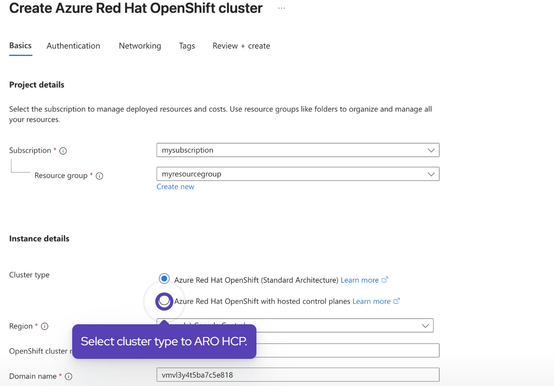 Click to launch the portal creation workflow demo of Azure Red Hat OpenShift with hosted control planes.
A hardened security foundation
Azure Red Hat OpenShift with hosted control planes integrates security controls that help organizations protect data, manage access, and isolate sensitive workloads while aligning cluster operations with established Azure security practices.
Encryption keys: Every cluster encrypts its OS disks with customer-managed keys, allowing you to provide and control the keys used to protect your data. With GA, support for mHSM backed key vaults is also supported.
Preferred identity provider: Configure your own identity provider to authenticate and authorize administrators and users, helping you apply consistent access policies across your environment.
Least-privilege principle: Clusters use managed identities, with separate role assignments for Red Hat OpenShift components and built-in roles scoped to the permissions required to operate the cluster. Workload identity allows customer application to use token-based authentication rather than user and password. This supports a least-privilege approach and reduces the need to manage application credentials.
Isolation for sensitive workloads: Red Hat OpenShift sandboxed containers provide an additional isolation boundary for workloads that require stronger separation.
Prepare for the next generation of applications with Red Hat OpenShift 5
Red Hat OpenShift 5, with its integrated operational intelligence, is designed to help teams more easily use the platform to troubleshoot issues more efficiently, assess risk, and assist with updates, while expanding security capabilities to support stronger multi-tenancy, certificate management, and post-quantum cryptographic protection.
Red Hat OpenShift 5 also introduces the MCP server for Red Hat OpenShift and an MCP gateway through Red Hat Connectivity Link, both generally available. These help teams connect AI tools and agents to the platform while governing access and enforcing policy. Combined with Red Hat OpenShift Lightspeed, platform teams can investigate and resolve issues using natural language.
Together, these capabilities can help organizations simplify hybrid cloud operations, improve infrastructure efficiency, and provide application teams with a flexible foundation for modern and AI-enabled workloads.
Other key functionality at GA
Provision clusters faster: Clusters with hosted control planes provision in approximately 15 to 20 minutes.
Manage clusters with greater consistency: With Red Hat Advanced Cluster Management for Kubernetes 5, you can create, upgrade, modify, and delete hosted control plane clusters from the Advanced Cluster Management console and apply preconfigured governance policies, bringing these clusters into a single view with the rest of your Red Hat OpenShift and Kubernetes estate for centralized governance and observability.
Bring advanced networking with Isovalent Enterprise: Azure Red Hat OpenShift with hosted control planes is certified with Isovalent Networking for Kubernetes as a fully supported Container Network Interface (CNI). Built on the open-source Cilium, Hubble, and Tetragon projects, it uses eBPF technology to deliver high-performance networking, zero-trust security capabilities, advanced policy enforcement, and pod-level observability.
Create clusters through a familiar Azure experience: Create and configure clusters directly in the Azure portal, or use the Azure CLI, ARM templates, or Bicep to provision clusters as part of automated, infrastructure-as-code workflows.
Deploy closer to your applications and users: Generally available in 8 regions globally - UK South, Canada Central, Australia East, Switzerland North, Brazil South, Central India, US East 2, West Europe. Availability will also expand to Sweden Central and East Asia post GA, followed by additional regions worldwide.
Next Steps
Start building the Azure Red Hat OpenShift environment with a smaller infrastructure footprint and familiar Azure management experiences:
- Create your first cluster in the Azure portal: Home - Microsoft Azure
- Watch the interactive demo: Create an Azure Red Hat OpenShift with hosted control planes cluster
- Read the documentation: QuickStart - Create a default Azure Red Hat OpenShift with hosted control planes cluster (preview) - Azure Red Hat OpenShift | Microsoft Learn
- Review pricing: Pricing - Azure Red Hat OpenShift | Microsoft Azure
- Learn more about Red Hat OpenShift 5: The next era of hybrid cloud: Introducing Red Hat OpenShift 5
Planning to attend Microsoft Ignite? Join us to hear about Azure Red Hat OpenShift with hosted control planes at sessions during Ignite:
- Simplify operations with Azure Red Hat OpenShift hosted control planes
- Red Hat on Azure: Advancing unified hybrid cloud together
- Build a secure platform for containers, VMs, and AI
Stop by the Azure AI Infrastructure booth to talk with our experts about Azure Red Hat OpenShift with hosted control planes and how we can support your platform strategy.

 Microsoft