By Gideon K. Agbavor Top Student Award Winner, Microsoft Agents League AISF Hackathon 2026
A Problem I Lived as a Teacher
Before I branch into software developer, I am a Mathematics and ICT teacher in Ghana education or school system. Every Sunday evening and sometimes every three days, I sat with a thick PDF — Ghana's NaCCA Standards-Based Curriculum — and spent hours manually converting dense curriculum indicators into lesson plans for the week ahead.
I was not alone. Across Ghana, thousands of Junior High School teachers (Primary teachers too) face the same challenge. They manage classes of 30 to 40 students, operate in under-resourced schools outside major cities, and have almost no planning support. The NaCCA Standards-Based Curriculum introduced by Ghana's National Council for Curriculum and Assessment is rigorous and well-structured — but translating its indicators into classroom-ready materials is time-consuming and administratively exhausting.
When I heard about the Microsoft Agents League AISF Hackathon 2026, I knew exactly what I wanted to build — a tool that eliminates this burden for every Ghanaian JHS teacher, regardless of where they teach or how much support they have.
That tool became CurriculumCraft AI — and it won one of the Top Student Award at the hackathon.
The Solution — CurriculumCraft AI
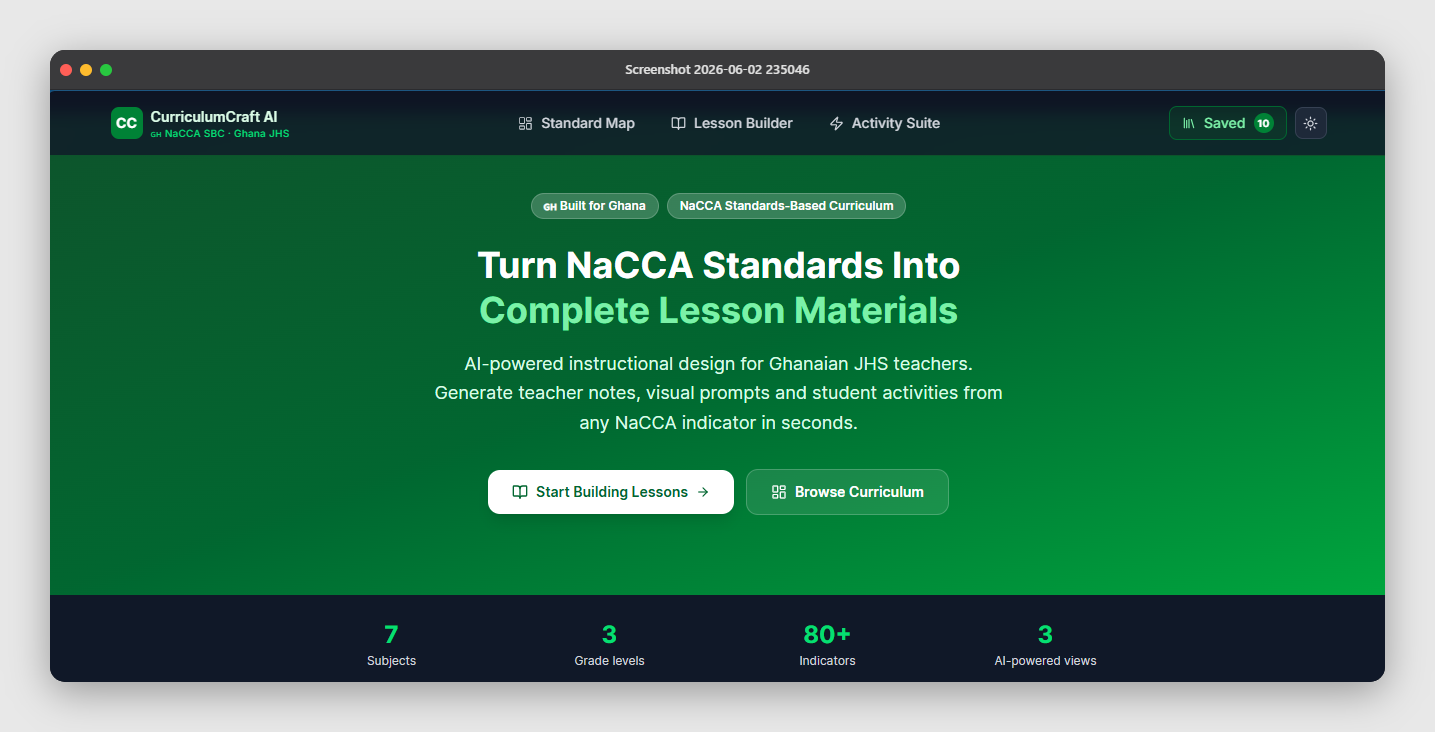
CurriculumCraft AI is a full-stack AI-powered instructional design platfo
rm that transforms any NaCCA curriculum indicator into complete, classroom-ready lesson materials in seconds.
A teacher visits the app, selects their subject, grade level (B7, B8, or B9), strand, and indicator from the real NaCCA curriculum tree — and the app generates three complete outputs instantly:
- Teacher Notes — a full lesson plan with timings, learning objectives aligned to Bloom's Taxonomy, key vocabulary, common misconceptions, and differentiation tips for mixed-ability classes
- Visual Content Prompts — four practical classroom visual aids a teacher can create with minimal resources, designed specifically for under-resourced Ghanaian classrooms
- Student Reading Material — a culturally relevant reading passage using authentic Ghanaian names, settings, and examples, complete with worked examples and comprehension questions
Beyond lesson generation, the app also features an Interactive Activity Suite that generates multiple-choice questions with instant answer feedback, writing prompts with sample answers, and assessment rubrics — all aligned to the selected NaCCA indicator.
Every piece of generated content uses authentic Ghanaian cultural context — local names like Ama, Kofi, and Adjoa, local settings like Kumasi Central Market and Cape Coast fishing harbour, Ghana Cedis for mathematical examples, and references to local foods and traditions. A student in Ho, Tamale, Accra, or Bolgatanga should see themselves in their learning materials.
Architecture and Technology
CurriculumCraft AI is built on a modern full-stack architecture designed for reliability, performance, and scalability.
architecture
Frontend:
- Next.js 15 with App Router and React Server Components
- Tailwind CSS v4 for responsive, accessible styling
- shadcn/ui for polished component design
- Dark and light theme support
Backend:
- Next.js API Routes for server-side logic
- Neon PostgreSQL (serverless) as the database
- Drizzle ORM for type-safe database queries
AI and Microsoft Services:
- Microsoft Foundry IQ — the intelligence grounding layer that retrieves NaCCA curriculum context before each generation request, anchoring outputs to actual curriculum standards
- GitHub Models (gpt-4o-mini) — the generation layer that produces lesson materials based on the grounded context
- GitHub Copilot — used throughout development in VS Code for schema generation, API route scaffolding, component design, and prompt engineering
Deployment:
- Vercel for frontend and serverless API hosting
- Neon PostgreSQL for persistent curriculum and lesson data
Data:
The database is seeded with real NaCCA curriculum data across 7 subjects — Mathematics, Science, English Language, Computing, Social Studies, RME, and Career Technology — covering all three JHS grade levels (B7, B8, B9) with authentic indicator codes like B7.1.1.1.
Microsoft Foundry IQ Integration
One of the core requirements of the Agents League Hackathon Creative Apps track was integrating at least one Microsoft IQ intelligence layer. I chose Microsoft Foundry IQ as the grounding layer for CurriculumCraft AI.
Before generating any lesson materials, the app queries the Agents League Foundry IQ hub to retrieve curriculum-specific context for the selected NaCCA indicator. This grounded context is then passed to the generation layer as additional prompt context, reducing hallucination and ensuring the generated content is anchored to actual curriculum standards rather than generic AI outputs.
The integration is implemented in the /api/generate route and includes graceful fallback to direct generation when the endpoint is unavailable — ensuring the app remains fully functional under all conditions.
GitHub Copilot — AI-Assisted Development
Building CurriculumCraft AI as a solo developer within the hackathon timeline would have been extremely difficult without GitHub Copilot in VS Code. Copilot accelerated development at every layer:
Database schema — I described the NaCCA curriculum structure in natural language and Copilot generated the complete Drizzle ORM schema for all five tables (subjects, strands, sub-strands, indicators, saved lessons) with proper foreign key relationships.
API routes — All four API routes (/api/curriculum, /api/generate, /api/generate/activity, /api/lessons) were scaffolded with Copilot inline completions, significantly reducing boilerplate.
TypeScript types — The full type definitions for the curriculum data structures, API request/response types, and component props were generated through Copilot Chat.
Prompt engineering — The system prompts in prompts/lesson.ts and prompts/activity.ts were refined iteratively with Copilot suggestions, helping me structure the cultural context instructions and output formatting rules effectively.
Bug resolution — ESLint errors, TypeScript type conflicts, and React hook dependency warnings were resolved quickly using Copilot Chat explanations, keeping the development velocity high.
Implementation — Key Challenges and How I Overcame Them
Challenge 1 — Seeding real NaCCA curriculum data
The NaCCA curriculum PDFs are dense documents not available as structured data. I manually extracted and structured the curriculum data for 7 subjects across 3 grade levels, creating a seed file that populates the database with authentic indicator codes and text.
Challenge 2 — Ghanaian cultural context in AI outputs
Generic AI models default to Western cultural examples. I solved this by writing detailed system prompts that explicitly instruct the model to use Ghanaian names, settings, currency, and foods in every generated output. The result is lesson content that feels authentically Ghanaian to every teacher and student who uses it.
Challenge 3 — Tailwind CSS v4 dark mode
Next.js 15 uses Tailwind CSS v4 which handles dark mode differently from v3. Instead of a tailwind.config.ts file, v4 uses @variant dark in globals.css. Resolving this required updating the CSS approach and adding proper dark: utility classes to every component.
Challenge 4 — PDF export with oklab colors
The html2canvas library used for PDF export does not support the oklab color function that Tailwind v4 uses internally. I resolved this by switching to a text-based PDF generation approach using jsPDF directly, which produces cleaner, searchable PDF output without any color function dependencies.
Results and Impact
CurriculumCraft AI is live at curriculumcraft-ai.vercel.app and covers:
- 7 NaCCA subjects — Mathematics, Science, English Language, Computing, Social Studies, RME, Career Technology
- 3 grade levels — B7, B8, B9 (Junior High School)
- 80+ authentic NaCCA indicators with real curriculum codes
- 3 AI-powered views — Standard Map Dashboard, Lesson Builder, Interactive Activity Suite
- Full mobile responsiveness — teachers can use it on their phones
The app requires no login and is completely free, removing all friction for teachers who want to try it immediately.
Since sharing the app with Ghanaian teacher communities, the response has been enthusiastic. Teachers appreciate that the generated content uses Ghanaian names, settings, and examples that their students can relate to — not generic Western content that feels foreign in a Ghanaian classroom.
Lessons Learned
Start with a real problem you understand personally. My teaching background meant I deeply understood the pain point I was solving. That clarity showed in every feature decision.
Cultural context is a competitive advantage. Any developer can build a lesson planner. Almost nobody builds one that generates a mathematics problem about cocoa farming in Ashanti Region for a B7 student. That specificity is what makes CurriculumCraft AI genuinely useful rather than just technically impressive.
Graceful degradation matters. Building the Foundry IQ integration to fall back gracefully when the endpoint is unavailable meant the app always worked — even during quota limitations on the shared hackathon hub.
Ship early, iterate fast. Having the app deployed on Vercel from day one meant I could test on real devices, share with real teachers, and get genuine feedback throughout the build.
Future Enhancements
CurriculumCraft AI is just getting started. Planned enhancements include:
- Authentication and user accounts — personalized lesson libraries per teacher
- School subscriptions — institution-level access for entire schools
- Lesson completion tracker — teachers mark indicators as taught, tracking curriculum coverage across the term
- Student Quiz Mode — shareable quiz links teachers send directly to students
- Expansion to other African curricula — Nigeria (NERDC), Kenya (CBC), Rwanda
- Offline support — PWA capabilities for teachers in low-connectivity areas
Conclusion
CurriculumCraft AI was built to solve a real problem faced by real teachers in Ghana every single week. By combining Microsoft Foundry IQ for curriculum grounding, GitHub Models for AI generation, and GitHub Copilot for accelerated development, I was able to build a production-ready application that delivers genuine value to Ghanaian educators.
The Microsoft Agents League Hackathon gave me the platform, the tools, and the motivation to build something meaningful. Winning the Top Student Award is an honour — but the real prize is knowing that a teacher in Ho, Tamale, or Bolgatanga can now spend less time on paperwork and more time with their students.
Try CurriculumCraft AI: curriculumcraft-ai.vercel.app
GitHub Repository: github.com/gideonagbavor8/curriculumcraft-ai
Connect with me: https://www.linkedin.com/in/gideon-k-agbavor
Gideon Komla Agbavor is a software developer and educator from Ho, Volta Region, Ghana. He is completing a BSc in Software Development at Brigham Young University-Idaho and is one of the Top Student Award winners at the Microsoft Agents League AISF Hackathon 2026.
Updated Jul 27, 2026
Version 1.0
GideonAgbavor
Tin Contributor
Joined July 15, 2026
Educator Developer Blog
Follow this blog board to get notified when there's new activity