Introducing Azure Adaptive Virtual Patching: autonomous, adaptive defense for the AI era
A critical vulnerability is announced. Your security team identifies affected workloads. Application owners begin testing the fix. Deployment plans take shape.
Attackers are already moving.
For defenders, patching requires care: understanding dependencies, validating compatibility, protecting availability, and coordinating changes across production environments. For attackers, a single exploitable path can be enough.
AI is widening that imbalance. Defenders need protection that can understand emerging threats, recognize where they matter, and act while patching is still underway.
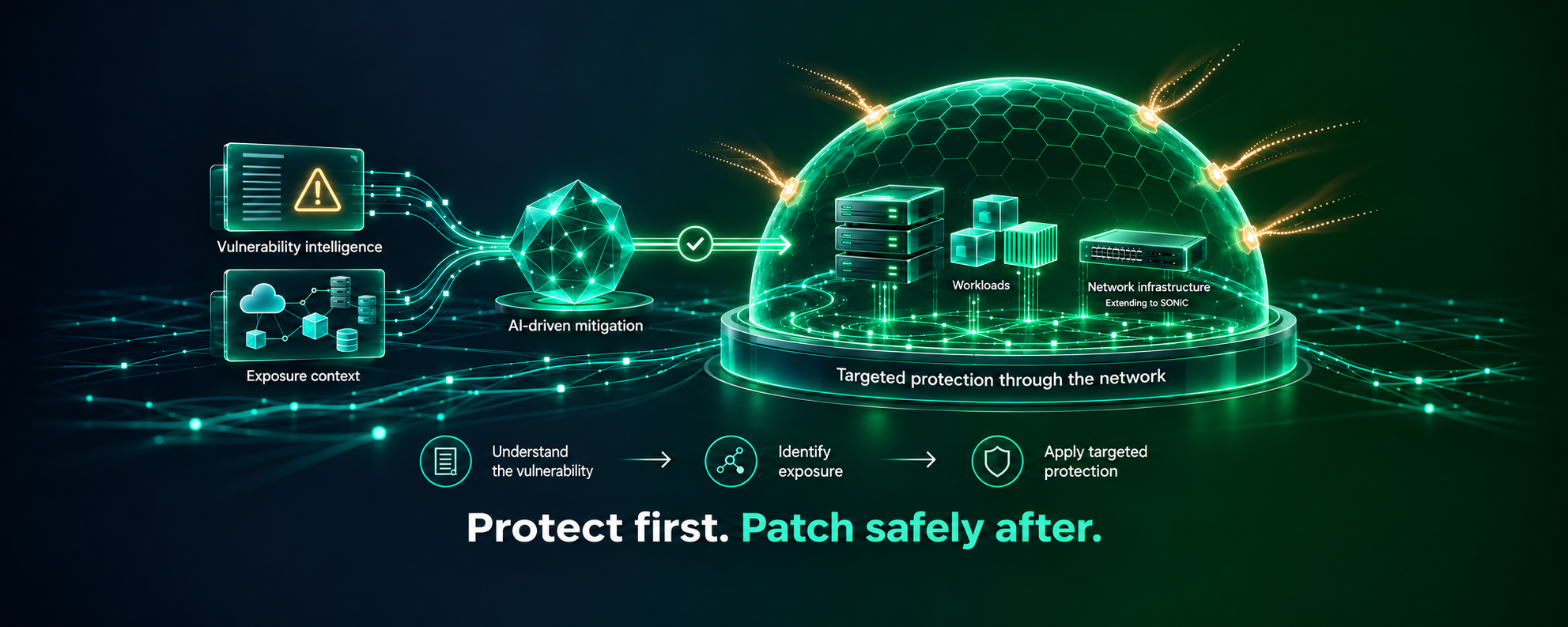
Today at Microsoft Ignite, we are announcing Azure Adaptive Virtual Patching, an AI-based adaptive shield designed to proactively reduce exposure to new, emerging, and zero-day vulnerabilities. It connects vulnerability intelligence and workload context with coordinated protection across the network and on the workload.
Our goal is straightforward: put power – and time – back in the hands of defenders.
Turning the adaptive security vision into protection
In his August 2026 blog, “The patch window is collapsing: Why security needs a new control plane,” Igor Sakhnov, Corporate Vice President and General Manager for Azure Networking, described a growing customer challenge: knowing that a workload is vulnerable does not mean an organization can immediately patch it. He outlined the opportunity for the network to serve as an adaptive control plane that reduces exposure during that interval.
Azure Adaptive Virtual Patching advances that vision into a new product capability.
It connects an understanding of how vulnerabilities work with an understanding of the workloads customers actually run. AI then orchestrates targeted mitigations through network-based controls, including inline intelligence, and eBPF-based runtime enforcement on the workload.
Together, these capabilities bring protection to multiple points along an attack path while customers prepare the permanent fix.
The attack timeline has changed. Production responsibilities have not.
Microsoft’s threat research shows adversaries embedding AI into how they plan, refine, and sustain attacks. AI accelerates research, code development, and iteration across the attack lifecycle.
Attackers can also access special models: models modified to weaken or remove safety refusal behavior. Research has found that models fine-tuned to remove safeguards can provide substantially more assistance with malicious tasks, further lowering barriers to misuse.
These capabilities can help adversaries move from vulnerability information to attack development faster than customers can responsibly test and deploy a fix.
A production change still requires validation. A critical service still has availability commitments. A maintenance window still needs coordination.
Customers should not have to choose between rushing an untested patch into production and leaving a known attack surface exposed.
Meeting this challenge requires AI-orchestrated defense that continuously connects emerging threats to customer environments – and translates that understanding into protection.
Three semantic layers. One adaptive defense.
Azure Adaptive Virtual Patching uses three connected semantic layers to move from vulnerability understanding to workload-specific mitigation.
- Understand the vulnerability.
The first layer builds a semantic knowledge graph of vulnerabilities, including emerging and newly disclosed zero-days. It connects affected components, exploit prerequisites, vulnerable behaviors, and potential mitigations.
The objective goes beyond recognizing a vulnerability identifier. It is to understand which software is involved, what conditions an attacker needs, and where controls could interrupt exploitation.
As intelligence develops, that understanding evolves with it.
- Understand the customer’s Azure environment.
The second layer builds a semantic knowledge map of the customer’s Azure estate.
It brings together telemetry about running processes, installed modules, operating systems, open ports, and other workload characteristics to understand how systems are configured and exposed.
The presence of a software package is only part of the picture. Exposure also depends on whether a vulnerable component is running, how it is used, and which network paths make it reachable.
This layer grounds vulnerability intelligence in each workload’s operational context.
- Understand exposure – and orchestrate protection.
The third layer combines the first two to determine the relevant attack surface and corresponding mitigation.
The service’s AI core reasons across vulnerability prerequisites, workload configuration, and network exposure to orchestrate protection at the appropriate enforcement points. Depending on the vulnerability and workload, this can involve network mitigations, local runtime controls, or a coordinated combination.
Together, the layers connect what the threat requires, what the customer runs, and where protection can interrupt the attack.
Protection across the network and on the workload
The adaptive shield brings together two complementary forms of enforcement.
Network-based mitigations use the network as a compensating control. Multiple network defenses, including inline intelligence, help identify and interrupt exploit-related traffic and constrain the paths through which vulnerable workloads can be reached.
This gives defenders a way to reduce exposure while the underlying software remains unpatched. The network becomes an active protection layer, applying controls around the workload while remediation proceeds.
Workload-based mitigations address relevant runtime behavior. Using eBPF-based enforcement, the service can apply granular controls at supported execution points on the workload itself.
The AI core coordinates these capabilities according to the vulnerability and the customer’s environment. A network control may constrain an incoming attack path, while a workload policy addresses the runtime operation that makes exploitation possible.
This combination expands the opportunities to interrupt an attack and tailor protection to the exposed resource.
From protected resource to protected execution
Customers bring workloads under the adaptive shield by adding them as protected resources. A neuron extension is then installed on each onboarded workload, connecting that resource to the service’s AI core.
The extension collects telemetry that helps the AI core understand the workload’s exposure and attack surface. It also deploys workload mitigations as instructed by the AI core.
Alongside those local mitigations, the service orchestrates network-based protection to address the relevant exposure paths.
This creates a continuous feedback loop: telemetry informs understanding, understanding informs mitigation, and coordinated enforcement puts protection into effect across the network and workload.
AI-synthesized policies. Granular runtime enforcement.
On the workload, mitigations are deployed through Tetragon, using eBPF-based security across user-mode and kernel-mode execution paths as needed and supported.
Tetragon provides security observability and runtime enforcement, including visibility into process execution, system calls, and file and network activity. Its policy framework supports hooks in kernel and user-space code, allowing policies to target specific operations and take defined actions when their conditions match.
The AI core synthesizes Tetragon policies dynamically, making them highly specific to each workload’s software, configuration, and relevant exploit conditions. The neuron extension deploys those policies to the corresponding protected resource.
Two workloads affected by the same vulnerability may run different binaries, load different modules, or expose different network paths. Their protections should reflect those differences.
AI adaptability with deterministic protection
Production security demands predictable, reliable behavior.
A central innovation in Azure Adaptive Virtual Patching is bringing AI-driven reasoning together with deterministic enforcement. AI interprets vulnerability information and workload context, then translates that understanding into defined mitigation controls.
For workload protection, synthesized Tetragon policies express explicit matching conditions and enforcement actions. Once deployed, those policies enforce the defined behavior locally without requiring a new generative AI decision for every matching event.
Across the Adaptive Shield, the principle is consistent: AI determines the appropriate protection; defined controls make enforcement predictable.
Autonomous preparation for emerging threats
When actionable intelligence about a newly announced zero-day becomes available, AI-based training pipelines can trigger autonomously to prepare defenses at scale.
The pipelines develop an understanding of exploit conditions and candidate protections. The semantic layers connect that learning to customer environments, and the AI core prepares workload-specific mitigations across the available network and runtime enforcement points.
The result is a continuous cycle: understand the threat, assess exposure, prepare mitigation, enforce protection, and adapt as intelligence or workload conditions change.
Proactive, pre-emptive defense means acting on those conditions before an attack succeeds.
HTTP/2 Bomb (CVE-2026-49975): interrupting resource exhaustion
HTTP/2 Bomb demonstrates how legitimate protocol features can combine into a disruptive attack.
The original research describes header compression amplification combined with stalled streams. Small requests can cause disproportionate server memory consumption, while flow-control behavior keeps resources occupied. Request size alone does not capture the risk: header counts, allocation behavior, and stream lifetime also matter.
In our testing, Azure Adaptive Virtual Patching successfully mitigated HTTP/2 Bomb attacks.
The semantic layers connect the resource-exhaustion mechanism with the server implementation, runtime environment, and network exposure of the protected resource.
That context informs where protection should apply. Network-based mitigations can address exploit-related traffic at an appropriate inspection point, while workload enforcement can target relevant runtime behavior. The service orchestrates the applicable controls for the workload.
This approach connects the incoming attack path to the behavior it triggers inside the server, supporting more precise protection while customers validate and deploy the permanent fix.
PHP2Shell: connecting network exposure to runtime exploitation
PHP2Shell presents a different challenge.
The vulnerabilities, CVE-2026-109618 and CVE-2026-109619, involve PHP runtime memory handling and can enable unauthenticated remote code execution under exploitable conditions. The PHP project’s advisories describe out-of-memory corruption and stale request state, with exposure influenced by server integration, configuration, extensions, and application behavior.
In our testing, Azure Adaptive Virtual Patching successfully mitigated PHP2Shell attacks.
Telemetry from the neuron extension helps the AI core connect vulnerability prerequisites to the workload’s PHP processes, installed modules, and operating environment. Network context establishes how the affected service can be reached.
Together, these inputs inform targeted mitigation: network controls can constrain relevant attack paths and exploit-related requests, while workload-specific runtime policies address applicable execution behavior.
The tested outcome demonstrates the value of coordinated protection. PHP’s advisories also make clear that interim measures do not provide complete coverage across every exploitation route. Protection against tested attacks buys time; installing the fixed software remains essential.
Time to patch. Protection while you do.
Azure Adaptive Virtual Patching deploys mitigations; it does not install the software patch. Customers continue to validate and deploy fixes through their patching processes. Once the patch is deployed and remediation confirmed, the corresponding temporary mitigations can be rolled back.
We are starting with Linux virtual machines and Virtual Machine Scale Sets on Azure. Over time, we plan to extend protection to additional workload types, including Windows-based workloads.
As AI accelerates offensive capabilities, defenders need the same advantage in understanding, coordination, and action. Azure Adaptive Virtual Patching brings those capabilities together through an autonomous adaptive shield – using the network as a compensating control and granular runtime enforcement to protect workloads while customers patch.
The patch window is closing. We are putting time back on the defender’s side.
Meet the team:
Product -
Alisha Jyoti - Product Manager, Azure Core Networking.
Ashish Jain, Partner Group Product Manager, Network & AI Security, Azure Core Networking
Engineering -
Ashish Bhargava, Principal Software Engineering Manager, Azure Core Networking
Chandan Aggarwal, Partner Engineering Manager, Azure Core Networking,
Priyanka Mathur, Principal Software Engineering Manager, Azure Core Networking
Xinyan Zan, Vice President, Azure Core Networking.

 Microsoft