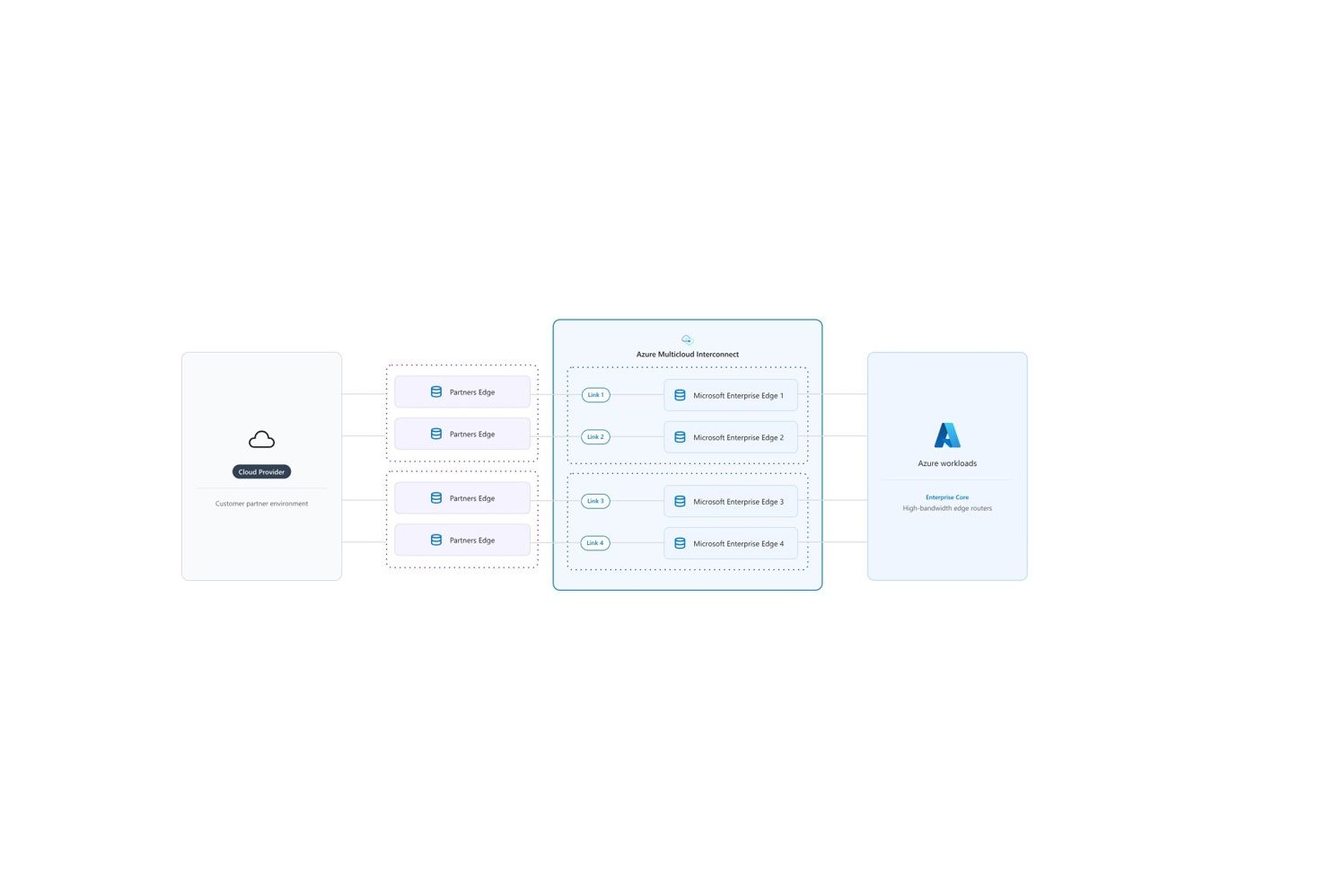
Azure Multicloud Interconnect is now generally available with AWS, enters public preview with Google Cloud, and extends toward the last mile interconnect with Lumen.
By Sudha Mahajan, Partner PM, Azure Networking, and Pankaj Garg, CVP, Azure Networking
In August, we introduced the public preview of Azure Multicloud Interconnect with Amazon Web Services (AWS) and described a simple goal: making the network the easiest part of a multicloud strategy, not the hardest. The preview replaced much of the customer-assembled work across circuits, routers, Border Gateway Protocol (BGP) sessions, encryption, and provider coordination with one logical resource and an integrated activation workflow.
Today, that journey advances in three important ways. Azure Multicloud Interconnect with AWS is now generally available. We are also announcing the public preview of Azure Multicloud Interconnect with Google Cloud, extending the same managed connectivity model to another cloud provider. And we are working with Lumen to simplify last mile connectivity into Azure, helping customers connect on-premises locations to Azure through a more integrated ExpressRoute and carrier experience.
Together, these announcements move Azure networking toward a consistent model across cloud-to-cloud and site-to-cloud connectivity: private paths, resilient infrastructure, provider-coordinated provisioning, and clear operational ownership, while customers retain control of their virtual networks, routing and security policies, and application architecture.
The problem: distributed applications, fragmented connectivity
Enterprises use multiple environments for practical reasons: distributed data and AI services, regulatory requirements, phased migrations, disaster recovery, mergers, partner ecosystems, and branch connectivity.
The challenge is creating a private, resilient, supportable, and end-to-end service. When customers must integrate across cloud and network providers themselves, provisioning can be slow, configuration problems difficult to isolate, and operational ownership is unclear.
1 | AWS: from public preview to general availability
At general availability, the service provides a production- ready private connection built on Azure ExpressRoute and operated cooperatively by Microsoft and AWS. Redundant paths across physically separate locations reduce exposure to an isolated device, link, or site failure, while the providers coordinate the lifecycle of the managed connection.
What customers can gain
- A simpler path to production. One logical resource and an integrated activation flow replace much of the provider-to-provider assembly work.
- Built-in resilience. Redundant infrastructure across separate locations reduces exposure to an isolated device, link, or site failure.
- Clearer operations. Microsoft and AWS coordinate the managed inter-provider connection, including maintenance and recovery of the underlying paths.
- Customer control where it matters. Customers continue to own their cloud networks, route intent, security controls, application design, and recovery strategy.
"Applications, data and AI are more distributed than ever, and connectivity has to keep up. With AWS now generally available, Google Cloud in preview and Lumen simplifying the last mile, we're giving customers one consistent, resilient way to connect clouds and sites to Azure. Customers keep control of their networks, and the providers remove friction."
Igor Sakhnov, Corporate Vice President, Azure Networking, Microsoft
2 | Google Cloud: extending the managed model in public preview
The Google Cloud preview applies the managed model through a consistent Azure experience while adapting to provider-specific resources, authentication methods, interfaces, and operational processes. Customers create a logical interconnect, authorize the intended cloud account, and let the providers coordinate the underlying connection rather than reconciling those differences themselves.
What customers can gain
- A repeatable multicloud network pattern. Teams can apply a more consistent approach as they connect Azure to another supported cloud.
- Greater redundancy. Private connectivity can support distributed AI and analytics, persistent application dependencies, staged migrations, high-throughput data movement, and disaster recovery scenarios.
- A flexible, enterprise-grade foundation. Customers can validate workload-specific bandwidth, availability, and security profiles in staging to seamlessly tune network performance before scaling production.
"AI is pushing enterprises to run models, data, and agents across clouds, and the network shouldn't be what slows them down. By bringing partner Cross-Cloud Interconnect to Azure, Google Cloud and Microsoft are giving customers private, high-bandwidth connectivity between the two clouds in minutes, jointly supported by both providers. It's another step toward the open, unified multicloud experience that Google Cloud's Cross-Cloud Network is built to deliver." '
Himanshu Mehra, Director of Product Management, Google Cloud
3 | Lumen: simplifying the last mile into Azure
For customers connecting offices, campuses, datacenters, edge environments, and partner locations to Azure, the last mile can still involve separate ordering, provisioning, portal, and support processes. The Lumen collaboration connects carrier reach with Azure-native networking to establish end-to-end private connectivity with fewer handoffs and clearer service boundaries.
The first experience is centered on integrated provisioning. Ordering and billing integration can evolve separately. Azure ExpressRoute remains the private connectivity foundation into Azure, while Azure Virtual WAN remains the Azure-native option for managed hybrid and branch connectivity and routing. Customers are not required to adopt a preferred third-party routing or orchestration platform.
“Enterprises shouldn’t have to choose between the agility of cloud and the performance and resiliency their critical workloads demand. By bringing Microsoft Azure and Lumen’s private, programmable network together, we’re simplifying how customers integrate their locations to the cloud and giving them a stronger foundation for what comes next.”
Scott Yow, SVP Product, Lumen Technologies
What customers can gain
- Fewer provisioning handoffs. A more integrated experience reduces the coordination required to connect a customer location to Azure.
- More connectivity choice. Lumen extends carrier reach while Azure services continue to provide the cloud networking foundation.
- Clear service boundaries. The collaboration simplifies the path without collapsing Azure and Lumen systems into a single operating model.
Read the Lumen announcement blog.
Looking ahead
As applications, data, and AI become more distributed, connectivity should become more consistent. We will continue building toward that goal with customers and partners.
Get started
Review the Azure Multicloud Interconnect documentation for the current AWS general-availability scope and Google Cloud preview availability. Work with your Microsoft account team and cloud-provider contacts to select a representative workload and confirm locations, bandwidth, addressing, security, commercial, and recovery requirements. For Lumen last-mile connectivity, contact your Microsoft or Lumen account team for current availability and onboarding details

 Microsoft