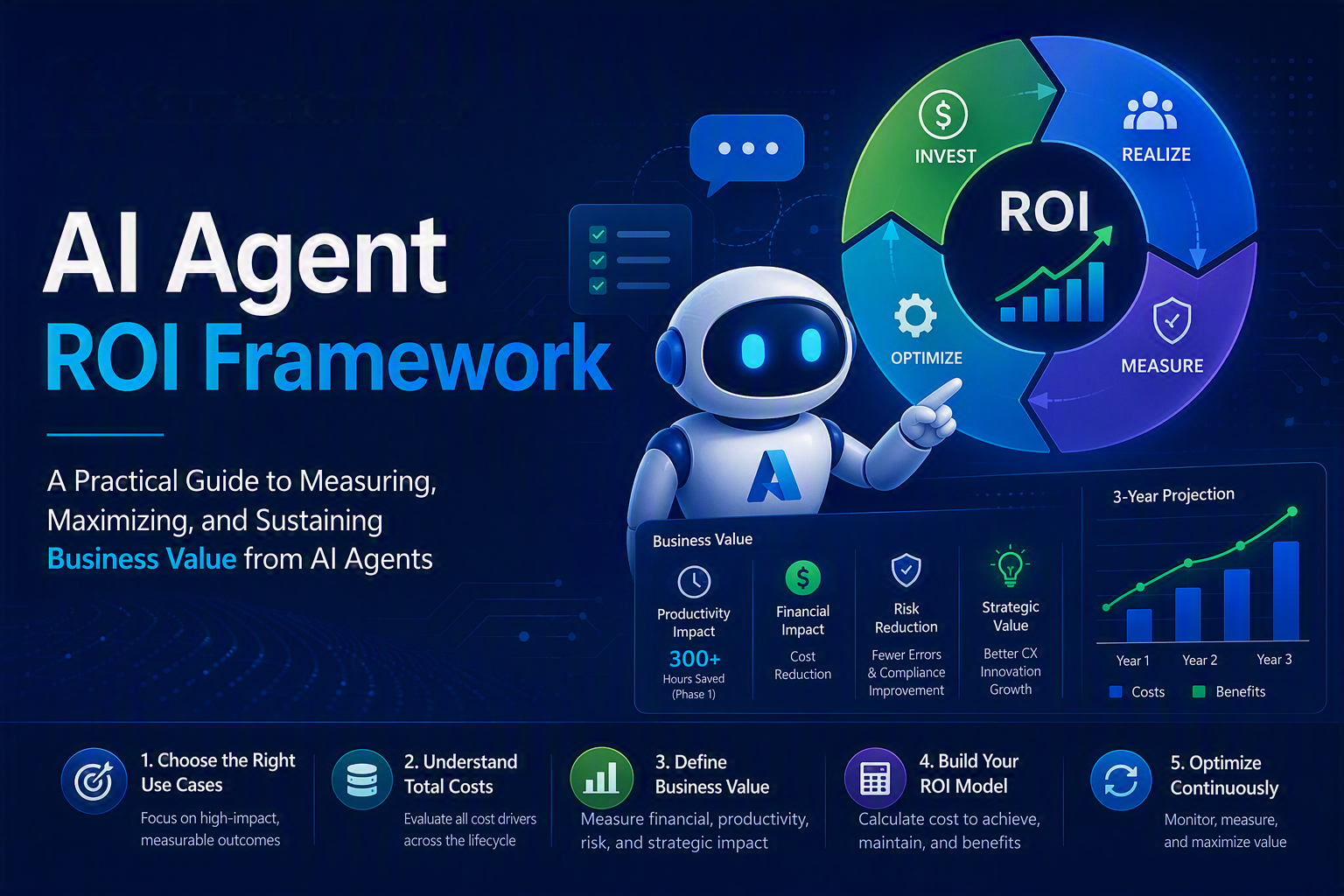
From Pilot to Payback: A Practical Framework for Measuring AI Agent ROI
Introduction
AI agents are rapidly becoming a core component of enterprise transformation strategies. Organizations are deploying agents to assist employees, automate business processes, improve customer experiences, accelerate decision-making, and scale operations. Yet many organizations still face a fundamental challenge.
How do we prove the business value of AI agents?
While innovation and experimentation are important, long-term success requires a disciplined approach to measuring outcomes, managing costs, and continuously optimizing investments. Organizations that fail to establish clear ROI measurements often struggle to justify continued funding, prioritize future investments, or scale successful solutions.
An effective AI Agent ROI Framework helps leaders connect technology investments directly to business outcomes. It enables organizations to identify the right use cases, understand cost drivers, quantify value, establish governance, and create a culture of continuous optimization.
This article presents a practical framework that can be used across industries and business functions to define, measure, and maximize AI agent return on investment.
Start with the Right Use Cases
One of the biggest mistakes organizations make is evaluating AI projects solely through a technology lens. Successful organizations begin with business outcomes.
Before building an AI agent, leaders should evaluate opportunities across six dimensions:
- Reduction of operational overhead
- Resource optimization
- Scalability improvements
- Workforce productivity gains
- Customer experience enhancement
- Revenue growth potential
The highest-performing AI initiatives typically address repetitive, high-volume, and measurable business processes where automation can quickly generate value.
Examples include:
- Employee support assistants
- Knowledge retrieval agents
- Customer service agents
- Sales enablement assistants
- Compliance review agents
- IT operations agents
Organizations should prioritize quick wins that provide:
- Low implementation complexity
- High business impact
- Short time-to-value
- Strong executive sponsorship
- Clear success metrics
Establishing early wins creates momentum, increases adoption, and generates measurable evidence that supports broader AI investments.
Understanding the Cost Structure of AI Agents
Accurate ROI calculations require a complete understanding of costs. Many organizations underestimate the true investment needed to deploy and operate AI agents successfully.
AI agent costs generally fall into five categories.
1. Infrastructure and Platform Costs
These costs include:
- AI model consumption
- Compute resources
- Storage
- Networking
- Hosting platforms
- Development environments
Organizations should select the simplest architecture that satisfies business requirements. Overengineering often becomes one of the largest sources of unnecessary spending.
2. Development and Integration Costs
Building an agent often requires:
- Solution design
- Business analysis
- Prompt engineering
- System integration
- API development
- Security implementation
- Testing and evaluation
These investments form the "cost to achieve" portion of ROI calculations.
3. Data Preparation Costs
Data remains one of the most significant contributors to AI project success.
Poor data quality increases costs through:
- Additional token usage
- Lower response quality
- Greater compliance risk
- Increased maintenance effort
Organizations should invest early in data cleansing, deduplication, classification, and governance.
4. People and Skills Costs
Successful AI implementations require cross-functional collaboration among:
- Business stakeholders
- AI engineers
- Data engineers
- Developers
- Security professionals
- Governance teams
- User experience specialists
Many organizations underestimate the ongoing talent investment required to operate AI solutions at scale.
5. Ongoing Operational Costs
Agent deployment is not the end of the journey.
Ongoing expenses include:
- Monitoring
- Evaluation
- Model updates
- Prompt optimization
- Governance reviews
- Support operations
Many enterprises find that annual operational expenses represent a meaningful percentage of the original implementation investment and should be included in ROI planning.
Defining Business Value
A common challenge when measuring AI ROI is focusing only on labor savings.
The most successful organizations evaluate value across multiple dimensions.
Productivity Impact
Productivity improvements include:
- Faster task completion
- Reduced manual work
- Improved employee efficiency
- Reduced process latency
Typical measurements:
- Hours saved
- Tasks automated
- Cycle-time reduction
- Increased throughput
Financial Impact
Financial value may include:
- Revenue growth
- Cost reduction
- Resource optimization
- Reduced outsourcing spend
Examples include higher conversion rates, increased deal velocity, or lower support costs.
Risk Reduction
AI agents can provide value through:
- Compliance improvements
- Better policy adherence
- Reduced operational errors
- Faster issue detection
Risk mitigation often generates significant value even when direct cost savings are difficult to observe.
Strategic Value
Not all benefits can be measured immediately in dollars.
Strategic outcomes may include:
- Improved customer experiences
- Better decision-making
- Increased innovation
- Brand differentiation
- Workforce empowerment
Organizations should measure both financial and strategic outcomes to capture a complete picture of value.
Example ROI Statement (for a Business Requirement Document)
- Manual process: 15 minutes per task
- Expected agent time saved: 10 minutes per run
- Expected runs per month per user: 10 runs/month per user
- Number of Users: 20 users ( whole team)
- User Adoption: 15 users for Phase 1 (first month after Agent Onboarding,75% adoption rate). Planned to expand to 100% adoption rate at Phase 2, with 20 users.
- Monthly time saved:
- At Phase 1: 18,000 min per year (300 hours)
-
- At Phase 2: estimated to 24,000 min saved per year (400 hours)
- Additional benefits: Reduced SLA breaches, improved data accuracy, automated documentation.
This becomes your measurable target for post-launch monitoring.
Building an AI Agent ROI Model
A practical ROI calculation includes three primary components:
Cost to Achieve
The investment required to build and deploy the solution.
Examples:
- Development
- Licensing
- Integration
- Infrastructure
- Training
Cost to Maintain
The ongoing investment required to operate the solution.
Examples:
- Model consumption
- Monitoring
- Governance
- Enhancements
- Support
Benefits Generated
The measurable value created by the AI agent.
Examples:
- Labor savings
- Revenue improvements
- Risk avoidance
- Productivity gains
A simplified ROI formula can be expressed as:
However, mature organizations move beyond simple ROI and evaluate investments across multiple years.
Example: Zava's (Fictional Organization) Customer Service Agent - 3-Year Projection
- Cost to Achieve = $80,000
- Cost to Maintain = 20,000/year*3years = 60,000
- Total Benefits over 3 years = $200,000
When used with the formula to calculate ROI this achieves a result of 42.86%
ROI = (60,000 ÷ 140,000) × 100 = 42.86%
Interpret the result
- ROI > 0% → Profitable investment
- ROI < 0% → Loss-making investment
A 42.86% ROI means the agent returns nearly 43 cents for every dollar spent over 3 years.
Looking Beyond ROI with NPV
Many AI investments generate value over several years.
Net Present Value (NPV) provides a more comprehensive evaluation by accounting for the time value of money.
Where:
- CFt = cash flow in year t
- r = discount rate
- n = number of years
- I = initial investment
Let's say: Zava's (Fictional Organization) Return Fraud Detection Agent - 5-Year NPV
- Initial Investment = $100,000
- Annual Cash Flow Impact (positive) = $30,000
- Time Horizon = 5 years
- Discount Rate = 8%
Then:
The 5-year discounted cash flow impact (NPV) is $19,781 dollars. Without applying the discount rate, the cash flow impact would be 50,000 dollars.
Interpret the Result
- NPV of the cash flow impact > 0 → Investment could be approved (subject to budget constraints)
- NPV of the cash flow impact < 0 → Investment should be rejected
This approach is especially useful for enterprise-wide AI platforms, multi-agent ecosystems, and large-scale digital transformation initiatives.
When finance teams evaluate strategic AI investments, NPV often becomes a more meaningful indicator than ROI alone.
Understanding sensitivity analysis for AI investments – Managing Uncertainty
AI investments involve uncertainty.
Identify key variables
Start by listing the assumptions that significantly influence ROI. For AI agents, these might include:
- Adoption rate (for example, % of users actively using the AI agent)
- Development cost (for example, agents' building and change management)
- Operational cost (for example, maintenance, updates, cloud usage)
- Performance outcomes (for example, time saved, errors reduced, revenue generated
Establish a baseline scenario and create alternative scenarios.
Common approaches include:
- Optimistic scenario: Higher adoption, lower costs, better performance
- Conservative scenario: Lower adoption, higher costs, modest performance
- Worst-case scenario: Minimal adoption, unexpected costs, poor performance
Calculate ROI and NPV for each scenario
Use the NPV formula or ROI calculation to assess financial impact under each scenario.
Visualize the results
Use a table or chart to show how changes in each variable affect ROI or NPV. This helps stakeholders quickly grasp the range of outcomes.
Interpret and communicate findings
Highlight which variables have the most influence. For example, if the adoption rate swings NPV by $50,000, it's a critical factor. Use this insight to guide investment decisions, risk planning, or further analysis.
Governance Frameworks That Support ROI
Organizations attempting to scale AI should establish governance structures that balance innovation with operational discipline.
AI Center of Excellence (AI CoE)
A strategic hub for AI strategy, governance, and standardization
Building the CoE — 5 Steps
- Secure executive sponsorship — budget, authority, credibility
- Appoint a CoE leader — single point of contact for AI strategy
- Assemble cross-functional team — data scientists, engineers, ethicists, business leaders
- Determine organizational placement — central vs. embedded
- Define operating model — centralized early, advisory as maturity grows
FinOps for AI
Traditional cloud cost management principles are increasingly being extended to AI workloads.
AI FinOps focuses on:
- Cost transparency
- Consumption accountability
- Usage optimization
- Budget forecasting
- Resource right-sizing
Organizations should establish visibility into costs at the level of agents, business units, products, and environments.
GenAIOps
Continuous evaluation and operational excellence have become critical capabilities.
Core practices include:
- Prompt lifecycle management
- Evaluation frameworks
- Observability
- Performance monitoring
- Quality tracking
- Automated improvement loops
Together, AI CoE, FinOps, and GenAIOps provide the governance foundation necessary to maximize long-term ROI.
Continuous Measurement and Optimization
Many organizations calculate ROI once and never revisit it.
High-performing organizations treat AI ROI as an ongoing process.
Recommended metrics include:
Business Metrics
- Revenue impact
- Cost savings
- Productivity gains
- Risk reduction
Adoption Metrics
- Active users
- Utilization rates
- User satisfaction
- Repeat usage
Operational Metrics
- Response quality
- Success rate
- Resolution rate
- Escalation rate
Financial Metrics
- Cost per interaction
- Cost per task
- Cost per outcome
- Budget variance
Continuous visibility helps organizations identify underperforming agents, optimize successful ones, and prioritize future investments.
Recommended AI Agent ROI Dashboard
A centralized dashboard turns this framework into an operating habit rather than a quarterly exercise. Track different groups of KPIs in one place Example:
- Financial — ROI %, cost per interaction, cost per task completed, revenue influenced
- Productivity — hours saved, tasks automated, throughput increase
- User experience — adoption %, satisfaction score, retention rate
- Governance — accuracy rate, escalation rate, compliance score, responsible AI metrics
A Practical AI Agent ROI Maturity Model
Organizations typically progress through four stages:
Level 1: Experimentation
- Individual pilots
- Limited measurement
- Basic cost tracking
Level 2: Managed
- Defined KPIs
- ROI modeling
- Governance processes
Level 3: Optimized
- Organization-wide standards
- Continuous monitoring
- FinOps practices
Level 4: Value-Driven AI
- Real-time ROI tracking
- Portfolio management
- Strategic investment optimization
- AI treated as a business asset
Levels 3 and 4 represent the target state in this proposed maturity model, where AI investments are continuously evaluated and optimized based on measurable outcomes.
Conclusion
The future of enterprise AI will not be determined solely by model performance or technological innovation. It will be determined by an organization's ability to create measurable and sustainable business value.
A successful AI Agent ROI Framework begins with selecting the right use cases, understanding the true cost structure, defining business outcomes, establishing governance, driving user adoption, and continuously optimizing performance.
Organizations that embrace ROI-driven AI strategies will be better positioned to justify investments, scale successful initiatives, and maximize the long-term value of their AI agent ecosystem.
The question is not whether AI agents can create value. The question is whether organizations have the discipline and framework required to measure, manage, and maximize that value at scale.
References
- Maximize ROI from AI
- FinOps for AI Overview
- Forecast the return on investment (ROI) of AI agents
- The Economics of Agent Optimization
- How are AI agents spending your tokens? - Stanford Digital Economy Lab
- Agentic AI adoption maturity model

 Microsoft
