User Profile

DerekLegenzoff
Former Employee
Joined 5 years ago


User Widgets
Recent Discussions
Re: When to use and how to get querying proficiency
Ahh the issue you're experiencing might be different than I was thinking. I've seen this issue when users try to pass data to their front-end and then nulls appear. If you're not getting the data at all, it might be a different issue. I would recommend submitting an issue on the GitHub repo so one of the developers of the SDK can look into it and provide guidance: https://github.com/Azure/azure-sdk-for-net4.9KViews1like1CommentRe: When to use and how to get querying proficiency
Thanks for the clarification. The reason that the data is ending up null is because a decision was made that we want customers to own their data models as a best practice so the in-built data types don't necessarily serialize all fields (you'll run into a similar issue with counts on facets). To get around the issue you're running into, I would recommend mapping the data from the response into classes that you create. You can do this pretty quickly with a package like Mapster: https://github.com/MapsterMapper/Mapster5KViews1like3CommentsRe: Handling spikes
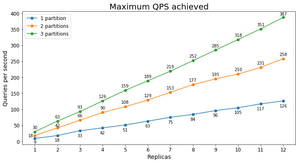
With as little data you have, I'm not sure adding additional partitions will be helpful to you. I'd recommend scaling replicas up or potentially moving up to a higher SKU (S2's are roughly 4x as powerful as an S1). Check out these performance tips that we recently published: https://docs.microsoft.com/en-us/azure/search/search-performance-tips. There's also some performance benchmarks we recently published: https://docs.microsoft.com/en-us/azure/search/performance-benchmarks. At the end of the day, your best bet will be to run performance tests. We recently published a solution to help bootstrap performance tests for search: https://github.com/Azure-Samples/azure-search-performance-testing.2.4KViews0likes1CommentRe: Ingest/Index static and dynamic web pages
Search720 there's no built-in indexer for crawling web pages so customers often leverage an open-source crawler such as Apache Nutch to extract content from web pages. From there, you can land the content in a supported data source such as Blob storage/Cosmos DB/ADLS Gen2 and index it. You can also push the data directly to the index via the Push API as described here.2KViews0likes3CommentsRe: Synonym map for similar terms
Roshini Yes - if the synonym map causes there to be extra terms to match the query, this will cause the document to be boosted higher. The biggest thing synonym maps are going to do for you is improve the recall of the query. All matching terms will be pulled and then fed into the BM25 algorithm. By the way, this video is a great resource on relevance/ranking: AI Show | Similarity and Scoring in Azure Cognitive Search - YouTube2.2KViews1like0CommentsRe: Integration of local hosted databases / applications
ThomasVetter if I'm understanding correctly, you're asking about how to properly apply security filtering to the data. In that case, you really just need to include an extra filterable field that includes information on who can see the document. Take a look at this link for some more details: Security filters for trimming results - Azure Cognitive Search | Microsoft Docs. You can also have some additional application-level logic that decides what data gets sent to the search index.1.6KViews1like0CommentsRe: Knowledge Management GitHub project
Scott Giesbrecht We do have some additional samples that might be valuable: dereklegenzoff/azure-search-react-template: React template for Azure Cognitive Search (github.com) Azure-Samples/search-qna-maker-accelerator: Cognitive Search Question Answering Solution Accelerator (github.com) liamca/covid19search: Covid-19 Search App (github.com) None of these samples show SharePoint integration yet because that functionality is new and still in preview. The first link I shared above show a really easy way to set up an application with end-to-end AAD through Azure Static Web Apps.2.7KViews1like0CommentsRe: New to Azure search and got some questions
Synonym Maps When a synonym map is deleted but a field still references it, search queries against that field will fail with Http Status 400, Bad Request. When you recreate the synonym map, you don't need to update the field configuration. Samples We generally try to bake in as many best practices into samples as we can. One great starting point is the Knowledge Mining solution accelerator. We also have a new sample showing how to integrate QnA with Azure Cognitive Search that includes a React Template. We also try to publish the code for a lot of our demos such as the COVID search app. Resetting Indexer This should be possible. Take a look at this doc (in particular ResetIndexer and RunIndexer).1.8KViews0likes2CommentsRe: Integration of local hosted databases / applications
We don't have indexers that can reach out to locally hosted databases, although we do have indexer support for Azure SQL Server VMs. There's also the option to migrate your data to Azure with a tool like Azure Data Factory. The other option is to use the Push API where you can send the search service the data directly. This can be a great option if your data isn't in a supported data source and you don't want to move it.1.6KViews0likes2Comments