admin
1434 Topics
schedule recurring Out of Office
Hi All I want to schedule recurring out of office every day. i have shared mailbox and i want to set out of office for shared mailbox for every email which is received from 9PM to 6AM as the users who have access to this shard mailbox works from 6AM to 9PM. Is this possible to set on exchange as OWA is disabled in my environment. Please guide me on thisSolved6.9KViews1like3Comments
Automating CRUD operations in MS Places
Hi, Has anyone been able to automate CRUD operations in MS Places yet? Given that the Places API calls support user access tokens only currently and Application access tokens isn't yet supported? We were able to do Get operations using App tokens but when run anything to modify, For Ex: Create a building using Set-Placev3 cmdlet it gives error. When raised an MS ticket they confirmed that the calls doesn't support application tokens yet.. We have a showstopper kind of situation.21Views0likes0CommentsTenant Migration
Our parent company wants to migrate us to their O365 tenant. We would keep our Brand and domain name, but the goal of the tenant move is: - to allow people to work seamlessly in Teams (currently, we need to Switch orgs to access our parent company Team sites) to chat, share files - to allow seamless interaction with Outlook (free/busy, calendar access) - seamless access to Sharepoint sites across orgs So far, we have been using Guest Accounts to access their Teams or Sharepoint sites. Challenges on our end: - we have an on-prem AD synchronizing to Azure AD and our own set of conditional policies and SSO applications for many SaaS tools. The parent company is looking at migrating our AD domain to their AD as a sub-domain - we have enrolled our laptops to Intune/Autopliot using Azure AD Join (no hybrid join) - we have Azure File shares joined to AD using NTFS permissions When migrating to another tenant, at which stage should the AD migration happen? Can we keep administering our domain once the migration is done (Mail flow rules, policies, Intune,...)? Is the migration possible at all in this scenario or would a domain name change would be required?1.7KViews0likes3CommentsPurview Launches New DLP Policy to Control Copilot Prompts
A new DLP policy for Copilot prompts monitors blocked sensitive information types like credit card numbers to stop their use in Copilot prompts. The new policy can’t be combined with the existing DLP policy for Copilot, which checks for files with specific sensitivity labels to prevent Copilot using their content in its responses. But that’s OK because the two policies do very different work. https://office365itpros.com/2025/11/20/dlp-policy-for-copilot-prompts/107Views0likes0Comments
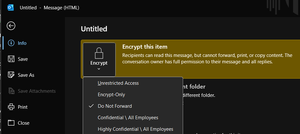
Outlook Classic for M365 - File > Encrypt > 'Encrypt-Only' option applies 'Do Not Forward' label?
I recently joined a new company and am helping support their M365 tenant and admin duties. I'm running into a very weird issue where no recipients can actually read/view the message when we encrypt emails using only 1 specific method (our organization largely uses the Outlook Classic for Microsoft 365 desktop app). If a user follows this method, for some reason the 'Do Not Forward' label is applied to the encryption, despite specifically selecting 'Encrypt-Only' - it defaults to 'Do Not Forward' every single time: New Email > File > Encrypt > Encrypt-Only Sending emails with this method gives any/all recipients a "You don't have sufficient permissions to open the mail." regardless of where they try to open the email (OWA, Outlook Classic, New Outlook) Yet, if the user tries this other method below - the proper Encrypt-Only label is applied, and any Outlook client immediately and opens/views the email as you'd expect: New Email > Options ribbon > Encrypt properly applies the Encrypt-Only label I verified IRM (Identity Rights Management) is enabled for our tenant: And encryption tests pass with flying colors: Ultimately, I'm at a loss for what's going on here and specifically where to check to fix this issue for this 1 specific encryption method. Poking around in the Purview portal, I'm having a hard time figuring out where these encryption policies/settings lie and how to get this method to stop defaulting to 'Do Not Forward' even though 'Encrypt-Only' is checked.Solved251Views2likes4Comments
Microsoft goofed: Group Policy Office ADMX/ADML Problem
https://www.microsoft.com/en-us/download/details.aspx?id=49030 That's the link MS gives to download the Office group Policy files. Everything works until you open GP and all the policies are in German. Yes, I selected ENGLISH (it was the only option). No, I can't speak German - wish I could. I can't find these files anywhere else. PLEASE HELP. Azure Server 2022 Datacenter - need latest Microsoft Office 365 ADMX/ADML files (which may still be the Office 2016 ones, nice job keeping up with the times, Microsoft).77Views0likes1CommentUnified Company Calendar for Mixed Microsoft 365 and Non-365 Users – 2025
Seeking a Shared Calendar Solution for Mixed Microsoft 365 and Non-365 Users I’m working on a solution to create a shared company calendar that everyone in our organization can view, while keeping editing permissions limited to a few selected individuals. The challenge: Some of our team members do not use Microsoft 365, and I’d like them to still be able to subscribe to or view the calendar and receive updates. Ideally, this should work without requiring full Microsoft accounts. I initially considered using an ICS-based calendar, but it seems Microsoft 365 Group calendars don’t support sharing via ICS links. I also explored creating a Group calendar as suggested in other threads, but ran into issues making it accessible to external users or those without 365 accounts. For context, I’m a Global Admin, so I have full access to configure settings in the Microsoft 365 Admin Center and Exchange if needed. We’re a small business, and our main goal is to have a centralized calendar for vacation schedules and company-wide events. It should be simple to access and maintain, with a focus on collaboration and accessibility across the board. What I’m looking for: A calendar that’s viewable by all, including non-M365 users Editable only by a few delegated team members Compatible with Microsoft 365, but not dependent on it for basic access Any tools, workarounds, or best practices that have worked for others in similar hybrid environments117Views0likes2CommentsPractical Graph: Creating a Multi-Workload User Activity Report
Microsoft 365 comes will many usage report APIs covering different workloads. This article explains how to use PowerShell to extract usage data for multiple workloads to combine together to create a holistic view of user account activity within a Microsoft 365 tenant. https://practical365.com/holistic-usage-report/31Views0likes0CommentsSharing a Planner Plan 1 plan with a guest user
Hi there, Looking for advice on what settings may be required to ensure that a guest user from another tenant can access a Planner Plan 1 plan which has been shared via a user in my tenant. Any assistance would be greatly appreciated! Guest user error message: "You do not have access to this plan. Ask any member to add you to the plan." Microsoft Planner Plan 1 user cannot share plan with guest user from another tenant Both users have Planner Plan 1 license assigned, the guest user has it assigned to their guest account on my tenant The Plan is shared in a Microsoft Team, of which both users are members The guest user has been added to the Plan The guest user has also tried opening the Plan directly via the Plan URL which was shared by the creator The guest user gets error message: You do not have access to this plan. Ask any member to add you to the plan." Other non-guest users from my tenant are able to access the Plan without any issues The guest user has selected their guest account from my tenant within their Teams app from their own laptop, and upon signing into the guest account, no Planner tab is listed for the user, and there is no ability to add it132Views0likes1Comment