isv success
164 Topics
Getting first customers after publishing what actually worked for you?
I published two transactable SaaS offers earlier this month (Microsoft 365 security and compliance assessment). The technical side went fine, with good support from the ISV team. Getting the offers in front of customers is where I'm stuck. So far I've reached Rewards Tier 3 and activated the listing optimisation benefit. I understand customer references are the gate to co-sell readiness, which feels like a chicken-and-egg problem when you have none yet. For publishers further along than me: what actually produced your first few customers? Was it private offers to targeted tenants, co-sell once you had references, the Marketplace Rewards activities, or something outside the marketplace entirely? I'd rather spend my limited time on what works than keep guessing.121Views1like0Comments
Are Shopify merchants using Dynamics 365 and Microsoft 365 Copilot a meaningful market segment?
Hi Marketplace community, We are testing a market assumption before investing further in a Microsoft 365 Copilot solution for retail loyalty operations. The solution, Loyalty Manager Copilot AI, helps teams review loyalty-program health and take bounded, reviewable actions, such as approving a win-back reward, from within a Copilot conversation. Some merchants we encounter use Shopify or Shopify Plus for the storefront, while Microsoft systems support parts of the back office. Readers who want to understand or try the current app can https://marketplace.microsoft.com/en-us/product/WA200010024. We know the technical pattern exists: Shopify at the storefront, with Dynamics 365 Business Central or other Microsoft business applications behind it. What We are trying to understand is whether the user and buying pattern is large enough to matter. For retailers using Shopify together with Dynamics 365 and Microsoft 365: Are loyalty, CRM, or marketing users working in Teams and Microsoft 365 Copilot regularly? Is Copilot adoption reaching these business roles, or is it still concentrated in IT, finance, and administration? Who usually evaluates or sponsors a cross-platform loyalty solution: the merchant, a Microsoft partner, a Shopify partner, or another stakeholder? Would an AppSource solution connecting loyalty operations to Copilot fit an established workflow, or would it require creating a new behavior? We would especially value firsthand observations from merchants, ISVs, system integrators, and Microsoft partners. We are not looking for a product pitch. We are trying to determine whether this represents a meaningful audience or a narrow edge case.Marketplace Publishing - Email with the Certification Team
Greetings partners, fellows, and friends, Standards Core is a 2nd year ISV - we currently have 1 SaaS and 2 Office add-in listings, now working on our first Apps and agents for Microsoft 365 and Copilot ... we have submitted our first publish, can currently working to address certification details. Why am I posting this? Well, after the 1st submission, in addition to the certification report on Marketplace, we also received an email - thereafter questions/iterations were immediately interactive with very quick and clearly attentive responses. So I wanted to mention that we really appreciate that!! Previous submissions that I have experienced were through the submissions portal only - the personalized email interaction was a pleasant surprise, and made the process feel much warmer than the previous "formal" portal-only interaction. Thank you [certification team], and looking forward to re-submit shortly. Thanks again, Leon, CTO/Standards Core LLCAuto Activation for SaaS Private Offers is a Game Changer!
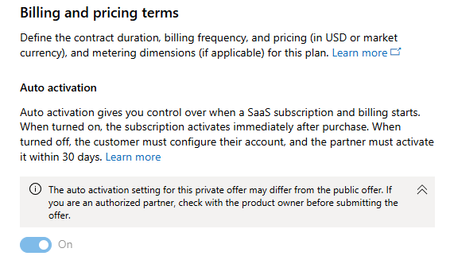
Shout out to Microsoft Marketplace for launching AUTO ACTIVATION for SaaS private offers. This has simplified our sales operations for Microsoft Marketplace private offers, as well as dramatically improved our seller and customer experience with by eliminating the #1 reason we've historically seen block customers from completing Marketplace SaaS private offer procurement. Auto activation for private offers allows customers to skip the step of going to our SaaS landing page and activate Marketplace SaaS billing by having to SSO with their AAD. The problem with this step is that most of our customers are in regulated industries, and their AAD admins do not allow SSO on SaaS landing pages without enabling profile sharing, which requires a Global Admin to enable. We've encountered far too many times where our customer is scrambling to find their Global Admin so that they can complete the final steps to finish the steps to activate Marketplace SaaS billing. This also puts our sellers in the awkward position of having to help customers diagnose and troubleshoot the situation, which as a rule they are not equipped to, or find a Microsoft resource to help. Now, with this new feature the whole SSO to our SaaS landing page and associated problems are eliminated. Ever since we started using it our customers' procurement experience has been faster and smoother. I'm looking forward to more improvements to the Marketplace experience! Here is the feature: https://learn.microsoft.com/en-us/partner-center/marketplace-offers/create-new-saas-offer-plans#configure-auto-activationA Short Story: Why Transact in Marketplace?
For anyone who is undecided a) if building a transactable offer is worth the effort or b) if leading with Marketplace is superior to legacy procurement processes: Last night while I slept, we closed an enterprise deal in Australia. Yesterday, I created a custom private offer for the customer and sent them the acceptance link with a link to the Microsoft Learn page with instructions on how they accept the offer. Woke up this morning to a Partner Center-generated message confirming the deal was won and done. Yes, we had given them a demo; and yes, we had to get stakeholder commitment . . . but: Zero haggling on price. Zero contract redlines. Zero delays with traditional vendor onboarding etc. Even better, we leveraged our Marketplace Rewards (bar none my favorite GTM program!) to amplify customer value by providing Azure Sponsorship credits to offset the deployment cost. Even more better, this deal hits three of the levers in the FY24 Transact & Grow Incentive Campaign - meaning sometime in the next ~60 days Microsoft is going to send us $40k in free money. 🙂 I share this story not to boast but to inspire and motivate. Nothing's special about us or what we did here - you can 100% replicate this experience simply by taking advantage of the resources Microsoft wants to give you. #MarketplaceChampions #SponsoredSolved2.4KViews22likes6Comments
Marketplace offers as transactable and azure benefit eligible
Query about Marketplace listings - I want to upload a new offer as SaaS. I want to make sure it's transactable and also have the azure benefit tag added to it. I have the banking and tax profile approved and completed. I'm unable to find how do I get the Azure benefit eligible tagged to this offer (or is there a pre-requisite). I have reviewed the Marketplace best practices but unable to find how do I exactly go about doing it.Question on MPO and Partner Quotes, what is your best practice?
Hello community, a question regarding how does MPO accelerate your deals? Today, direct to customer private offers can accelerate deals by using the private offer process for a customer to "electronically sign" a document attached to the private offer. However, for MPO we do not have a way for a channel partner (aka: reseller) to "electronically sign" a partner quote via Marketplace because MPO does not have a way to attach a pdf that the partner exclusively sees & accepts. In other words, any pdf we attach is also visible to the end customer which we do not want. As a result, we struggle to use MPO to accelerate deals (note: we are in discussion with partners about using REO but they also want to use MPO) Have you considered the MPO partner quote scenario and if so, have you found a way through this to accelerate deal making? What do you do?SolvedHow do you actually unlock growth from Microsoft Teams Marketplace?
Hey folks 👋 Looking for some real-world advice from people who’ve been through this. Context: We’ve been listed as a Microsoft Teams app for several years now. The app is stable, actively used, and well-maintained - but for a long time, Teams Marketplace wasn’t a meaningful acquisition channel for us. Things changed a bit last year. We started seeing organic growth without running any dedicated campaigns, plus more mid-market and enterprise teams installing the app, running trials, and even using it in production. That was encouraging - but it also raised a bigger question. How do you actually systematize this and get real, repeatable benefits from the Teams Marketplace? I know there are Microsoft Partner programs, co-sell motions, marketplace benefits, etc. - but honestly, it’s been very hard to figure out: - where exactly to start - what applies to ISVs building Teams apps - how to apply correctly - and what actually moves the needle vs. what’s just “nice to have” On top of that, it’s unclear how (or if) you can interact directly with the Teams/Marketplace team. From our perspective, this should be a win-win: we invest heavily into the platform, build for Teams users, and want to make that experience better. Questions to the community: If you’re a Teams app developer: what actually worked for you in terms of marketplace growth? Which Partner programs or motions are worth the effort, and which can be safely ignored early on? Is there a realistic way to engage with the Teams Marketplace team (feedback loops, programs, office hours, etc.)? How do you go from “organic installs happen” to a structured channel? Would really appreciate any practical advice, lessons learned, or even “what not to do” stories 🙏 Thanks in advance!582Views2likes4CommentsMarketplace sales are never showing as "Won"
I was looking through the Insights page of the Partner Portal today and I came across a weird quirk of the way Marketplace sales are reported. None of our Azure Marketplace Leads (the leads & sales we get from customers buying our solutions from the Azure Marketplace) are showing up as "Won". On the https://partner.microsoft.com/en-us/dashboard/opportunities/referral/cohort, under "Business performance" we see that Won rate, Lost rate, and Value won all are missing the customers we've gotten through the marketplace. It only appears to be showing manually entered co-sell leads. This seems to be messing pretty heavily with our cohort generation/analysis as we're placed into the incorrect tier. (Sidenote: are cohorts only generated once a year?) Under the https://partner.microsoft.com/en-us/dashboard/opportunities/referral/leads for the "Marketplace leads" tab I'm also seeing 0 "Won" and 0 "Won value" for all of our Marketplace Offers. They get stuck under "Leads" without progressing forward. Is there a way I'm missing to mark our Marketplace Leads as "Won"? We have a bunch of leads that I'd like to reflect in the tool properly.5 App Advisor capabilities that help sell faster on Microsoft Marketplace
Signing in to App Advisor unlocks features that help you manage projects, personalize your development guidance, and move from build to Marketplace sales faster. App Advisor helps streamline the process for anyone, with no barriers to start. However, when you sign in and authenticate, the experience becomes even more powerful. Read the 5 reasons to authenticate in App Advisor here.