edge
867 TopicsResource Guide: Making Physical AI Practical for Real‑World Industrial Operations
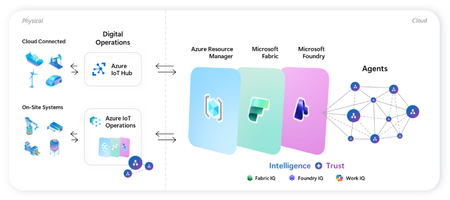
Microsoft's adaptive cloud approach brings together connected devices, industrial data, contextual intelligence, and governed actions across the edge and cloud. Azure IoT Hub and Azure IoT Operations connect operational assets, Azure Device Registry provides a common management foundation, Microsoft Fabric turns operational signals into contextualized intelligence, and Foundry Local enables AI inferencing at the edge. Together with Azure Arc and Azure Local, these technologies help organizations build, manage, and scale Physical AI solutions across real-world environments. Key Purpose Offering Direct-to-cloud device management + telemetry ingestion Azure IoT Hub Unified device and asset management + governance Azure Device Registry Industrial connectivity + edge data plane Azure IoT Operations Unified analytics + real-time intelligence Microsoft Fabric On-device AI inferencing runtime Foundry Local Azure-managed infrastructure for edge computing and AI workloads Azure Local Industry recognition Microsoft named a Leader in the 2026 Gartner® Magic Quadrant™ for Global Industrial AIoT Platforms Read the announcement See it all come together Before diving into each component, watch this end-to-end demo showing how Azure IoT Operations, Azure IoT Hub, Microsoft Fabric, and Foundry Local work as one stack across the edge-to-cloud lifecycle - Making industrial AI practical for real-world operations with adaptive cloud. How these components work together Azure IoT Hub and Azure IoT Operations connect devices and industrial assets, bringing operational data from the physical world into Azure. Azure Device Registry provides a unified foundation for managing devices and assets, while Microsoft Fabric combines real-time operational signals with business context for analytics and intelligence. Foundry Local enables AI inferencing at the edge, with Azure Arc and Azure Local extending Azure management and infrastructure capabilities into on-premises environments. Together, these technologies provide the foundation for building and scaling Physical AI solutions across the edge and cloud. This blog walks through where to get started with each product capability: 1. Manage Cloud-Connected Devices and Telemetry with Azure IoT Hub Azure IoT Hub is a fully managed cloud service that enables secure bidirectional communication, device-to-cloud telemetry ingestion, cloud-to-device command execution, per-device authentication, remote management and more. Azure IoT Hub also integrates directly with Microsoft Fabric Eventstreams, enabling organizations to ingest, transform, and route device telemetry for real-time analytics and downstream intelligence. Recommended Usage: Azure IoT Hub is best suited for distributed, standalone devices that connect directly to the cloud for telemetry, monitoring, and remote management. These devices typically do not require cloud-managed containerized workloads or local industrial protocol connectivity. Examples include water monitoring stations, vehicle telematics, and distributed fluid-level sensors. Resources Check out the latest announcements from Ignite 2026 in our blog post: https://aka.ms/ignite-2026-do-services Overview of generally available services: Azure IoT Hub Azure IoT Hub Device Provisioning Service Azure Device Registry Certificate management (new) Firmware analysis with Azure Device Registry (new) Azure Device Update for IoT Hub Overview of preview capabilities: IoT Hub: MQTT v5 connection profile Azure Device Registry: Groups, Jobs, and Software Update Connect IoT data to Microsoft Fabric: https://learn.microsoft.com/en-us/fabric/real-time-intelligence/event-streams/ Scalable solution guides: Best practices for large-scale IoT deployments - Azure IoT Hub Device Provisioning Service Scale Out an Azure IoT Hub-based Solution to Support Millions of Devices - Azure Architecture Center Azure IoT Hub scaling 2. Connect Industrial Assets with Azure IoT Operations Azure IoT Operations provides a unified industrial data plane running on Azure Arc-enabled Kubernetes clusters. It connects industrial equipment and operational systems, processes and contextualizes data locally, and routes it to cloud analytics and intelligence services. With the latest release, Azure IoT Operations expands connectivity to systems such as SQL Server and REST endpoints, supports direct data flow outputs to Microsoft Fabric OneLake and other analytics destinations, and introduces preview capabilities for semantic modeling and governed agent access. Recommended Usage: Azure IoT Operations is designed for environments that need local industrial connectivity, edge data processing, and cloud-managed workloads. It supports deployments ranging from small gateways and remote sites to factory infrastructure. Azure IoT Operations Essentials provides a lightweight option for single-node deployments, while Azure IoT Operations Standard supports more complex industrial environments, including OPC UA connectivity and multi-node configurations. Resources Product documentation and getting started What is Azure IoT Operations Azure IoT Operations Documentation Hub Releases · Azure/azure-iot-operations Quickstart: Explore Sample Latest release announcement: https://aka.ms/aio2610 Demos and open-source projects Making industrial AI practical for real-world operations with adaptive cloud Explore Azure IoT Operations: How we built the demo Microsoft Edge AI GitHub repository Physical AI Toolchain (Azure + NVIDIA): microsoft/physical-ai-toolchain Additional video tutorials Microsoft IoT Developers on YouTube Microsoft Developer: Azure Essentials Show, Video 1 Microsoft Developer: Azure Essentials Show, Video 2 Latest Announcements & Blogs Put Your Industrial Data to Work with New Azure Capabilities From Connected Devices to AI-Ready Operations Making Physical AI Practical: Part 1 and Part 2 Introducing small form factor infrastructure Unlock Industrial Intelligence | Microsoft Hannover Messe 2026 3. Advanced Analytics with Microsoft Fabric Microsoft Fabric brings together streaming operational data and enterprise information to deliver real-time analytics and actionable insights. Fabric Real-Time Intelligence enables organizations to ingest, analyze, and visualize live industrial signals, while Operations Agents help detect conditions and recommend actions. Fabric IQ adds business context through governed entities, relationships, and semantic models, helping agents reason over operational data in the context of business processes. Resources Get Started with Microsoft Fabric Learning Path Fabric Real-Time Intelligence documentation - Microsoft Fabric Microsoft Fabric Eventstreams documentation Fabric IQ documentation - Microsoft Fabric Introducing the new Microsoft IQ: Putting your organization's intelligence to work in every agent 4.Run AI Models at the Edge with Foundry Local and Azure Local Foundry Local enables AI models to run directly in edge environments, supporting low-latency inference and scenarios where connectivity or data residency requirements make local processing important. Together with Azure Local, organizations can deploy and manage intelligent workloads on Azure-managed infrastructure at the edge. New capabilities announced at Ignite 2026 expand support for smaller devices, including ARM64-based hardware such as NVIDIA Jetson AGX Thor, and vision-language-action models for physical AI applications. Resources Introducing small form factor infrastructure Foundry Local on Azure Local Documentation Participate in Foundry Local on Azure Local preview form Foundry Local on Azure Local: HELM deployment Demo Customer Stories Chevron: Chevron plans facilities of the future with Azure IoT Operations Husqvarna: Husqvarna Group Boosts Operational Efficiency with Azure Adaptive Cloud Ecopetrol: Ecopetrol standardizes industrial data across 100+ energy assets with Azure IoT Operations and Microsoft Fabric P&G: Procter & Gamble cuts model deployment time up to 90% with Azure IoT Operations Toyota: Toyota Industries innovates its paint shop processes with Azure industrial AI and Azure IoT Hub Partner Solutions and Industrial AI Ecosystem Microsoft partners bring industrial connectivity, domain expertise, and specialized solutions that help organizations turn operational data into actionable intelligence. Explore how partners are building on Azure IoT to address real-world industrial challenges: Physical AI Partner Resource Guide From pilots to production: How Microsoft and partners are accelerating intelligent operations How Mesh Systems Builds on Azure IoT Hub and Azure IoT Operations to Accelerate Industrial AI Unlocking the Human Telemetry Layer for Safer Industrial Operations Unlocking Smart Manufacturing: Siemens Industrial Edge Meets Azure IoT Operations Solving the Data Challenge for Manufacturers with Sight Machine & Azure IoT Operations Microsoft and Rockwell Automation: Transforming Industrial AI Together Scaling Industrial AI at the Edge with Helin and Azure IoT1.7KViews3likes0CommentsMicrosoft Physical AI Partner Guide: Choosing the Right Data Expertise for Every Stage
As organizations scale Physical AI, the challenge shifts from technology selection to deciding who should lead which part of the journey -- and when. Which partners should establish secure connectivity? Who enables production grade, AI ready industrial data? When do systems integrators step in to scale globally? This Partner Guide helps customers navigate these decisions with clarity and confidence: Identify which partners align to their current digital transformation and Physical AI scenarios leveraging Azure IoT and Azure IoT Operations Confidently combine partners over time as they evolve from connectivity to intelligence to autonomous operations This guide focuses on the data foundation for Physical AI, highlighting the partners and capabilities that connect industrial systems, contextualize operational data, and make it available to AI-powered applications. It does not attempt to catalog every Physical AI solution. Instead, it helps customers understand how specialized partners establish the trusted data and operational context needed for AI systems to move from insight toward informed, responsible action in the physical world. Common Customer Journey Steps 1. Modernize Connectivity & Edge Foundations The industrial transformation journey starts with securely accessing operational data without touching deterministic control loops. Customers connect automation systems to a scalable, standards-based data foundation that modernizes operations while preserving safety, uptime and control. Outcomes customers realize Standardized OT data access across plants and sites Faster onboarding of legacy and new assets Clear OT–IT boundaries that protect safety and uptime Partner strengths at this stage Industrial hardware and edge infrastructure providers Protocol translation and OT connectivity Automation and edge platforms aligned with Azure IoT Operations 2. Turn Operational Data into Intelligence With a consistent edge-to-cloud data foundation in place, customers can move beyond dashboards to build repeatable, production-ready intelligence into their industrial operations. Expert partners help transform operational data into contextualized signals that support analytics, intelligent applications, and increasingly sophisticated Physical AI scenarios across assets, lines, and sites. Outcomes customers realize Improved Operational efficiency and performance Adaptive facilities and production quality intelligence Energy, safety, and defect detection at scale Partner strengths at this stage Industrial data services that contextualize and standardize OT signals for AI consumption Domain-specific acceleration for common Industrial AI scenarios Data pipelines integrated with Azure IoT Operations and Microsoft Fabric 3. Prepare for Intelligent, Governed Action As organizations move from insights toward intelligent action, the focus shifts to safely connecting operational intelligence with real-world processes. Partners help align data, infrastructure, and operational interfaces while supporting the governance, monitoring, and lifecycle management needed for increasingly automated operations. Outcomes customers realize Proven reference architectures deployed across plants AI‑ready data foundations that adapt as operations scale Coordinated interaction between OT systems, AI models, and cloud intelligence Partner strengths at this stage Industrial automation leadership and control system expertise AI-ready edge infrastructure designed to support industrial intelligence and Physical AI workloads Systems integrators enabling end‑to‑end implementation and repeatability Partner Ecosystem: Building the Data Foundation for Physical AI This matrix highlights partners with specialized expertise in accessing, contextualizing, and operationalizing industrial data to support Physical AI solutions at scale. The matrix is not a catalog of end‑to‑end Physical AI applications; each partner contributes specialized capabilities that customers can combine to connect operational systems, establish trusted context, and support increasingly intelligent applications. How to use this matrix: Start with your scenario → identify primary partner types → layer complementary partners as you scale. Partner Type Adaptive Cloud Primary Solution Example Scenarios Geography Advantech Industrial Hardware, Industrial Connectivity LoRaWAN gateway integration + Azure IoT Operations Industrial edge platforms with built in connectivity, industrial compute, LoRaWAN, sensor networks Global Accenture GSI Industrial AI, Digital Transformation, Modernization OEE, predictive maintenance, real-time defect detection, optimize supply chains, intelligent automation and robotics, energy efficiency Global Avanade GSI Factory Agents and Analytics based on Manufacturing Data Solutions Yield / Quality optimization, OEE, Agentic Root Cause Analysis and process optimization; Unified ISA-95 Manufacturing Data estate on MS Fabric Global Belden Industrial Connectivity, Networking, Security Belden Horizon Data Operations (BHDO) + LioN-X with Azure IoT Operations OT-IT convergence, network orchestration and monitoring, ruggedized ethernet and switching, industrial WiFi, multi-vendor protocol connectivity, OT security, OPC UA Global Capgemini GSI The new AI imperative in manufacturing OEE, maintenance, defect detection, energy, robotics Global DXC GSI Intelligent Boost AI and IoT Analytics Platform 5G Industrial Connectivity, Defect detection, OEE, safety, energy monitoring Global Helin Industrial Data Services, Edge-to-Cloud IoT Platform RedZone Vision AI solution, Helin Platform built on Azure IoT Hub Renewable energy monitoring, maritime fleet monitoring, oil & gas vision/hazard detection, Azure IoT Central migration Global Innominds SI Intelligent Connected Edge Platform Predictive maintenance, AI on edge, asset tracking North America, EMEA Litmus Automation Industrial Connectivity, Industrial Data Ops Litmus Edge + Azure IoT Operations Edge Data, Smart manufacturing, IIoT deployments at scale Global, North America Mesh Systems GSI & ISV Azure IoT & Azure IoT Operations implementation services and solutions (including Azure IoT Operations-aligned connector patterns) Device connectivity and management, data platforms, visualization, AI agents, and security North America, EMEA Nortal GSI Data-driven Industry Solutions IT/OT Connectivity, Unified Namespace, Digital Twins, Optimization, Edge, Industrial Data, Real‑Time Analytics & AI EMEA, North America & LATAM NVIDIA Technology Partner Accelerated AI Infrastructure; Open libraries, models, frameworks, and blueprints for AI development and deployment. Cross industry digitalization and AI development and deployment: Generative AI, Agentic AI, Physical AI, Robotics Global Oracle ISV Oracle Fusion Cloud SCM + Azure IoT Operations Real-time manufacturing Intelligence, AI powered insights, and automated production workflows Global Rockwell Automation Industrial Automation FactoryTalk Optix + Azure IoT Operations Factory modernization, visualization, edge orchestration, DataOps with connectivity context at scale, AI ops and services, physical equipment, MES Global Schneider Electric Industrial Automation Industrial Edge Physical equipment, Device modernization, energy, grid Global Siemens Industrial Automation & Software Industrial Edge + Azure IoT Operations reference architecture Industrial edge infrastructure at scale, OT/IT convergence, DataOps, Industrial AI suite, virtualized automation. Global Sight Machine ISV Integrated Industrial AI Stack Industrial AI, bottling, process optimization Global Softing Industrial Industrial Connectivity edgeConnector + Azure IoT Operations OT connectivity, multi-vendor PLC- and machine data integration, OPC UA information model deployment EMEA, Global TCS GSI Sensor to cloud intelligence Operations optimization, healthcare digital twin experiences, supply chain monitoring Global This Ecosystem Model enables Physical AI solutions to scale through clear roles, respected boundaries and composable systems: Control systems continue to be driven by automation leaders Safety‑critical, deterministic control stays with industrial automation partners who manage real‑time operations and plant safety. Customers modernize analytics and AI while preserving uptime, reliability, and operational integrity. Data, AI, and analytics scale independently A consistent edge to cloud data plane supports cloud scale analytics and AI, accelerating insight delivery without entangling control systems or slowing operational change. This separation allows customers and software providers to build AI solutions on top of a stable, industrial‑grade data foundation without redefining control system responsibilities. Specialized partners align solutions across the estate Partners contribute focused expertise across connectivity, analytics, security, and operations, assembling solutions that reduce integration risk, shorten deployment cycles, and speed time to value across the operational estate. From Data to Physical Intelligence Physical AI starts with a reliable understanding of the physical world. By connecting industrial systems, contextualizing operational data, and bringing together the right partner expertise, organizations can build a foundation for intelligence that goes beyond insights to support better decisions and responsible action. Use this guide to identify the partners and capabilities that can help you take the next step on your Physical AI journey with Microsoft Azure.2.3KViews4likes0CommentsAzure IoT Operations 2610 is now available: Scaling the foundation for Physical AI
AI is moving out of dashboards and onto factory floors, oil fields, and production lines, where it can sense, reason, and act in the physical world. Most industrial organizations are only beginning to make that shift, and they need a platform that lets them start with confidence and keep going as their ambitions grow. Azure IoT Operations 2610 is built for exactly that. For the first time, Azure IoT Operations ships on two channels at once. The generally available (GA) release delivers production-ready capabilities that help organizations understand their operations across many more sites, at lower cost. A new public preview channel gives customers hands-on access to the capabilities that are coming next, including governed access to operations for AI agents and AI inference running directly inside edge data pipelines. Taken together, the two channels show where the platform is today and where it is heading. This release is part of a broader set of Physical AI announcements at Microsoft Ignite. Microsoft's Ignite Physical AI announcement (https://aka.ms/Ignite2026/PhysicalAIBlog) describes how IoT, Industrial AI, and Physical AI connect data, decisions, and action: IoT helps organizations understand their operations, Industrial AI helps them reason, and Physical AI helps them act, together forming a continuous learning loop. Within Microsoft's adaptive cloud approach, Azure IoT Operations is the on-site foundation for that loop. This post goes one level deeper into what 2610 delivers and what it makes possible. Physical AI and where Azure IoT Operations fits Physical AI is AI that works in the physical world. It perceives what is happening across an operation, reasons about what it means, and acts to improve the outcome. Getting there is a journey rather than a single leap, and customers should not feel they have to take on everything at once. Azure IoT Operations is designed to make that journey practical, so organizations can start simply, prove value, and evolve toward far more sophisticated applications of AI and agents at their own pace. The journey begins with easy integration into the physical operation customers already run. Many start with perception: connecting equipment, bringing in data from sensors and cameras, and seeing what is happening in real time. From there, they move into reasoning, with AI models and agents that diagnose issues and recommend improvements. Ultimately, they move into action, where approved decisions reach equipment through partner control systems. Each step builds on the one before it, on the same platform. Azure IoT Operations is also designed from the ground up to protect each customer's proprietary operational data. Customers decide who can access which data and how, and that applies to AI agents as much as to people and applications. They also decide what data leaves the site, if any at all. That control lets customers choose the deployment model that fits their operation: cloud-first deployments that rely on AI in the cloud, hybrid deployments that combine cloud AI with local AI models and agents, and fully local deployments where AI and agents run only on site and data never leaves it. Whichever path and deployment model a customer chooses, the role of Azure IoT Operations comes down to three core functions and two key intersections with the systems around it. Three core functions Understand the operation. Azure IoT Operations keeps trusted operational context close to the process: what each asset is, what its data means, how equipment relates, its current and historical state, observations from cameras and other sensors, and the capabilities and constraints of the process. Standards such as OPC UA and W3C Web of Things are the tools. The outcome is context that people and AI can rely on. Optimize the operation. AI models and agents run at the edge, next to the operational data and the process, where they can perceive, diagnose, recommend, optimize, and coordinate. Microsoft Foundry supplies the models and agent development capabilities. Azure IoT Operations supplies the operational environment in which those agents become useful. Govern action. When an agent proposes an action, Azure IoT Operations turns it into an authorized, bounded, and observable operation. It authenticates the actor, evaluates policy and current conditions, obtains approval where required, invokes an authoritative command path, records the decision, and verifies the result. Two key intersections Where AI meets control: Azure IoT Operations optimizes, partners actuate. Azure IoT Operations decides, predicts, and recommends, sometimes in the form of a control input such as a new setpoint, and issues that intent through governed interfaces. Partner control systems and robots run the deterministic real-time loop and own safety, for people and machines, at all times. As a simple example, Azure IoT Operations can set the thermostat, but the thermostat and the HVAC system get the room to the correct temperature. Partners are already proving this pattern. Azure IoT Operations integrates with Rockwell Automation's FactoryTalk Optix and is part of Schneider Electric's EcoStruxure Automation Expert. In Schneider's green-hydrogen pilot with H2E Power, AI agents validated control logic in simulation before deploying it to hardware; the system ran for more than 6,000 hours autonomously and cut the levelized cost of hydrogen by roughly 10%. Where edge meets cloud: local intelligence at the edge, enterprise intelligence in the cloud. Azure IoT Operations integrates local operational intelligence at each site. Microsoft Fabric integrates enterprise-wide and cross-site intelligence. The two are federated, so when customers choose to share data beyond the site, the context created at the edge flows to the cloud without being rebuilt. These three core functions follow the same path customers take into Physical AI: understanding the operation turns raw data into trusted context, optimizing it is where AI reasons over that context, and governing action is how decisions safely reach the physical world. Clear roles at each intersection are what make AI credible to the people who run plants. Customers get AI that is useful on the floor without trading away the control systems, certifications, and safety practices they already trust. What 2610 delivers Azure IoT Operations already provides the foundation many industrial customers run in production today: governed cloud-to-edge management actions, no-code data flow graphs, broad industrial connectivity, and unified health reporting. Release 2610 builds on that foundation in two directions. The GA release deepens the first core function, understanding the operation, and makes it practical at fleet scale. It also strengthens the intersection where edge meets cloud by landing edge data directly in the lakehouse. The preview release takes the first concrete steps into the second and third core functions: running AI against live operational data at the edge, and giving AI agents governed, auditable access to operations. Core function Generally available in 2610 In preview with 2610 Understand the operation Essentials SKU for large fleets, ODBC-based connector for SQL Server, smarter OPC UA collection, leaner data flow writes to the lakehouse Asset context with Web of Things and the edge registry, type-based OPC UA discovery, live data in the operations experience, Azure Marketplace connectors and the Akri Connector Builder, Microsoft Fabric integration Optimize the operation Service calls from custom WebAssembly modules, AI-assisted data flow authoring in VS Code Inference connector with Foundry Local and Azure Machine Learning, file-backed graph processing Govern action Management actions for HTTP/REST assets MCP server with policy-governed tool access, data-driven management actions, application lifecycle for agents and MCP servers Two release channels: what you can run today, and what is coming next Starting with 2610, every Azure IoT Operations release ships on two channels. GA (stable) is production-ready and fully supported. This is what you run on the factory floor. Preview includes everything in GA plus new capabilities that are ready for hands-on feedback. Use it in test or pilot environments to evaluate what is coming and help shape it before it reaches GA. You choose a channel when you deploy, through the Azure portal deployment wizard or the Azure CLI, and you upgrade within that channel. Switching an existing instance between GA and preview is not supported, so production deployments stay on a predictable, stable path. Connector and transform versions follow the same rule: GA instances see only GA versions, while preview instances see both. For technology leaders, the second channel changes how you can plan. You no longer have to wait for GA to evaluate a major capability or sign up for a one-off private preview. The preview channel is a working view of the roadmap, available every release, that your teams can put in front of real equipment and real operators while production keeps running. Generally available: understanding operations at scale Physical AI is only as good as the operational context beneath it, and that context has to exist at every site, not just at the flagship plant. The GA capabilities in 2610 turn on-site data into actionable intelligence: they make operational context cheaper to establish, broader in what it covers, and easier to hand up to enterprise analytics. Bring Physical AI to more sites: Azure IoT Operations Essentials A new Essentials SKU sits alongside the full-featured offering, now called Standard. Essentials delivers the core of Azure IoT Operations, the edge MQTT broker, Akri connectors, and data flows, on single-node clusters at a lower price point. Many organizations need a reliable edge data layer at hundreds or thousands of small sites, such as stores, substations, wind turbines, or remote equipment, that do not need the full industrial feature set. Essentials makes those fleet-wide rollouts cost-effective. Standard remains the choice for full industrial deployments that need OPC UA connectivity or multi-node clusters. You choose the SKU when you create an instance, and moving to Essentials requires a new deployment. Together with ARM64 support, generally available since release 2607, Essentials lowers both the cost and the hardware bar for line-level and pilot deployments. Data flow graphs that land data directly in your lakehouse Data flow graphs write directly to Azure Data Lake Storage Gen2 in Delta or Parquet, Microsoft Fabric OneLake tables in Delta, and Azure Data Explorer or local storage in Parquet. Teams can branch, window, filter, and run custom WebAssembly transforms at the edge, then write the result straight into analytics-ready tables with no extra messaging hop and no second pipeline to maintain. In 2610, Delta Lake writes use less memory and carry less transaction-log overhead, with checkpoints running in the background. Less, cleaner data goes to the cloud, which lowers storage and ingestion costs. This is where edge meets cloud, in practice: the edge does the local work, and Fabric receives context it can use for cross-site analysis. More of the plant, connected The new ODBC-based connector for SQL Server brings data from the databases behind MES, quality, batch, and historian systems into the same pipelines as OPC UA and MQTT telemetry. Teams configure a SQL Server connection and its assets in the operations experience and define datasets with SQL queries, with no custom extraction code. Management actions now extend to assets connected through the HTTP/REST connector as well, so teams can collect data from and act on REST-connected equipment alongside everything else. That brings governed management actions to more of the plant. Smarter OPC UA data collection OPC UA is a widely used open standard that lets industrial machines share their data, and 2610 makes the Azure IoT Operations connector for it smarter about what it collects and sends. It can now ignore values that barely change, drop readings the equipment itself flags as unreliable, and sample data at a fixed interval. Filtering out noise and bad readings at the source means less data to move and store, lower cloud costs, and cleaner input for analytics and AI. When a machine restarts or the network drops, applications can request a complete snapshot of the machine's current state, or receive one automatically when a key value changes, instead of waiting for values to trickle back in. Optional health signals confirm that the connection is alive and that data has been delivered, and an optional fast failover gets data flowing again sooner when a connection fails. Faster to build, easier to operate Several GA capabilities shorten the path from idea to running pipeline. Developers can describe a data flow in plain language to GitHub Copilot in VS Code, validate it locally, and deploy it. Custom WebAssembly modules in data flow graphs can now call request-response services over MQTT while processing a message, for enrichment, lookups, routing decisions, or asset management actions. The edge state store now supports paged key scans and multi-key reads, so applications can discover and retrieve the context available to them. Live data views in the Azure IoT Operations Data Flow extension for VS Code speed up commissioning and troubleshooting, and an updated navigation layout in the operations experience makes instances and their resources easier to find. Public preview: AI that reasons over operations, with action that stays governed The preview channel is where 2610 reaches furthest toward Physical AI. These capabilities put agentic AI to work on live plant data at the edge, within the governance controls the customer sets, and give agents a governed path into operations. Customers can evaluate them now in test and pilot environments. Connect AI agents to edge operations, with guardrails Azure IoT Operations now includes a Model Context Protocol (MCP) server that gives compatible AI agents and assistants authenticated, authorized access to live MQTT telemetry and state store data at the edge. A single endpoint aggregates supported first-party and third-party MCP tools, so teams can register their own MCP servers behind the same entry point instead of managing separate client connections. Authentication and authorization policies that you control govern access to every registered tool, so each agent gets only the tools its role allows, and publishing MQTT messages requires Admin permissions. New application lifecycle capabilities also let teams deploy and manage agents and MCP servers on the cluster, alongside connectors. This is the third core function, govern action, taking shape. Teams want AI copilots that can answer "why is line 3 down?" or "which assets are unhealthy?" without giving AI broad access to production systems. With a single governed entry point, organizations bring the agent they already use and decide exactly what that agent can see and do. Run predictive AI models in the data pipeline The new Inference connector runs registered machine learning models, using predictive models served by Foundry Local on the cluster or models hosted in Azure Machine Learning, with multiple models running concurrently. Large inputs such as high-resolution images are read from files rather than passed through the message broker, and new graph-level file stores let custom WebAssembly transforms read and write those files on persistent cluster storage. Moving a model from a notebook onto a live production line usually means custom integration code for every model. With the Inference transform, a model becomes another step in the pipeline, and its results can feed downstream transforms or trigger management actions on connected assets, closing the loop from perception through reasoning to action. This is the second core function, optimize the operation, running where the data is. Give data meaning: asset context and the edge registry Raw tag values are not enough for analytics or AI to reason about an operation. A new WoT Enrich transform uses Web of Things mappings to give asset messages a consistent structure and add context such as what a value means and its units, and a new Microsoft Fabric integration formats and batches that telemetry for Eventhouse or Lakehouse. The new edge registry stores JSON Schemas and Web of Things Thing Models and Thing Descriptions on the cluster, where local workloads can reach them, and keeps them in sync with the cloud registry. Type-based OPC UA discovery finds assets and event groups from OPC UA type information, and assets such as Modbus pumps or S7 PLCs can be onboarded through OPC UA servers that implement the OPC UA Web of Things Connectivity API. When context travels with the data from the source, both Fabric reports and AI agents understand what they are looking at, even when cloud connectivity is interrupted. See data as it flows, and connect more sources Live data in the operations experience lets authorized users inspect incoming asset messages and validate data as it moves through transforms, WebAssembly modules, and data flow graphs, which answers the first question in every rollout: is the data arriving, and does it look right? To broaden connectivity, customers on the preview channel can discover and deploy supported third-party connectors from Azure Marketplace through the Azure portal or Azure CLI. For protocols that no connector covers yet, the Akri Connector Builder, a GitHub Copilot agent plugin, turns protocol specifications into connector code, tests, and documentation, and validates the result against a generated protocol simulator and a local Azure IoT Operations environment. Azure IoT Operations in Azure Government Azure IoT Operations is now in public preview in Azure Government (US Gov Virginia), running the 2610 GA feature set. US government agencies and their partners can evaluate edge data collection and processing in a government cloud, deploying through Azure CLI and using the operations experience. The preview channel is not available in Azure Government. Physical AI in action Customers are already putting this foundation to work. Unilever, working with Microsoft, NVIDIA, and Accenture, has built an advanced digital twin that captures the behavior of a whole factory as a connected system. The solution uses Azure IoT Operations to ingest and integrate sensor data, contextualize it at the edge, and feed it to edge and cloud AI services. By identifying bottlenecks, testing interventions, and recommending actions before issues affect production, it helps unlock greater efficiency, faster changeovers, and reduced waste, while giving engineers and factory teams AI-powered insight to make faster, better-informed decisions. What comes next Each Azure IoT Operations release now shows two things: what is ready for production, and what is coming next. Over the coming releases, the platform will keep moving from perceiving and informing, to reasoning and recommending, to orchestrating action through partner control systems. As it does, the human role shifts from approving every step to overseeing the system with the ability to intervene, and the platform's two key intersections, with partner control systems and with the cloud, stay the same throughout. Get started Deploy Azure IoT Operations 2610 with the Azure portal deployment wizard, Azure CLI, or Bicep, and choose the GA or preview channel and the Essentials or Standard SKU at deployment. Upgrade existing instances with Azure CLI, following the release-specific upgrade instructions. To try preview capabilities, deploy a new instance on the preview channel in a test or pilot environment. Review the public documentation (https://aka.ms/aiodocs) and release notes (https://github.com/Azure/azure-iot-operations/releases) for full details. Read Microsoft's Ignite Physical AI announcement (https://aka.ms/Ignite2026/PhysicalAIBlog) for the full picture across Azure IoT Hub, Azure Device Registry, Azure Local, Microsoft Fabric, and our partner ecosystem. Azure IoT Operations 2610 strengthens the foundation that is in production today and shows where Physical AI is heading. Wherever your organization is starting from, we look forward to building the next era of Physical AI with you.126Views3likes0CommentsAdvancing Device Firmware Security with Fleet Insights and Continuous Vulnerability Visibility
Firmware underpins IoT, OT, and network-device security, yet remains difficult to inventory, assess, and secure continuously. Earlier this year, we expanded firmware analysis enabled by Azure Arc to connect vulnerabilities to devices through Azure Device Registry, enrich CVE prioritization, analyze complex firmware, and improve software-supply-chain collaboration. At Microsoft Ignite, we're adding capabilities to surface firmware insights in device management, identify potentially risky function calls, refresh vulnerability information, and expand component discovery. These updates turn point-in-time firmware assessments into actionable insights across the device lifecycle. Bringing firmware security insights directly into Azure Device Registry In April, we introduced an integration between firmware analysis and Azure Device Registry (ADR) that maps analyzed firmware to the devices and assets running it, revealing fleet impact rather than an isolated scan result. At Ignite, we’re bringing firmware security insights directly into the Azure Device Registry experience. From an ADR device or asset, customers can view a firmware security summary, see whether vulnerabilities appear in the CISA Known Exploited Vulnerabilities (KEV) Catalog, and open the full firmware analysis report. Firmware is associated with devices and assets by manufacturer, model, and software version. Why it matters: Security teams can move from a vulnerability to affected devices, while operations teams can move from a device to firmware risk. Connecting firmware analysis and ADR reduces manual correlation and helps teams prioritize devices exposed to vulnerabilities known to be exploited in the wild. This makes firmware security part of the device-management lifecycle rather than a separate workflow. Keep firmware vulnerability information current with Latest CVEs A firmware image doesn't become static from a security perspective simply because its bits haven't changed. A firmware image’s security posture can change even when its bits do not. New CVEs or updated vulnerability data can introduce risk after the original analysis, requiring customers to re-upload firmware and compare results manually. With Latest CVEs, now in Preview, firmware analysis provides a refreshed view of vulnerabilities affecting an existing firmware image while preserving the original results for comparison and audit. It includes original and newly identified CVEs, relevant metadata changes, and additions to the CISA Known Exploited Vulnerabilities (KEV) Catalog—the authoritative catalog of vulnerabilities with evidence of exploitation in the wild. Customers can compare Original results captured at upload with the Latest view and filter for newly identified CVEs or severity-impacting metadata changes. Why it matters: Firmware may remain deployed for years, so teams need a fresh risk picture—not only the original assessment. Latest CVEs surfaces newly introduced risk, including when a vulnerability enters CISA KEV, and helps identify affected firmware and devices for priority patching, mitigation, or investigation. Finding potentially unsafe function calls in firmware Vulnerabilities aren't limited to known CVEs. Security issues can also originate in the way firmware itself is implemented. The new Unsafe Function Calls analysis, now in preview, scans supported ELF executables for functions that can create security issues without controls such as input validation, bounds checking, and buffer-size validation. The preview identifies calls to functions including strcpy, strcat, printf, fprintf, sprintf, system, mmap, and popen. It also surfaces network-related function-call information, allowing analysts to consider prioritizing executables containing both unsafe function calls and network-related calls for further review. This helps security and firmware-engineering teams identify binaries for deeper review and investigate risky implementation patterns beyond CVE analysis. A flagged function does not necessarily indicate a vulnerability; exploitability depends on its use, input data, and surrounding protections. The preview supports ELF user-space executables on AMD64/x86-64, ARM64/AArch64, ARM32 and MIPS32. Broader SBOM discovery across firmware An accurate Software Bill of Materials is essential to firmware risk assessment: unidentified components cannot be reliably mapped to disclosed vulnerabilities. Over the past few months we have added 70 new SBOM component detectors to expand discovery of software embedded in firmware images. These detectors expand the range of software components that firmware analysis can identify, improving software inventory visibility and supporting component-level vulnerability analysis. This expansion addresses component-discovery gaps across real-world firmware through ongoing validation of customer firmware and comparison results. Why it matters: Better component discovery improves software-supply-chain visibility and helps identify affected firmware when vulnerabilities are disclosed. Extending firmware security visibility beyond the initial scan Together, these capabilities make firmware security insights broader, more current, and easier to operationalize: Azure Device Registry integration connects firmware security posture—including CISA KEV findings—to the devices and assets customers manage. Latest CVEs helps customers understand how firmware vulnerability posture changes after initial analysis and prioritize affected firmware and devices when a CVE is added to CISA KEV. Unsafe Function Calls analysis adds another layer of static security analysis beyond known vulnerabilities and software inventory. Expanded SBOM detection increases visibility into the software components that make up firmware. Firmware security should continue after the scan by connecting findings to devices, detecting risks beyond CVEs, tracking vulnerabilities over time, and maintaining visibility into fleet software. These investments in firmware analysis, enabled by Azure Arc and Azure Device Registry, make firmware security more visible, actionable, and integrated into edge management and security. As always, we welcome customer feedback as we expand firmware analysis.56Views0likes0CommentsHow to permanently disable 'Turn off developer mode extensions' popup in Edge?
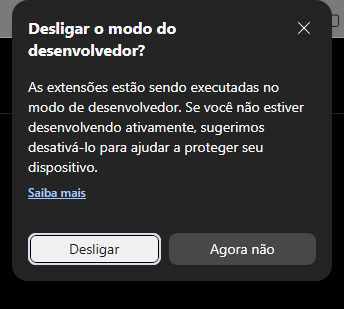
Hello everyone, I am currently running Windows Insider Preview (Build 26200) and I use Microsoft Edge as my primary browser. For my daily workflow, I need to keep Developer Mode permanently active because I run multiple local/unpacked extensions. Every single time the browser starts, I am greeted by the annoying popup: "Turn off developer mode extensions? Extensions are running in developer mode...". I've tried every advanced workaround available: modifying shortcuts with '--disable-features', tinkering with registry keys under 'Policies\Microsoft\Edge' (like ExtensionDeveloperModeSettings and ExtensionInstallAllowlist), but recent updates seem to have completely blocked these workarounds on the stable channel. Moving to Edge Dev or Canary shouldn't be the only solution just to avoid a startup prompt. Why can't Microsoft give us a simple, legitimate Registry Toggle to say "Yes, I know what I'm doing, stop asking me every day"? Is anyone else experiencing this frustration on recent builds, and has anyone found a clean way to whitelist local extensions without enterprise formatting errors? Thanks, André193Views1like2Comments
Edge sync failing on desktop
Hi! Edge sync on my PC (Edge 156.0.4314.56, Windows, personal Microsoft account) gets stuck in "Initializing" every time I restart the browser. Signing out and back in fixes it, but only until I restart again. In edge://sync-internals, the encryption key downloads fine after signing in, but after a restart "Has Keystore Key" goes back to false and Edge never requests the key again, so sync never starts, and it's actually very annoying. I noticed it on October 29 and have already sent feedback through Alt+Shift+I. Is anyone else seeing this, or is there a fix that doesn't require signing out every time?222Views0likes3Comments
TypeError: Cannot read properties of undefined (reading 'media_size')
Since version 153.0.4234.48 (Official build) (64-bit) was released and installed on my machine on 9/18/2026 I've been getting the following error while using Edge to debug a Web Application in Visual Studio 2022: TypeError: Cannot read properties of undefined (reading 'media_size') Thead: edge://print StackTrace: at ei.updateSettingsValues (edge://print/index.js:5:91848) at ir.onSelectedDestinationCapReady (edge://print/index.js:3935:3913) at Object.handleChange (edge://print/index.js:3935:175) at or.notify (edge://print/index.js:1:20564) at Kr.notify (edge://print/index.js:1:20736) at Ae.updateDestination (edge://print/index.js:5:51222) at s (edge://print/index.js:5:53037) at Ae.onCapabilitiesSet (edge://print/index.js:5:53089) Source modules: edge://print/index.js c7754cdafbaf1eb70a049a157e46719b4bd6bd79117bb1ad6fc57a38b51bca24 I thought it had to do with the print JavaScript code I was doing, but any page I try to print from the "..." Print menu options does the same thing. The error doesn't occur in Firefox and appears to be caught and ignored in Chrome.461Views0likes3Comments
【Sync Issue】Edge Sync Stuck on “Setting up sync” on All PCs for One Microsoft Account
English Version Problem Description Microsoft Edge sync is stuck on “Setting up sync” and never completes. The issue appears to be associated with one specific Microsoft account. I have tested multiple devices and accounts, and the results consistently point to an account-specific issue rather than a problem with a particular PC. Troubleshooting Results Same account, multiple PCs: The same account cannot complete Edge sync on multiple different PCs. It remains stuck on “Setting up sync.” Different accounts, same PC: When I sign in with another Microsoft account on the same PC, Edge sync works normally. Same account, mobile device: Sync works normally on the mobile version of Edge using the affected account. Consistent results: The problem follows the same account across multiple PCs, while other accounts sync normally on the same computers. Affected account: mailto:email address removed for privacy reasons Request for Assistance Could this issue be related to the account's server-side sync status, account configuration, or sync data? Is there a way for Microsoft Support to check the sync status of this account or reset its server-side sync state if necessary? Since I have already tested multiple PCs and different accounts, I would appreciate assistance in investigating a possible account-specific sync issue. Thank you for your help! 中文版本 问题描述: 我的 Microsoft Edge 账号同步功能出现异常,登录后一直显示“正在设置同步”,无法正常完成同步。 目前已通过多组测试确认,问题似乎与特定账号有关,而不是某一台电脑或单一设备的配置问题。 已确认的测试结果: 同一账号,不同 PC: 在多台不同的 PC 上登录同一个账号,均无法完成同步,一直停留在“正在设置同步”。 同一 PC,不同账号: 在出现问题的同一台 PC 上切换到其他 Microsoft 账号,Edge 同步功能可以正常使用。 同一账号,手机端: 该账号在手机端可以正常同步。 问题具有一致性: 目前测试结果表明,异常始终跟随同一个账号出现。 出现问题的账号: mailto:email address removed for privacy reasons 希望获得的帮助: 请问这种情况是否可能与账号的同步服务状态、服务器端配置或账号同步数据异常有关? 是否有办法检查该账号的同步状态,或者重置账号在服务器端的同步状态? 我已经进行了跨设备和跨账号测试,希望微软技术支持人员能够协助进一步排查账号层面的问题。 感谢帮助!250Views0likes2CommentsEdge Sync Persistent Failure
Subject: Edge Sync Persistent Failure: "Our services aren't available" on syncreset page and Sync Engine stuck on "Initializing" Hi everyone, I’m seeking urgent help regarding a persistent Microsoft Edge sync issue that has lasted for several days across 5 different devices (4 Windows PCs and 1 iOS device). The Symptoms: Sync Engine Deadlock: On all my Windows devices, the edge://sync-internals page shows the Transport State as "Initializing" or "Backed off". The Total Entries often drop to 0, or it shows Network error (ERR_CONNECTION_CLOSED). Server-Side Lockdown: I am unable to access the Edge sync reset page (https://edge.microsoft.com/syncreset) from ANY browser or ANY network environment (including mobile data and different VPN nodes). It consistently returns: "Our services aren't available. We're working to restore all services as soon as possible. Please check back soon." Question: Since the syncreset page is unavailable globally for my account, it seems to be a back-end identity/gateway issue rather than a local client error. Has anyone else encountered this "Services aren't available" error on the reset page recently? Is there a way to force a server-side sync container refresh when the official reset tool is down?629Views0likes6Comments