compliance
966 TopicsWindows 11, version 26H2 security baseline
Update: The Windows 11, version 26H2 security baseline has been updated to reflect the general availability of Administrator protection. An updated v2 package is now available, and organizations should review and test the existing Administrator protection configuration as appropriate for their environment. You can download the baseline package from the Microsoft Security Compliance Toolkit, test the recommended configurations in your environment, and customize / implement them as appropriate. Summary of Changes This release includes several changes since the Security baseline for Windows 11, version 25H2 to further strengthen enterprise security and align the baseline with current platform capabilities and industry standards. Security Policy Change Summary Printer\Configure Windows Ready Print driver ranking Configured as “Enabled” to reduce reliance on third-party print drivers in the stack, narrowing the overall print driver attack surface. Internet Explorer\Internet Control Panel\Advanced Page\Turn off encryption support Updated from TLS 1.1 and TLS 1.2 to TLS 1.2 and TLS 1.3 to align with current security standards. User Account Control: Configure type of Admin Approval Mode (updated) Configured as “Admin Approval Mode with Administrator protection” to enable Administrator protection. User Account Control: Behavior of the elevation prompt for administrators running with Administrator protection (updated) Configured as “Prompt for credentials on the secure desktop” to require credential verification for administrative elevation. Windows Ready Print driver ranking Configure Windows Ready Print driver ranking" is the newly added setting under Administrative Templates\Printers to control whether Windows prefers the modern inbox IPP class driver over third-party OEM drivers when installing new printers. We recommend enabling this policy to reduce reliance on third-party print drivers in the stack, narrowing the overall print driver attack surface. Note that driver ranking applies when printers are installed via a connection method that supports IPP, such as USB or network multicast discovery. In those cases, if the printer supports IPP, Windows will install using the class driver even if a vendor V3/V4 driver is available. If the printer doesn't support IPP, or is installed directly as a TCP/IP printer, there's no change in behavior. Encryption Support We have updated the policy "Turn off encryption support" to allow only TLS 1.2 and TLS 1.3. Previous baseline releases permitted TLS 1.1 and TLS 1.2; however, TLS 1.1 is now considered obsolete and is no longer recommended for enterprise environments. This change aligns the security baseline with modern cryptographic standards while maintaining compatibility with widely deployed services that support current TLS versions. Administrator Protection (update) Administrator protection is now generally available. Organizations can enable it through Microsoft Intune or Group Policy. Important: Organizations should review and test their existing configuration and adjust these settings as appropriate for their environment. The security baselines for Windows 11, versions 24H2, 25H2, and 26H2 include settings that enable Administrator protection. The following policies are part of the security baseline: User Account Control: Configure type of Admin Approval Mode User Account Control: Behavior of the elevation prompt for administrators running with Administrator protection An updated v2 package has been published for Windows 11, version 26H2, to reflect this change. Please let us know your thoughts by commenting on this post or through the Security Baseline Community.Secure Data at Microsoft Ignite 2026: Plan Your Experience
We're excited for you to join us at Microsoft Ignite 2026, our biggest event of the year! As organizations scale Microsoft Copilot, Cowork, and AI agents, one question keeps coming up: is our data ready? This post is your one-stop Ignite guide to sessions on data security and activities we have planned, so you can learn how Microsoft Purview helps prepare, manage, and protect data as you scale AI adoption. Visit Microsoft Ignite homepage to learn more, register, and build your agenda. When: November 17–20, 2026 Where: Moscone Center in San Francisco, plus a digital event experience online Types of sessions Here’s a quick overview of what types of sessions there are so you can decide which ones to join that will get you to the next step in your data security journey: Keynotes: The opening keynote is on Tuesday, November 17, from 10:00 AM to 12:00 PM PT, live from the Chase Center in San Francisco and online. Hear Microsoft's latest announcements and get a preview of what's coming across AI, cloud, security, and data. Breakout sessions: Expert led L200–L400 sessions with best practices, tips, and deep technical information, open to both in-person and online attendees. Labs: Expert led sessions that give you hands-on experience with our technology in a virtual environment. You'll need to reserve a seat. Late night labs run Tuesday and Thursday evenings, from 6:15 to 7:30 PM PT. Theater sessions: 25-minute technical deep dives with demos of product features, held inside the Hub. Lightning talks: Informal 15-minute sessions designed to spark conversation, questions, and discussion. Table talks: Small-group technical conversations that extend and deepen what you learn in the formal sessions. Microsoft Purview breakout sessions Day / time (PT) Session What you'll learn Wed, Nov 18 | 11:30 AM–12:15 PM BRK346: Protect data and accelerate AI adoption with Microsoft Purview Learn how Microsoft Purview provides unified data security and compliance to help you identify risk, protect sensitive data across Microsoft 365 and Copilot, and accelerate investigations — so you can scale AI securely and confidently. Wed, Nov 18 | 4:15–5:00 PM BRK348: From understanding sensitive data to protecting it Secure AI starts with understanding your data. Discover how Microsoft Purview uses AI-powered classification and sensitivity labels to identify sensitive content, automate protection, and help organizations confidently scale Copilot adoption. Thu, Nov 19 | 9:00–9:45 AM BRK342: Secure data and manage AI risk for Microsoft Copilot Chat and Cowork Confidently deploy and scale Microsoft Copilot Chat and Cowork. Explore how Microsoft Purview helps you understand and protect sensitive data, reduce oversharing risk, govern permissions and investigate incidents, to secure your AI-powered workplace. Thu, Nov 19 | 11:30 AM–12:15 PM BRK211: Secure and govern Microsoft Copilot Chat and Cowork Microsoft Copilot and Cowork are transforming how employees and agents work together, creating new opportunities and new governance challenges. Learn how to secure, govern, and manage Copilot & Cowork across your organization using Microsoft's integrated security, compliance, and governance capabilities. We'll cover protecting sensitive data, reducing oversharing risks, meeting regulatory requirements, and gaining visibility into usage so you can confidently scale Copilot & Cowork adoption. Thu, Nov 19 | 4:00–4:45 PM BRK329: Get your data AI-ready: Discover and mitigate sensitive data exposure risks As AI accelerates access to information, organizations need stronger protections for sensitive data. Learn how Microsoft Purview combines classification, permissions insights, and controls to reduce oversharing and secure data across AI. Thu, Nov 19 | 4:00–4:45 PM BRK335: Insights from Microsoft's journey to prepare its data for AI adoption Before deploying Copilot broadly, Microsoft focused on the fundamentals: understanding sensitive data, managing access, reducing oversharing risks, and establishing governance. Learn the strategies and lessons from our AI readiness journey. Fri, Nov 20 | 10:15–11:00 AM BRK338: Protect and govern data to scale your AI agents with Microsoft Purview AI agents can access data and automate work at unprecedented scale. Learn how Microsoft Purview helps discover agent activity, protect sensitive information, detect risk, and meet compliance requirements for a growing landscape of AI agents. Fri, Nov 20 | 11:30 AM–12:15 PM BRK347: Microsoft Purview: Scale data protection with sensitivity labels As data grows and AI accelerates how quickly it’s accessed, shared, and used, organizations need a scalable way to protect sensitive information. Microsoft Purview sensitivity labels provide persistent protection and context that travels with your data. Learn how to build an effective labeling strategy and use auto-labeling to automate protection and prevent oversharing in Microsoft 365 Copilot interactions. Microsoft Purview lab and theatre sessions Day / time (PT) Session What you'll learn Tue, Nov 17 | 6:15–7:30 PM; Wed, Nov 18 | 8:30–9:45 AM; Wed, Nov 18 | 12:00–1:15 PM; Fri, Nov 20 | 9:00–10:15 AM LAB685: Deploy Copilot with confidence: Find and protect exposed sensitive data Prepare your organization for secure AI adoption. In this hands-on lab, assess oversharing risks, identify exposed sensitive data, apply labels and policy controls, and validate that Microsoft Copilot can scale without exposing critical information. Wed, Nov 18 | 10:10–10:35 AM THR878: Secure exfiltration gaps with Microsoft Purview Data Loss Prevention Learn how Microsoft Purview provides unified data security and compliance to help you identify risk, protect sensitive data across Microsoft 365 and Copilot, and accelerate investigations — so you can scale AI securely and confidently. Microsoft Purview Lighting Talks Day / time (PT) Session What you'll learn Tue, Nov 17 | 4:25–4:40 PM LTG1234: Beyond data classification: Understanding human and data interactions Data security goes beyond knowing what's sensitive. It's understanding how people interact with data, where insider risk may emerge, and whether that activity fits the business need. Learn why user-data interactions are critical to reducing risk and securing AI. Thu, Nov 19 | 11:00–11:15 PM LTG1243: Turn global regulations into operating control with Microsoft Purview Regulatory demands are outpacing evidence. Understand how Microsoft Purview turns global AI and data requirements into assigned actions, operating protections, and reviewable records across data security, insider risk, and compliance management. Thu, Nov 19 | 12:15–12:30 PM LTG1241: Stay audit-ready for every AI interaction with Microsoft Purview Effective governance requires visibility. Learn how Microsoft Purview helps organizations track agent activity, support investigations, and maintain the auditability and evidence needed to satisfy compliance requirements. Microsoft Purview Table Talks Day / time (PT) Session What you'll learn Wed, Nov 18 | 1:20–2:05 PM TT2531: Protecting AI in real time: Ask the experts Effective governance requires visibility. Learn how Microsoft Purview, Defender, and Entra help organizations track agent activity, understand data access, support investigations, and maintain the auditability and evidence needed to satisfy compliance requirements Wed, Nov 18 | 3:30–4:15 PM TT2533: What's next for Microsoft Purview? Join this interactive community table talk to explore what’s next for Microsoft Purview. Share your feedback on protecting data across Microsoft 365, Copilot, and AI agents—and help shape the future of integrated data security and compliance. Thu, Nov 19 | 9:00–9:45 AM TT2534: Microsoft Purview AMA: Preparing your data for secure AI Bring your questions and join the conversation. In this interactive table talk, discuss real-world challenges, best practices, and lessons learned for classification and labeling. Explore how organizations are building the data foundation needed for secure AI adoption. More ways to connect at Ignite Visit the Hub: Stop by the Hub at the Moscone Center campus (November 17–19) to explore booths, catch theater sessions, and connect with Microsoft experts. Visit the booth area during Hub drop-in hours to ask questions, see live demos firsthand, and get practical guidance to make the most of your Ignite experience. Attendee Hours Mon Nov 16 – Tue Nov 17 12:00 PM – 6:00 PM Wed Nov 18 8:30 AM – 5:00 PM Thu Nov 19 8:30 AM – 6:00 PM Pre-day sessions and labs: Get a head start on Monday, November 16 with hands-on pre-day training designed to help you build skills you can put into action right away. Get certified: Eligible in-person attendees can take one Microsoft or GitHub certification exam at no cost, subject to the offer terms. Registration is required, so reserve your slot early. Can't make it in person? Register for the digital pass to stream keynotes and sessions online and catch up on demand after the event. Build your agenda We can't wait to see you at Ignite! Head to the homepage to register, add the Microsoft Purview sessions above to your schedule, and reserve your seat for LAB685 before it fills up. Learn more about Microsoft Purview Discover Microsoft Purview: Explore how Microsoft Purview helps you secure and govern data and manage compliance. Explore Microsoft Purview Explore technical documentation: Find guidance and resources to get started with Microsoft Purview. Browse Microsoft Learn Stay up to date with the latest innovations: Discover the latest Microsoft Purview announcements and innovations from Ignite 2026. Read the blogThe CISO Cheat Sheet to Microsoft Digital Defense Report 2026
I know we’re all busy, so I’ve pulled the most important data from this year’s Microsoft Digital Defense Report into one short read. The full report is well worth exploring, but this article focuses on the numbers and trends most relevant to security leaders. This year’s edition shows that AI is lowering the time, expertise and cost required to discover and exploit weaknesses, enabling attackers to operate with greater speed, scale and autonomy. The report describes this as AI “changing the physics of cybersecurity”: attack timelines are compressing and agentic systems are beginning to automate more of the attack lifecycle. Trend 1: Time has collapsed The clearest finding is about speed. Vulnerability discovery is increasingly running ahead of remediation, while the time from discovery to weaponisation is shrinking. In the AI era, weaponisation can follow in hours. Vulnerability discovery and weaponisation now often needs only a well-written prompt. The median time from discovery in the wild to weaponisation is below 24 hours. Vulnerabilities were on track for a record estimated 72,000 CVEs in 2026. The report expects a multi-year period in which the number of known but unpatched vulnerabilities rises sharply before eventually declining. The median time from container start to first exploit attempt is 5.3 hours. The ransomware actor Storm-1175 moved from web-facing exploitation to deploying Medusa ransomware in as little as 24 hours. CISA added over 110 CVEs to its Known Exploited Vulnerabilities catalogue between November 2025 and May 2026, most within a week of disclosure. The mismatch with enterprise reality is the uncomfortable part. The report says the disclosure-to-exploitation window has shrunk to single-digit days. Between November 2025 and May 2026, CISA added more than 110 vulnerabilities to its Known Exploited Vulnerabilities catalogue, most within a week of disclosure. In one example, Storm-1175 moved from exploiting a web-facing vulnerability to deploying Medusa ransomware in as little as 24 hours. Microsoft’s Red Team makes an important point: a patch is also a disclosure. Every fix points attackers towards the flaw it closes. As AI-assisted analysis makes reversing patches faster and more reliable, the report argues that patch velocity, not simply patch availability, becomes the control that matters. Trend 2: Attack chains are gaining autonomy The report charts a clear progression: September–November 2025: AI assists in orchestrating a campaign, as in the Anthropic-reported espionage case. April–June 2026: Full-chain autonomy is demonstrated in labs. July 2026: Real-world autonomous attacks of increasing complexity appear. Two frontier models, Mythos and GPT-5.5, completed a 32-step attack chain against an emulated enterprise with no human help. The test environment had no defenders. The UK AI Security Institute reached a similar finding independently. GPT-5.5 was the second model to solve its end-to-end corporate network attack simulation, a task AISI estimates would take a human about 20 hours. Open-weight models lag closed models at orchestrating attacks by about seven months. In the wild, early July 2026 saw the first documented automated ransomware extortion attack, named JADEPUFFER by Sysdig. Microsoft has seen AI-orchestrated intrusions that share elements with it. Initial access consistently came from internet-exposed services running known-vulnerable software. The report is measured on this point. Volumes of AI-orchestrated activity remain low. In most observed real-world operations, complex end-to-end intrusions still retain meaningful human direction. The Red Team's framing is the most useful one: AI doesn't create a new class of attack, it collapses the effort needed to find and exploit existing attack paths. Trend 3: AI has become an attack surface The report's second takeaway is that attackers are already targeting AI itself. The adoption numbers explain why. 88% of enterprises are experimenting with agents, and 82% of leaders plan broader rollouts within 12–18 months. The report cites industry projections of roughly 1.3 billion agents in production by 2028. What attackers are doing to AI systems: Four techniques accounted for roughly 90% of observed attack activity in telemetry from Azure AI workloads: malicious link injection (52%), jailbreaks (16%), tool and agent abuse (12%), and identity and credential abuse (10%). Memory poisoning: An attacker who can place content anywhere an agent reads can often place it where the agent remembers. Email is the dominant pathway the Red Team has observed. Human-in-the-loop isn't a complete control: Red team testing saw approval prompts ignored, or bypassed by a policy stored in poisoned memory. Developer tools turned against their owners: The "s1ngularity" malware hijacked locally installed AI command-line tools to hunt for secrets. It leaked about 2,000 secrets and 20,000 files across 225 victims. AI browsers: In daily use at more than 40% of organisations in Microsoft's dataset, they were the initial infection vector in incidents involving 57 malware families in a May 2026 analysis. Chat histories as a target: Malicious AI-assistant extensions reached nearly 900,000 installs and more than 20,000 enterprise tenants, harvesting AI chat histories that often contain code, architecture and credentials. The identity implications are direct. Each agent needs its own identity, not one borrowed from an employee, and a named human sponsor. The report also treats revocation latency, the time to cut off a compromised agent, as a measured outcome. Trend 4: The front door is still identity AI changes the speed and personalisation of social engineering. It hasn't changed where attacks start. Initial access in Defender Experts data: User execution: 30% Valid accounts: 20% Malicious copy-and-paste: 13% Phishing: 11% Together, user execution and valid accounts account for over half of observed activity. In incident response engagements, phishing as an initial access vector jumped from 7% to 23% year on year. The standout numbers: ClickFix: Defender saw user-pasted malicious commands on more than 1.1 million unique devices between February and early May 2026, roughly an 8x increase. AiTM: URLs accounted for 45% of the identified phishing techniques in the report’s breakdown. Separately, the share of AiTM phishing and token-theft attacks more than doubled during the first six months of 2026, although the report notes that their overall share remained comparatively small. Teams vishing: Weekly confirmed malicious volume increased 502% year on year. Per attempt, 48% of vishing calls kept the victim engaged for more than 20 seconds, and 30% lasted more than one minute. When a call succeeds, attackers can persuade the victim to install a remote-management tool and complete reconnaissance in two minutes or less. Business contact impersonation (BCI): The report introduces this term for conversations that start with a trusted-looking contact. Microsoft detected more than 46 million attacks in 12 months, with a 121% spike in April 2026. The share of first-contact messages that explicitly asked for money or documents fell from 17% to 3%. The first message is deliberately bland, like "Are you at your desk?" Password attacks declined 26% year on year, which the report describes as strong evidence that MFA and passkeys are forcing attackers to pivot. That pivot includes techniques such as fatigue attacks, AiTM phishing and token theft designed to circumvent conventional MFA. Trend 5: Attackers are inheriting trust rather than breaking in The report's headline theme is that risk is increasingly interconnected. Threats travel through the trusted relationships between identities, software supply chains, partners and cloud platforms. The numbers: Supply chain: Major open-source ecosystems saw attacks roughly every ten days, accelerating through Q2 2026. Shai-Hulud 2.0 affected 25,000 repositories. Megalodon backdoored 5,561 GitHub repositories in under six hours. Trusted signing: In May 2026, Microsoft disrupted Fox Tempest, a "malware-signing-as-a-service" operation that obtained genuine certificates for ransomware loaders and infostealers. Microsoft revoked over a thousand fraudulent code-signing certificates. Legitimate access: An unsanctioned remote monitoring tool is now one of the most reliable mid-stage indicators of a human-operated intrusion. Cloud identity: Cloud identity abuse was the most observed technique against critical infrastructure, representing 78% of the technique mix in Microsoft’s data for March to June 2026. Hybrid intrusions: The Storm-2885 case showed an attacker using a privileged cloud identity to close and downgrade security alerts. The report says identity governance and alert-handling workflows deserve Tier 0 treatment. Dwell time: DART data shows a statistically significant increase in dwell time year on year, meaning organisations took longer to detect intrusions. Ransomware shows the same ecosystem pattern. Qilin led leak-site data with 16.4% of victims, up 386%. Defender detections tell a different story, with Akira at 22%. Trend 6: Defence works best when it's connected The report is not only a catalogue of threats. The strongest defensive evidence: Disruption works. Following the March 2026 disruption, Tycoon2FA activity had fallen 95% from its November 2025 peak by June. Its share of CAPTCHA-gated phishing declined from 76% in December 2025 to 12% in June 2026. Correlation is the highest-leverage variable. The report argues that how well defenders share and correlate signals across endpoint, identity, cloud, email and network is one of the highest-leverage strategic variables under their control. AI is also changing defensive operations. The report describes AI-assisted triage, incident summarisation, hunting-query generation and detection engineering as ways to accelerate investigations and allow analysts to concentrate on higher-value work. Automated disruption can compress response time. The report says that when a correlated incident reaches a defined confidence threshold, defensive systems can automatically isolate devices, disable compromised accounts, revoke sessions or quarantine affected cloud resources. It also stresses the importance of appropriate governance and human oversight for high-risk AI actions. The report also recommends changing what leaders measure. It suggests moving from patches deployed to exposure reduced, detection coverage increased and time-to-mitigate compressed. What the MDDR recommends: ten security priorities The report starts its recommendations with the foundations: Secure by Design, Secure by Default and Secure Operations, applied through identity-centric Zero Trust. Microsoft says these keep the priorities below durable as AI adds more identities, applications, agents and dependencies to govern. Govern cyber risk at leadership level. Report identity exposure, patch latency, agent permissions, critical dependencies, dwell time and recovery readiness to the board. Defend identity as the primary control plane. Deploy passkeys and phishing-resistant MFA, reduce privilege and govern human and non-human identities. Invalidate and rotate tokens and session credentials quickly. Establish governance, visibility and data controls for AI. Keep visibility of approved AI tools, services and agents, and monitor for unauthorised or unmanaged use. Apply sensitivity-aware access and data protection to the data those systems can reach. Reduce exposure and edge risk. Continuously discover internet-facing assets and patch edge devices quickly. Centralise high-fidelity logging, enforce strong authentication and combine network visibility with threat intelligence. Focus on cross-signal correlation. Correlate endpoint, identity, cloud, application, email and network signals to detect intrusions earlier. Correlation also helps defenders anticipate attack paths and likely targets. Enact a continuous threat and vulnerability management model. Combine asset visibility, vulnerability identification, threat detection and AI-accelerated insight into a single continuous programme. Validate exposure through proactive testing. Run assume-breach exercises on cloud services, SaaS platforms, APIs and workflow automation. Prioritise them by where your highest-value data is stored, accessed or aggregated. Secure software dependencies. Harden software installation, keep a software inventory and validate provenance. Monitor packages and prepare for rapid containment. Participate in collective defence. Share actionable threat indicators and victim-informed intelligence with trusted partners and law enforcement. This supports coordinated tracking, investigation and disruption. Prepare for long-horizon technology transitions. Build a cryptographic inventory and advance post-quantum planning alongside AI governance. Read together, the numbers tell one story: the attacker’s workflow is becoming faster and less expensive. AI can shorten vulnerability discovery, exploitation, secret discovery and lateral movement, while organisations still face the slower operational work of testing, coordinating and deploying safe changes across complex environments. At the same time, agent identities can proliferate faster than organisations can inventory, govern and revoke them The defining question for boards today is not whether disruption will occur, but whether the organization can continue operating, contain harm, recover quickly, and maintain trust when it does. Source: Microsoft Digital Defense Report 2026, Version 1.1. Reporting period: July 2025–June 2026.
M365 Admin Center Global Administrator Lockout
Hello Microsoft Community, I am seeking urgent assistance and guidance regarding a critical Microsoft 365 tenant lockout that has been ongoing for several days without a resolution or proper communication from the support team. Our organization manages Microsoft 365 services for a business with more than 200 active users who depend on Microsoft 365 for their daily operations. Issue Description We have been locked out of our Microsoft 365 tenant's administrator account. This prevents us from properly managing our Microsoft 365 environment and restoring normal access to essential business services. Our business-critical data, including important documents and operational information, is stored in SharePoint. The inability to access and manage these services has significantly disrupted our business operations. Microsoft Support Ticket References We have raised multiple support tickets and followed up repeatedly, but the issue remains unresolved. Tracking ID: 2610050040001149 Tracking ID: 2610090010001066 Tracking ID: 2610050040001222 Despite these support cases and repeated follow-ups, we have not received a satisfactory resolution or a clear recovery timeline. Support Experience So Far Following a discussion with the support team, we were expecting a call to assist with unlocking the administrator account and providing a temporary password through the appropriate recovery process. However, we have not received the expected call or a meaningful update. Our main concerns are: Complete loss of access to the Microsoft 365 tenant administrator account. More than 200 users affected by the ongoing incident. Critical business data and documents stored in SharePoint. Multiple support tickets without a concrete resolution. Lack of clear communication regarding the root cause and recovery timeline. No clear escalation path or confirmation of the next recovery steps. Our Concerns We understand that technical issues can occur, but leaving a business-critical environment inaccessible for an extended period without meaningful updates is extremely concerning. We purchase Microsoft 365 licenses through a partner and expect appropriate technical support and escalation assistance when critical incidents occur. Our organization previously used Google Workspace and recommended migrating to Microsoft 365 because of its enterprise capabilities. This incident has seriously affected user confidence and business continuity. If access cannot be restored promptly, we may have to consider alternative email hosting arrangements to minimize further disruption. Request for Assistance I would appreciate guidance from Microsoft engineers, Microsoft 365 administrators, and community members who have experienced similar situations. What is the appropriate escalation process when all available tenant administrator accounts are inaccessible? How can we expedite tenant ownership verification and administrator account recovery? Is there a dedicated Microsoft team that handles critical tenant lockout incidents affecting business operations? What is the recommended recovery process when the administrator cannot access the Microsoft 365 Admin Center? How can we obtain urgent assistance when multiple support tickets and repeated follow-ups have not resulted in a clear resolution? Can the three referenced support tickets be escalated for urgent review by the appropriate Microsoft support team? We are not looking for workarounds that compromise tenant security. We need Microsoft's official recovery process to restore authorized administrative access safely. Microsoft Support Team: If any Microsoft support representatives are monitoring this community, we would appreciate your guidance on the appropriate escalation channel for this incident. We can provide additional information privately through the appropriate official channels. Thank you for your time and assistance. Any guidance that helps us restore our services and protect business continuity would be greatly appreciated. Best regards, Microsoft 365 Tenant Administrator273Views0likes1Comment
CSP Program enrollment was DEACTIVATED
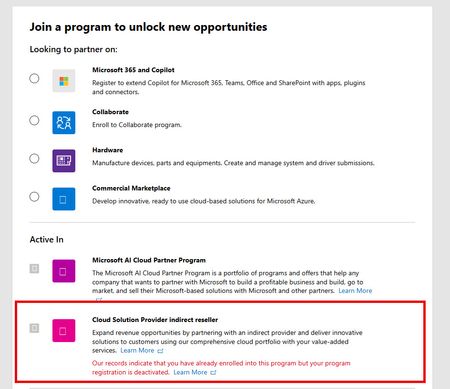
We are an active Microsoft reseller in the AI Cloud Partner Program. We were also enrolled in the CSP Indirect Reseller Program. Last year, our CSP enrollment was DEACTIVATED (not SUSPENDED and not TERMINATED). Of course, we got the typical response on our tickets when asking WHY we were deactivated stating that MS can walk away with no explanation. We BELIEVE it is because we had not sold at least $1000 in the previous 12 month period. Everything I read states that we can re-enroll 12 months after our "onboarding date" which I am not sure what that date is. We were deactivated around October 2025. The "Learn More" link doesn't really help, and focuses mostly on SUSPENSIONS which I believe is different. Even using that link, none of the reasons for a suspension apply to us other than the "program requirements" which is where the $1000 minimum comes from. Can anyone offer some additional guidance here? Thanks!
Verification closed, appeals exhausted, duplicate seller account. Need reopen.
We're a Delaware C corp ISV (Evident Systems Inc.) running an AI SaaS platform on Azure, trying to complete AI Cloud Partner Program and Commercial Marketplace verification for ISV Success. Our Partner and Developer verifications are both closed as Rejected with no appeals left. The trouble came from our address. We used a virtual office first, then switched to our Delaware registered agent address to match our incorporation documents. Neither met the requirement that the business exist at the stated address. Our real principal office is in South Carolina, where we hold a municipal business license and a state Certificate of Authority. Re-enrolling in Commercial Marketplace also created a duplicate seller account and extra business locations by mistake. Identity, email, and contact verification all passed. We have a support ticket open #2611040040007807. Could someone from Partner Vetting reopen our case, confirm we should update the legal address to our principal office, and merge the duplicate seller accounts? We will hold all changes until a reviewer confirms, so we don't trigger another automated rejection. Global Partner ID: 7176457 Thank you.Cybersecurity in 2026: Is Zero Trust Enough to Defend Against AI-Powered Threats?
As cyber threats become more sophisticated, organizations are increasingly adopting Zero Trust architectures, identity-based security, and AI-powered threat detection. But an important question remains: Are our existing security strategies evolving fast enough to address the next generation of cyberattacks? Microsoft has developed a comprehensive security ecosystem through Microsoft Defender XDR, Microsoft Sentinel, Microsoft Entra ID, and Microsoft Intune. These technologies provide powerful capabilities for identity protection, endpoint security, threat detection, and incident response. However, attackers are also leveraging automation, generative AI, and increasingly sophisticated social engineering techniques. I'd like to open a discussion around five important questions: 1. Zero Trust implementation: Are organizations genuinely implementing Zero Trust principles, or are many simply deploying security products without changing their underlying security architecture? 2. AI-powered threats: How prepared are Microsoft security environments to detect AI-assisted phishing, identity attacks, and automated intrusion attempts? 3. Microsoft Defender and Sentinel: What practical improvements have security teams experienced by integrating Microsoft Defender XDR with Microsoft Sentinel? 4. Identity as the new perimeter: With hybrid workforces and cloud-based infrastructure, should identity security now take priority over traditional network perimeter protection? 5. Autonomous security operations: How much authority should AI-powered security agents have to investigate threats, isolate devices, disable accounts, or initiate incident response actions without human approval? One of my biggest concerns is that organizations may invest heavily in cybersecurity tools while overlooking the fundamentals: visibility, configuration management, access governance, employee awareness, and incident response readiness. Security is no longer just about preventing unauthorized access. It's about building resilient systems that can detect, contain, recover from, and continuously adapt to emerging threats. I'd be interested to hear from security architects, SOC analysts, Microsoft MVPs, and IT administrators: What do you consider the biggest cybersecurity challenge facing Microsoft-based enterprise environments today, and what practical steps should organizations prioritize in 2026? Looking forward to your insights and real-world experiences.290Views0likes3Comments
Error 2100 during MAICPP enrollment – Legal info blank
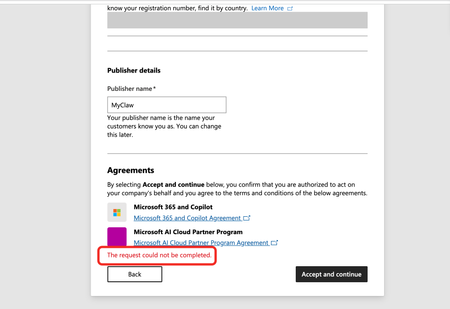
Issue: I'm stuck at the Agreements step of the Microsoft AI Cloud Partner Program (MAICPP) enrollment. When I click Accept and continue, the page displays: The request could not be completed. No further details are provided (no reference number, no transaction ID). Evidence of orphaned legal entity (error 2100): After the failed submission, I navigated to Settings → Account settings → Organization profile → Legal info, and the page renders only the title and description text—no tabs, no form fields, completely blank (screenshot attached). This matches the documented symptom of error 2100 / orphaned legal entity: the backend created a legal entity record during the first submission attempt, but it was never linked to a program enrollment. Subsequent attempts to accept the agreements fail because the system tries to create a duplicate entity. Environment: Tenant ID: 70a418c9-dca7-4bf3-90b0-765294ae60aa Verified domain: http://myclaw.ai/ Publisher name: MyClaw Account type: Company Submitting user role: Global Administrator Target program: Microsoft AI Cloud Partner Program (MAICPP) Goal: Obtain Partner ID → apply for Verified Publisher in Entra ID Already tried: Clearing cache, incognito mode, different browsers – no change Checked Identifiers page – also blank (no Partner ID, no publisher table) Cannot use the standard support form (requires a workspace, which I don't have until enrollment completes) Cannot use the no-login support form (Submit button fails) Request: Please manually clear the orphaned legal entity record or link the existing entity to the MAICPP enrollment, so I can complete the registration. Attached screenshots: "The request could not be completed" error at the Agreements step Legal info page rendering no tabs Thank you.316Views1like3Comments
MAICPP Partner roaster synchronization Issue - Technofocus Levelup Campaign Eligibility
Hello Community Team and Moderators, I am posting to seek guidance and visibility regarding an active Partner Operations support request (Case #2610290050004098) regarding campaign roster synchronization for our organization, Belvit Hub (Partner ID: 7157172). Context & Status: Partner Status: Belvit Hub’s Microsoft AI Cloud Partner Program (MAICPP) enrollment is active, and legal entity vetting was authorized on September 24, 2026. Issue: 500+ candidates from our organization participating in the Technofocus LevelUp / Certification Week campaign are receiving an "Ineligible Domain" block when attempting to register for exam vouchers. Vendor Feedback: Technofocus (LevelUp) support confirmed in writing that their portal cannot manually override domain eligibility and that they are waiting for an updated partner eligibility roster refresh from Microsoft Skilling Operations. Partner Support engineer Hesham Ali has initiated an internal consultation to route this to the relevant internal team. We are posting here to ask if community moderators can assist in ensuring this roster update reaches the Skilling Operations team so our candidates can access their exam vouchers. Thank you for your assistance. Reference Details: Partner Name: Belvit Hub Partner ID (MPN): 7157172 Support Ticket: #2610290050004098