ai
592 Topics
Your Agents Need More Than a Place to Run
In architecture reviews with enterprise teams moving their first agentic applications toward production, I often hear the same plan: the team has containerized their agent and intends to run it on the managed Kubernetes cluster the organization already trusts. The reasoning is sensible, since the platform team knows the tooling and security has approved the network model, and for the first use case or two it is often the right call. Having watched this unfold in my years leading AgenticAI customer engineers and forward deployed engineers, and now helping customers reach production on Azure, I want to describe what happens next, before leaders commit rather than after. One thing to note is Azure supports multiple ways to build and operate agents. Foundry Agent Service provides an integrated managed runtime around your agent code. Azure Kubernetes Service supports teams that need Kubernetes-level control or want to extend an established platform, while Azure Container Apps provides managed container hosting. These services can work together. The decision is which capabilities and responsibilities best fit the workload. Where the cluster is the right answer A stateless retrieval application, a document extraction pipeline, or a classification job is a web service that happens to call a model, and a container platform runs web services well. A large retail customer of mine ran an invoice extraction agent on containers for over a year with almost no issues, and I never suggested they move it. The cluster remains the right home for several other situations as well. LLM invocations embedded inside existing microservices, event driven, or batch pipelines fit container platforms naturally. Genuine constraints such as air-gapped or sovereign environment, regions where a managed service is not yet offered are a good reason to run your own stack, and strong engineering team that already operates at that level can be a real asset. Even when the agents themselves move to a managed runtime, the tool servers, business APIs, and data services those agents call, often stay on your cluster, so they are complementary far more often than they are competitors. The problem is that these early wins can make agents seem like just another workload. Where the wheels come off The first failure is the state. A research agent that plans, searches, and synthesizes for ninety minutes is a long-running stateful process, while a Kubernetes pod is a disposable container the scheduler may restart at any time. A financial services team I worked with lost costly research run to a routine node upgrade, and responded as capable engineers do by building checkpointing, a durable store, and a resume mechanism. It worked, but they now owned a piece of infrastructure they had to keep correct as their agent's framework changed beneath it. A managed agent runtime absorbs this. Hosted agents in Foundry Agent Service, as one example, give every session a VM-isolated sandbox with a persistent file system, a durable state store that survives crashes and restarts and can hold checkpoints for frameworks such as LangGraph or Microsoft Agent Framework, and a resilient execution mode that recovers long-running work after a process interruption. The second is the human-in-the-loop. A commercial insurance customer’s claims agent needed sign-off from an adjuster and sometimes a second reviewer, with days between steps. Stopping an agent cleanly at the moment it needs a decision, holding its full session for four days without paying to keep it running, and resuming it correctly when the approval arrives is not something a container orchestrator gives out the box. The team built agent session suspend and resume, a queue, a durable state store, notifications, and an approval interface, and ended up with a small workflow engine nobody had planned to own. In hosted agents, an idle session is deprovisioned with its state persisted and restored onto fresh compute when the same session ID returns, so an agent waiting on an approval cost nothing while it waits, and sessions are retained for up to thirty days of inactivity. The approval experience remains yours to design, which is where your engineers' time should go. The third is multi-turn conversation, which quietly pushes teams into building their own context management system. The first version appends each turn to history, and within few turns the history outgrows the context window while cost and latency climb. So, the team adds truncation, then summarization, then retrieval of earlier turns, then per-user and per-tenant scoping, then expiry and deletion rules for privacy. An industrial customer's safety compliance assistant, with conversations stretching across days, followed exactly this path and ended up with a bespoke thread store and summarization pipeline nobody had budgeted for. Its first serious incident came when a summary silently dropped a compliance-relevant instruction. With the Responses protocol in hosted agents in Foundry, conversation history is a durable, platform-managed record keyed by a conversation ID and reachable from any channel, so the thread store is no longer yours to build, although deciding what to summarize or retrieve remains a design choice for your agent. The fourth is identity. On a cluster, the path of least resistance is a shared service account, and in one review a security architect asked which actions had been taken on behalf of which user, only to learn that the logs could not say. Hosted agents create a dedicated Microsoft Entra agent identity for each agent at deploy time, use on-behalf-of flows to act with the user's delegated permissions in interactive scenarios and the agent's own identity in autonomous ones, and keep the agent identifiable for audit in both cases. The fifth is per-user session isolation, which is the difference between an agent that serves many people and an agent that mixes them up. Agents read files, run code, and hold working data, and on a shared pod the default is that many users share a process, a file system, and often a cache. Giving every user session its own sandboxed environment and storage, so that one person's documents and intermediate results can never surface in another's, means engineering hard isolation boundaries and proving them to your security team. Hosted agents make a VM-isolated sandbox per session the default, and their durable state store can partition items per end user, so one store is safe to share across the users of a multitenant agent. And lastly, Evaluation and optimization are where the gap widens. The largest difference between teams that scale and those that stall is evaluation. Because agents are probabilistic and multi-step, staging tests often miss failures such as a wrong tool choice or a policy violation deep in a task. One customer’s agent passed every offline check but degraded unnoticed for weeks after a model update because evaluation stopped at release. Mature teams continuously evaluate production traces, combine automated judges with sampled human review, and red-team regularly.Once quality is measurable, teams can deliberately balance prompts, models, tools, latency, and cost. One team cut per-task cost by routing simple steps to smaller models after evaluation confirmed quality held. Self-built stacks require teams to assemble and maintain tracing, datasets, judges, and release gates. Hosted agents instead combines default OpenTelemetry traces with continuous evaluation, adversarial testing, and datasets generated from agent instructions. Staged closed-loop optimization uses those traces to improve instructions, tool descriptions, and model selection without extra plumbing. The real cost is the velocity gap Leaders usually expect me to quantify the initial build, and that is the smaller number. A team of four building the first agent often becomes ten or twelve within a year, and a growing share of them are maintaining a runtime for agents rather than building agents that serve the business. The enterprise has quietly created an internal agent infrastructure company in a field where the patterns for memory, tools, evaluation, and safety are rewritten every few months, while hyperscalers put hundreds of engineers on exactly this problem and ship at a cadence no single platform group can match. Foundry Agent Service, for instance, bundle content safety guardrails into the runtime and route outbound traffic through a customer virtual network, capabilities that platform teams otherwise assemble one integration at a time. This plumbing does not differentiate your organization, so the question is whether your scarcest engineers should spend years on it or on the workflows, data, and judgment only your company has. This is also why the technology companies held up as examples are a poor template. Many built their own runtimes because managed options did not yet exist and had large platform organizations to carry the load. Even they tend to invest in a custom runtime for the first handful of use cases and then migrate as managed services mature, because the maintenance burden compounds while the strategic value of owning the plumbing does not. What I would do as the leader I am not arguing against Kubernetes or for moving everything tomorrow. Comparable managed runtimes exist across the hyperscalers, and I use hosted agents as the running example only because it is the one I know best from the inside. Managed agent services are still maturing, some workloads have real data residency or customization needs, and abstraction always constrains something. What I am arguing for is a deliberate choice for each use case, guided by three questions: whether the agent must outlive a single request by running long, waiting on humans, or remembering across sessions whether it must act with its own identity, auditable delegation, and policy enforcement whether your team would be building anything a managed service already provides, and who will still maintain it in two years. Key takeaways Match the runtime to the workload. Containers on your existing cluster suit stateless, short-lived agents, while long-running, human-in-the-loop, and memory-dependent agents need capabilities your platform team was never hired to build. Count the hidden team. The real cost of self-hosting is the growing group of engineers maintaining state, identity, memory, guardrails, and tracing instead of solving business problems. Make evaluation continuous and connected to production traces. Pre-release testing alone will miss the drift and trajectory failures that hurt you, and optimization of quality, cost, and latency depends on that evaluation data. Follow the pattern of the leaders, not their early architecture. Companies that built custom runtimes did so before managed options matured, and most of them move toward managed services as those options improve. A practical place to begin is your roadmap for the next twelve months. Sort each use case into stateless and short-lived or long-running and human-dependent, and for every agent in the second group put a price on the engineers who would maintain the runtime rather than the business logic. I would like to hear how you have drawn this line, and where a managed service was not yet ready for something you needed.199Views1like0CommentsVoice agents in Foundry Agent Service: architecture, trust boundaries, and real-audio latency
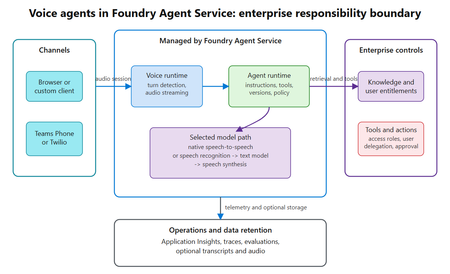
Assess where voice agents in Foundry Agent Service simplify the runtime, where enterprise trust boundaries remain, and what a 300-turn real-audio benchmark reveals about latency across six configurations.184Views0likes0CommentsCopilot, Microsoft 365 & Power Platform Community call
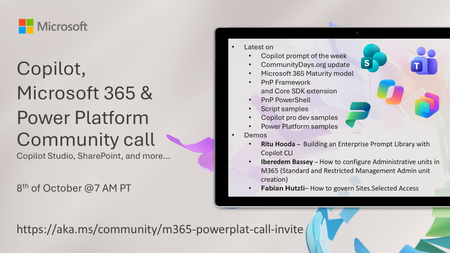
💡 Copilot, Microsoft 365 & Power Platform weekly community call focuses on different use cases and features within the Microsoft 365 and Power Platform - across Microsoft 365 Copilot, Copilot Studio, SharePoint, Power Apps and more. Demos in this call are presented by the community members. 👏 Looking to catch up on the latest news and updates, including cool community demos, this call is for you! 📅 On 8th of October we'll have following agenda: Latest news and events from Microsoft Topics Copilot prompt of the week CommunityDays.org update Microsoft 365 Maturity model PnP Framework and Core SDK extension PnP PowerShell Script samples Copilot pro dev samples Power Platform samples Demos this time Ritu Hooda – Building an Enterprise Prompt Library with Copilot CLI Iberedem Bassey – How to configure Administrative units in M365 (Standard and Restricted Management Admin unit creation) Fabian Hutzli – How to govern Sites.Selected Access 📅 Download recurrent invite from https://aka.ms/community/m365-powerplat-dev-call-invite 📞 & 📺 Join the Microsoft Teams meeting live at https://aka.ms/community/m365-powerplat-dev-call-join 💡 Building something cool for Microsoft 365 or Power Platform (Copilot, SharePoint, Power Apps, etc)? We are always looking for presenters - Volunteer for a community call demo at https://aka.ms/community/request/demo 👋 See you in the call! 📖 Resources: Previous community call recordings and demos from the Microsoft Community Learning YouTube channel at https://aka.ms/community/youtube Microsoft 365 & Power Platform samples from Microsoft and community - https://aka.ms/community/samples Microsoft 365 & Power Platform community details - https://aka.ms/community/home 🧡 Sharing is caring!55Views0likes0CommentsCopilot, Microsoft 365 & Power Platform product updates call
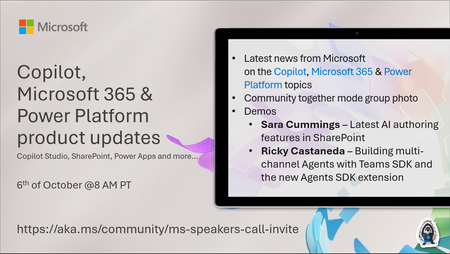
💡Copilot, Microsoft 365 & Power Platform product updates call concentrates on the different use cases and features within the Microsoft 365 and in Power Platform. Call includes topics like Microsoft 365 Copilot, Copilot Studio, Microsoft Teams, Power Platform, Microsoft Graph, Microsoft Viva, Microsoft Search, Microsoft Lists, SharePoint, Power Automate, Power Apps and more. 👏 Weekly Tuesday call is for all community members to see Microsoft PMs, engineering and Cloud Advocates showcasing the art of possible with Microsoft 365 and Power Platform. 📅 On the 6th of October we'll have following agenda: News and updates from Microsoft Together mode group photo Sara Cummings – Latest AI authoring features in SharePoint Ricky Castaneda – Building multi-channel Agents with Teams SDK and the new Agents SDK extension 📞 & 📺 Join the Microsoft Teams meeting live at https://aka.ms/community/ms-speakers-call-join 🗓️ Download recurrent invite for this weekly call from https://aka.ms/community/ms-speakers-call-invite 👋 See you in the call! 💡 Building something cool for Microsoft 365 or Power Platform (Copilot, SharePoint, Power Apps, etc)? We are always looking for presenters - Volunteer for a community call demo at https://aka.ms/community/request/demo 📖 Resources: Previous community call recordings and demos from the Microsoft Community Learning YouTube channel at https://aka.ms/community/youtube Microsoft 365 & Power Platform samples from Microsoft and community - https://aka.ms/community/samples Microsoft 365 & Power Platform community details - https://aka.ms/community/home 🧡 Sharing is caring!75Views0likes0CommentsHow to make AI responses faster on Microsoft Foundry: lessons from 2,040 measurements
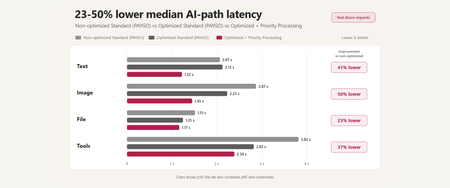
A reproducible Microsoft Foundry performance study covering prompt caching, multimodal input, tool orchestration, MCP lifecycle, Toolbox tool search, and Priority Processing - with correctness and reliability measured alongside latency.297Views0likes0CommentsWhen AI Starts Taking Action: Building Execution Boundaries with OpenSandbox and AKS
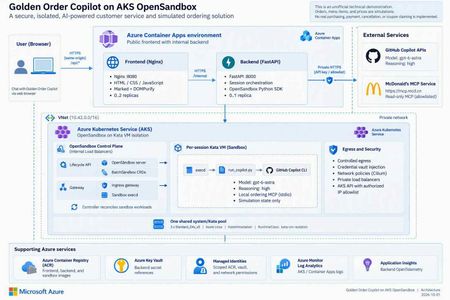
1. An agent needs more than a smarter model Imagine you are building a food-ordering assistant. In its first version, it says, “You might enjoy a burger and fries.” That is primarily a content-generation problem. In the next version, it queries coupons, reads a menu, calculates prices, creates files, and calls a local program to create an order. The engineering problem has changed. You are no longer asking a model to speak. You are allowing software to act on someone's behalf. This is a distinction I emphasize in technical talks: model capability determines what the agent can propose; the execution platform determines where, with which permissions, and for how long those proposals can become actions. Running every agent's tool processes inside the business API container creates awkward coupling. Leftover files, stuck processes, dependency changes, or excessive resource consumption from one session can affect another. Even if customers cannot invoke an arbitrary shell, CLI processes, tool dependencies, and temporary state still need boundaries. A sandbox is therefore not an instruction that says “please be safe.” It is a working environment with a lifecycle, a resource budget, and an access policy. Figure 1. A tool protocol, a working environment, and runtime isolation solve different problems. 2. Separate three concepts that often get conflated MCP describes tool interaction; it does not put tools inside a VM The Model Context Protocol gives model-facing applications a consistent way to discover and invoke tools. But “called through MCP” does not automatically mean “executed within a security boundary.” An MCP server can run on a developer's laptop, in a business-service container, remotely, or in a dedicated sandbox. Whether a tool can write data, who may invoke it, and how its side effects can be reversed are separate design questions. OpenSandbox makes the working environment an application resource OpenSandbox is an open-source platform for agent execution environments. It exposes sandbox lifecycle, command execution, file operations, and network-access capabilities. Applications use SDKs and APIs to create environments, run work, retrieve results, and clean up. Docker supports a local starting point; Kubernetes provides a cluster deployment path.1 Think of it as a workspace management system: it allocates a room, delivers materials, exposes ways to work, and reclaims the room at the end of its lease. The strength of the walls depends on the runtime and deployment underneath. OpenSandbox is not a language model, not a replacement for Kubernetes, and not synonymous with Kata. The upstream project also provides pools, multiple runtime paths, and snapshot-related capabilities. Availability, state semantics, and infrastructure requirements must be checked against the selected version and runtime. A project-wide feature list is not a promise that every backend behaves identically.1, 5 Kata adds a separate guest kernel to the sandbox pod Conventional containers generally share the host kernel. Kata Containers runs workloads in lightweight virtual machines, adding a VM boundary. With AKS Pod Sandboxing, the isolation unit is the pod using the Kata runtime, with its own guest kernel.2, 3 That does not mean every container in the same pod gets its own VM. Nor does a VM replace application authentication, outbound restrictions, or business approvals. The useful summary is: MCP defines the tool interface. OpenSandbox manages the working environment. Kata provides runtime isolation. The application still owns authorization and business rules. 3. What does “per-session Kata VM” actually isolate? In this project, a session is identified by session_id. The backend creates an OpenSandbox sandbox for a new session, and its pod selects the Kata RuntimeClass. Later requests in the same session reuse that environment. Several distinctions matter: It is not a new VM for every message. Related turns can reuse files and temporary state produced by the tools. It is not an Azure VM purchased for every user. Kata pod VMs run on AKS nodes; multiple sandboxes can share a node's underlying compute resources. It is not one sandbox per node. Capacity depends on resource settings, VM overhead, system components, and concurrent work. A session ID is not authorization. It identifies routing and resource mappings; production services must validate session ownership. My favorite analogy is a campus: AKS is the campus, nodes are buildings, Kata sandboxes are workrooms, and OpenSandbox is the workspace management system. A session repeatedly uses the same room; a lifecycle policy eventually clears it. That final step matters. Files surviving between turns does not mean they survive sandbox deletion. Orders, code artifacts, or audit records that must outlive the environment need explicit, governed persistence. Figure 2. This project hosts its frontend and backend in regular ACA, and OpenSandbox/Kata on AKS. Model inference is called through an external API, not hosted on the AKS nodes. 4. OpenSandbox on AKS: installation is not the finish line Kubernetes supplies scheduling and declarative resource management. OpenSandbox turns that infrastructure into sandbox operations that an application can consume. The execution path in this project is: The FastAPI backend requests a sandbox through the OpenSandbox SDK. The lifecycle service creates a BatchSandbox resource. The controller reconciles that declaration into a sandbox pod. The pod starts with the Kata runtime. The SDK accesses execd through the gateway for command and file operations. Deletion or expiration reclaims the sandbox. The upstream Kubernetes operator also supports pool allocation. However, warming an image in this sample is not the same as maintaining a ready-to-allocate pool of sandbox instances. Cached image layers and ready idle sandboxes are different latency optimizations.5 4.1 Declare the runtime, then verify the running boundary The important part of the project's BatchSandbox pod template is: spec: runtimeClassName: kata-vm-isolation nodeSelector: kubernetes.azure.com/kata-vm-isolation: "true" securityContext: seccompProfile: type: RuntimeDefault This is a fragment of the pod template, not a complete manifest that works independently of cluster prerequisites. The deployed example uses one shared system/Kata pool: three Standard_D4s_v5 Azure Linux nodes with KataVmIsolation, created through AKS API 2026-07-01. The model is gpt-6-astra accessed through GitHub Copilot APIs; this is not a GPU model-serving deployment. To avoid confusing “Kata appears in the configuration” with “the boundary is working,” deployment checks inspect the actual pool properties, three Ready nodes, the RuntimeClass, and the guest kernel inside a temporary Kata pod. The kernel check is a deployment acceptance signal, not a formal proof of the entire system's security. 4.2 More platform control also means more platform ownership OpenSandbox on AKS gives a team control over its runtime, images, network layout, and application integration. It also leaves the team responsible for node capacity, image provenance, control-plane upgrades, resource budgets, observability, recovery, and removal of temporary installation privileges. For simplicity, this demonstration uses a shared system/Kata pool. Three nodes are not presented as a high-availability guarantee. A production design should reconsider dedicated system and workload pools, zones, quotas, and tenant separation rather than copy the demonstration's footprint. 4.3 Credentials should be usable without being casually readable Credential Vault is especially interesting here. The trusted backend supplies credentials and bindings to OpenSandbox's egress sidecar. The Copilot workload process receives placeholders; the proxy injects authentication into matching outbound HTTPS requests.4 Precision matters: this reduces the workload's direct access to long-lived credentials; it does not make credentials disappear from the system. The backend and egress sidecar remain in the trusted computing base. It would be inaccurate to claim that real credentials can never exist anywhere within the pod VM. Preventing a model from reading a token also does not prevent misuse of operations authorized by that token. This project still restricts remote tools to read-only operations and uses exact hostname bindings for credential injection. Production systems should further scope operations, paths, tenants, and data. The upstream guide also explains that Kubernetes pause/resume can recreate the sidecar, requiring a trusted client to repopulate its in-memory vault.4 That distinction is valuable: restoring compute state, restoring identity context, and restoring business permissions are different operations. 5. Before comparing ACA Sandbox, stop treating it as another name for Dynamic Sessions Azure Container Apps includes several compute models: Model Primary concern Regular Container Apps Web apps, APIs, continuous services, and replica scaling Jobs Tasks that start, run, and complete Dynamic Sessions Isolated execution through a session pool and identifier Sandboxes Explicit lifecycle, state, and policy control over individual environments The current official overview describes ACA Sandboxes as a distinct resource model. A Microsoft.App/SandboxGroups resource is the management boundary for sandboxes, disk images, snapshots, volumes, and related resources. Documented capabilities include suspend/resume, memory and disk state, ports, egress policies, and Azure Blob/Data Disk volumes.6 Integration has its own control-plane contract: ARM manages sandbox groups, while the Sandboxes data plane manages individual instances, files, and related resources. The documentation requires a Microsoft Entra ID identity and the Container Apps SandboxGroup Data Owner role for sandbox management, assigned at an appropriate scope rather than granting broad access by default. These platform access requirements still do not replace your application's end-user authentication and authorization.6 Dynamic Sessions centers on Session Pool + identifier. A pool allocates a session, routes related requests to it, and reclaims it according to lifecycle and cooldown settings. Context can survive while that session exists; calling it “completely stateless per request” would be misleading. But it is not the same abstraction as a workspace with explicit snapshot and volume management.7, 8 There is also a release-status caveat. At the time of review, Microsoft Learn described these Sandboxes capabilities, while Microsoft's earlier repository documentation still carried an Early Access label and warned that early resources might need recreation.9 This article does not infer universal GA or regional access, nor does it treat the older “SDK coming soon” wording as current. Verify access, SDKs, RBAC, networking options, and service terms before adoption. Figure 3. This is an ownership comparison, not a security rating or performance ranking. 5.1 A comparison that helps make a decision Dimension OpenSandbox on AKS: this project's path ACA Sandboxes ACA Dynamic Sessions Main object OpenSandbox sandbox and Kubernetes workload Sandbox group and individual sandbox Session pool and identifier Platform operations Team operates OpenSandbox and configures AKS workloads/nodes; Azure still manages the AKS control plane Azure manages underlying infrastructure; the app explicitly manages sandbox lifecycle Azure manages pool allocation and session lifecycle Isolation This project explicitly selects Kata pod VMs Documented independent security boundary; this article does not infer a particular open-source runtime Officially documented Hyper-V isolation State Temporary per-session state here; upstream persistence/snapshot paths need separate configuration and validation Explicit suspend, resume, snapshots, and volumes Context while a session exists; treat state as ephemeral after reclamation Images and tools Custom images, CLI, MCP, and runtime policy OCI images converted to root filesystems; validate workload compatibility Built-in interpreters or custom container pools Network and credentials Team combines private networking, egress policy, Vault, and app authorization Service identity/network/policy capabilities; do not assume equivalence to OpenSandbox Vault Pool access and network controls; app owns identity and tool authorization Startup experience Depends on cache, scheduling, runtime, and initialization; no instant-start guarantee in this sample Documentation describes prewarmed subsecond startup/restore; measure your own workload Documentation describes low-latency prewarmed allocation; distinguish spare pool capacity from cold starts Team fit Kubernetes expertise and a need for deeper runtime control Managed infrastructure with explicit workspace state control Managed execution sessions without managing every environment's full lifecycle The ACA entries describe documented capabilities, not measurements from this project.6, 7, 8 A shared OCI image format does not make SDKs and APIs interchangeable. The existing backend depends on OpenSandbox creation, command-log, health, credential-proxy, and deletion semantics. Moving it to ACA Sandboxes requires mapping and testing those contracts, not changing an endpoint URL. Cost is also more than a price per hour. A useful measure is total cost per successfully completed task: execution resources, warm capacity, state storage, images, networking, logs, model usage, and operational effort. ACA documentation says stopped sandboxes incur no CPU/memory fees; that does not zero the bill for the application, storage, or dependencies. Deleting an AKS sandbox does not eliminate fixed node costs either.6 6. How I would choose for different scenarios Scenario A: upload a CSV and ask AI to run a short analysis If work is brief, the built-in runtime is sufficient, and state can be discarded afterward, I would evaluate Dynamic Sessions first to reduce platform work. Generated code remains untrusted input, and downloadable outputs still need content and authorization checks. Scenario B: a coding agent that works across turns and time This agent may need dependencies, a source tree, and process state. A user leaves, the environment pauses, and work continues later. ACA Sandboxes' explicit lifecycle is a compelling capability to validate. The design must still decide what may enter a snapshot, how credentials are reauthorized after restore, and how deletion policies meet business obligations. Scenario C: an enterprise with an established AKS platform If a team needs existing Kubernetes governance, runtime control, custom toolchains, or a platform built around a unified sandbox API, OpenSandbox on AKS is attractive. Its benefit is control and composability, not the assumption that open source removes operating costs. Scenario D: the agent only calls a governed business API If there is no generated-code execution, local tool process, or temporary filesystem requirement, a sandbox per user may be unnecessary. A regular ACA API with authentication, server-side permissions, and a well-defined tool gateway can be simpler. Not every agent needs a sandbox platform. These choices are not mutually exclusive. Our project uses regular ACA for the lightweight web/API layer and AKS for the execution plane. Different task classes could eventually use different execution backends, provided identity, lifecycle, results, and error contracts are explicit. 7. The concrete example: an ordering assistant that does not place real orders Project: kinfey/aks_opensbx_ghc_demo. This is an unofficial McDonald's-themed technical demonstration, not an official service or a real transaction system. Its value is not that AI can recommend a burger. It places several boundaries in an understandable business story: Application boundary: a public Nginx frontend and an internal FastAPI backend. Execution boundary: per-session OpenSandbox/Kata running Copilot CLI and local MCP. Operation boundary: selected read-only remote queries; order creation exists only in local simulation tools. Credential boundary: placeholders in the CLI workload, with authentication injected for allowed requests by a trusted egress proxy. Presentation boundary: original Markdown preserved in transit and sanitized before browser rendering. Figure 4. Querying external information and writing a simulated order are different paths, even when they appear in the same conversation. 7.1 What should a reasonable interaction look like? The following is an illustrative workflow, not an invented transcript of a live customer: A user asks, “Check current offers, then calculate a simulated meal.” The backend creates or reuses the session sandbox. Copilot invokes a read-only remote MCP tool for official offers rather than inventing them. Local get_menu and calculate_order tools price the simulation, clearly distinguished from official quotes. The assistant displays items and the total and asks for confirmation. Only after confirmation does it call local create_order, producing an explicitly simulated order. Session completion or the idle policy triggers sandbox cleanup; the order file is not retained as a durable business record. The tool rejects confirmed=false. Its limit should also be clear in any technical presentation: an agent-supplied boolean is not an independently authenticated, auditable purchase-approval system. Real commerce would require server-verifiable authorization bound to a user and the exact order contents. The current backend keeps session mappings in memory, runs at most one replica, and does not provide public user login or authenticated session ownership. These are demonstration constraints, not a production multitenancy template.10 7.2 Three lessons from making it work First: startup latency is not one number. An initial pull of the roughly 2.8 GB sandbox image took almost six minutes. That delay was not slow model inference, and it could not simply be attributed to feature approval. We moved image warmup outside the user request path and waited for actual execd health. End-to-end latency = queue/scheduling + image pull + guest startup + certificate/proxy setup + CLI startup + model/tool execution + result transport and rendering This is why a documented subsecond allocation from warm capacity should not be compared directly with one cold image pull in this project. A meaningful evaluation controls the image, cache state, concurrency, region, and measurement boundary, then tracks percentiles, failure rates, and cost per successful task. Second: a working isolation boundary does not guarantee a working data contract. We encountered a deceptively simple issue: the web renderer supported Markdown, but real replies still had no proper tables. CSS was not the problem: Copilot's default terminal output had already converted Markdown tables into character borders. Execd's line-oriented logging removed the terminators from nonempty lines. The fix extracted original assistant content from CLI JSONL, encoded it in a single-line JSON envelope across command logs, and decoded it back into Markdown in the backend. Marked and DOMPurify then preserved tables, headings, and code without inserting arbitrary model-generated HTML directly into the page. Third: acceptance must cover the real path. A browser test with a fixed reply proves that the renderer works, not that model output survives the CLI, logs, and API. The project added a live-model test that checks raw Markdown, actual DOM tables, mobile layout, and confirmed sandbox deletion.11 Similarly, successful remote tool use should be established from tool-execution events, not merely from the model saying “I checked.” The broader engineering rule is the same: prove completion with structured results and actual side effects, not a success-shaped sentence. 8. What I would add before calling this production I would not start by adding more tools. I would answer five questions: Question Required design Who owns the session? Authentication, tenant binding, server-side session ownership, and resource authorization Which state deserves to survive? Separate temporary workspace files, durable artifacts, business orders, and audit records Who may cause side effects? User approval bound to contents, idempotency, and auditable authorization beyond model instructions Where can the system fail? Stage-level startup metrics, admission control, budgets, timeouts, retries, and resource reclamation Can the execution backend change? Contract tests for create, execute, files, credentials, state restoration, and deletion For the last question, ACA Sandboxes is a worthwhile alternative backend to evaluate. But it should be a measured migration experiment with a deliberate identity design, not an untested promise of a seamless swap. Closing thought: an agent platform puts capability inside boundaries OpenSandbox gives applications an abstraction for working environments. AKS and Kata let a team implement that abstraction on observable, configurable infrastructure. ACA Sandboxes and Dynamic Sessions offer managed alternatives with different levels of operational ownership. I prefer to rewrite the selection question as three questions: What do we need to control? What are we willing to operate? How will we prove that execution completed as intended? Those questions are more useful than a simple “self-hosted versus serverless” debate. A reliable AI application needs both a capable model and a workspace with clear boundaries, a reclaimable lifecycle, and an auditable record of what happened. Further reading and scope Full deployment instructions: English README. Runnable source: project repository. The four diagram sets are original technical illustrations. imgs/ contains Chinese and English PNGs, scalable SVGs, and matching editable .excalidraw files. They are not benchmarks or product certifications. Resource descriptions are generic. Supply your own AZURE_RESOURCE_GROUP, AKS_NAME, and other configuration when reproducing the deployment. Sources OpenSandbox: scope, SDKs, runtimes, and examples Kata Containers: lightweight VM isolation OpenSandbox Credential Vault: broker and restore semantics, pinned revision OpenSandbox Kubernetes operator: BatchSandbox, Pool, snapshots, pinned revision Azure Container Apps Sandboxes overview Azure Container Apps Dynamic Sessions overview Official comparison of Dynamic Sessions and Sandboxes Microsoft's earlier ACA Sandboxes Early Access documentation This project: session management and runtime boundaries This project: real-reply end-to-end browser test185Views0likes0Comments
Your Agent Shouldn't Wait for a Prompt: Build an Event-Driven Microsoft Foundry Routine
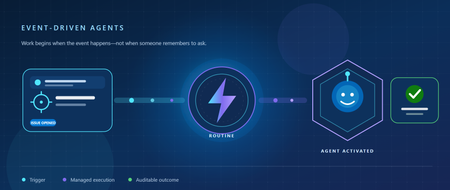
Most agents are still waiting in a chat window. They may be capable of classifying an incident, finding the right documentation, or recommending an owner - but nothing happens until someone remembers to ask. The hard part is no longer always the reasoning. It is noticing that work has arrived, invoking the agent securely, and keeping enough history to understand what happened. Routines in Microsoft Foundry close that gap. A routine connects a trigger - such as a schedule, timer, GitHub issue, or Microsoft Teams message - to an agent action. Microsoft Foundry queues the invocation, runs the agent, and stores a run record for later inspection. In this post, we will build an event-driven routine for a familiar developer workflow: When someone opens a GitHub issue, invoke a triage agent immediately - without waiting for a person to copy the issue into a chat. Along the way, we will look at the architecture, create the routine with the Azure Developer CLI (azd), test it, inspect its run history, and make an explicit identity decision before putting it into production. From conversational agents to event-driven agents A chat-first agent follows a request-response pattern: A user opens an interface. The user provides a prompt. The agent performs work. The interaction ends or waits for another prompt. An event-driven agent starts differently. Work in an external system becomes the prompt. A newly opened issue, for example, already contains useful context: its title, description, author, repository, labels, and timestamps. A routine can receive that event through an authorized connection and invoke an agent while the context is still fresh. That changes the agent's role. It is no longer only a place people go for answers. It becomes a participant in an operational workflow. The routine does not replace the agent. It supplies the managed automation around it: Trigger: Defines when work starts. Connection: Authenticates the event source. Action: Identifies the agent and invocation protocol. Dispatch identity: Determines whose permissions are used when the agent and its tools run. Run history: Records executions so operators can inspect outcomes. This separation is useful. The agent owns the reasoning; the routine owns when and how that reasoning begins. The scenario: triage every new GitHub issue Our example assumes that a triage agent is already deployed in a Microsoft Foundry project. When an issue opens, the agent should: Summarize the issue in two or three sentences. Classify it as a bug, feature request, documentation issue, or support question. Estimate severity and explain the evidence. Recommend an owner or team. Identify missing reproduction details. Produce a proposed response for a maintainer to review. Keeping a human review step is intentional. Event-driven does not have to mean unrestricted autonomy. A routine can automate the expensive first pass while a maintainer remains responsible for labels, assignments, and public responses. Prerequisites You need: An active Microsoft Foundry project. The Foundry User role or higher on the project. A deployed prompt agent or hosted agent. Workflow agents are not currently supported by routines. The Azure Developer CLI. A GitHub connection authorized in the Foundry project. The routines extension for azd. Install the extension and confirm that the routine commands are available: azd extension install azure.ai.routines azd ai routine --help Set the project endpoint through your active azd environment or pass it explicitly to each command: azd env set AZURE_AI_PROJECT_ENDPOINT \ "https://<account>.services.ai.azure.com/api/projects/<project>" The agent must exist before you attach a routine to it. A routine references an agent; it does not deploy one. Create the GitHub issue routine The following command creates an enabled routine named triage-on-open. Replace the placeholders with the connection and repository details from your environment: azd ai routine create triage-on-open \ --trigger github-issue \ --connection-id "<workspace-connection-id>" \ --owner "<github-owner>" \ --repository "<github-repository>" \ --issue-event opened \ --action agent-invoke \ --agent-name "triage-agent" \ --description "Triage every newly opened GitHub issue" There are two important type translations in this command: The CLI alias github-issue represents the routine trigger type github_issue. The CLI alias agent-invoke invokes the agent through the Invocations API. If your agent uses the Responses API instead, use --action agent-response. Choose the protocol that matches the deployed agent rather than treating the two actions as interchangeable. For automation that belongs in source control, define the routine as an azure.ai.routine service in azure.yaml. This makes the relationship between the agent and its trigger reproducible across environments: services: triage-agent: host: azure.ai.agent project: ./agent triage-on-open: host: azure.ai.routine uses: - triage-agent description: Triage every newly opened GitHub issue enabled: true triggers: issue-opened: type: github_issue connection_id: ${GITHUB_CONNECTION_ID} owner: ${GITHUB_OWNER} repository: ${GITHUB_REPOSITORY} issue_event: opened action: type: invoke_agent_invocations_api agent_name: triage-agent Deploy the routine after the target agent: azd deploy triage-on-open --no-prompt The uses relationship tells azd to order the agent before the routine. Deployment is idempotent: redeploying updates the named routine instead of creating duplicates. Give the agent a clear triage contract Automation magnifies ambiguity. A vague instruction that is merely inconvenient in a chat can produce inconsistent work every time an event fires. Give the triage agent a bounded contract such as: You are the first-pass triage agent for this repository. For each newly opened issue: 1. Summarize the reported behavior without adding facts. 2. Classify it as bug, feature, documentation, or support. 3. Assign severity only when the issue contains supporting evidence. 4. List missing information needed to reproduce or route the issue. 5. Recommend an owner from the approved ownership map. 6. Draft a response, but do not publish, close, label, or assign the issue. Return structured JSON that matches the triage schema. A useful output contract might look like this: { "summary": "The CLI exits when a project endpoint contains an explicit port.", "category": "bug", "severity": { "level": "medium", "reason": "The issue blocks routine creation but has a documented workaround." }, "missing_information": [ "Azure Developer CLI version", "Redacted project endpoint shape", "Full error output" ], "recommended_owner": "developer-experience", "proposed_response": "Thanks for the report. Could you share..." } Structured output gives downstream systems something predictable to validate. It also makes evaluation easier: you can test category accuracy, required-field completeness, unsupported severity claims, and whether the agent attempted a prohibited action. Test before waiting for a real event Start by checking that Foundry stored the routine you intended: azd ai routine show triage-on-open --output json Confirm: The routine is enabled. The trigger watches the correct owner and repository. issue_event is opened. The action references the intended agent. The connection ID belongs to the expected Foundry project. You can manually dispatch a routine while testing: azd ai routine dispatch triage-on-open \ --input '{"test":true,"issue":{"number":123,"title":"Test triage event"}}' The manual input is a one-time override for that dispatch. It does not replace the event payload or modify the routine's stored configuration. Inspect recent executions: azd ai routine run list triage-on-open --top 20 Then open a test issue in the watched repository and inspect the run list again. A production test should verify more than "the agent ran." Check that the correct event started the run, the agent received enough context, tool calls used the intended identity, the output matched the schema, and prohibited actions did not occur. Choose the dispatch identity deliberately Every routine uses the agent identity by default. This is usually the better fit for unattended automation because access belongs to the agent rather than to an employee's account. Use agent identity when the agent's tools authenticate with managed identity, workload identity, or keys and the agent has been granted only the permissions required for the task. Some tools require delegated user access. In that case, you can create the routine with creator identity. Creator identity means the Microsoft Entra identity of the person or service principal that creates the routine—not the agent publisher, connection creator, latest editor, or user who caused an event. This distinction has operational consequences: If the creator loses access or consent, delegated tool calls can fail. Recreating the routine as another principal changes the delegated creator identity. The event connection identity is separate from the identity used to dispatch the agent. Dispatch identity is a creation-time decision. To switch an existing routine between agent and creator identity, delete and recreate it. For a GitHub triage flow, a strong starting design is: Use a narrowly scoped project connection to receive issue events. Use agent identity for Foundry and Azure resources. Keep repository-changing actions disabled until evaluation demonstrates reliable behavior. Require human approval before posting, assigning, labeling, or closing. Identity is not a deployment detail. It is part of the automation's behavior and should be reviewed with the same care as the prompt and tool list. Make failure visible An event-driven agent can fail even when its reasoning is sound. The connection might expire. The agent might receive an unexpected payload. A tool might lose permission. The output might violate its schema. Monitor the workflow at four boundaries: Trigger: Did the expected event fire the routine exactly once? Invocation: Did Foundry invoke the intended agent and protocol? Tools: Did tool calls succeed with the intended identity and scope? Outcome: Did the output satisfy the triage contract? Use azd ai routine run list for routine execution history and your agent's Foundry observability data for traces, tool calls, latency, and failures. Preserve representative failures as evaluation cases instead of fixing each incident only in the prompt. Also design for duplicate delivery. Before taking a repository-changing action, check whether the issue and event have already been processed. Idempotency matters more once an agent can act without a person initiating each run. Know the current boundaries Before adopting routines for a regulated or business-critical workload, review the current service constraints: Routines support prompt agents and hosted agents, but not workflow agents. A recurring schedule has a minimum interval of five minutes. GitHub issue triggers support opened and closed issue events. Routines inherit the project's networking configuration and can work with virtual-network-secured projects. Routines do not currently support customer-managed key encryption. Regional availability has exceptions; verify your project's region in the current documentation. These boundaries can change. Treat the routines documentation as the source of truth when moving from a tutorial to production. What changes when agents stop waiting? The most interesting part of this design is not the GitHub trigger. It is the change in operating model. The agent begins work because the world changed, not because someone opened a chat. That makes trigger scope, identity, output contracts, run history, evaluation, and human approval part of the agent design—not infrastructure to consider later. Once the triage routine is working, the same pattern can support: A Teams message that starts support classification. A nightly backlog review. A one-time release-readiness check. A scheduled compliance summary. A hosted agent that uses the reminder tool to resume the same conversation after a long-running task. Start with one bounded event and one reversible outcome. Measure what the agent does, not merely whether it ran. Then expand its permissions only as evidence earns that autonomy. Try it next Choose the path that matches where you are: Build: Follow the Microsoft Foundry routines documentation and connect one existing agent to a schedule or event. Harden: Review dispatch identity, connection scope, idempotency, output validation, and human approval before enabling repository-changing tools. Extend: Add the reminder tool to a hosted agent that needs to continue work later. Explore: Open the Microsoft Foundry portal to inspect your project, agents, and routine runs. Your agent already knows how to do useful work. The next step is teaching it when that work should begin.347Views2likes2CommentsUsing Jev with Agents in Microsoft Foundry for Model Evaluation
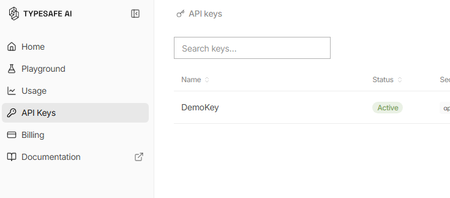
What is Jev? Jev is a new AI model from TypeSafe AI, first released in early access on 15 September 2026. TypeSafe describes Jev as its first “System One” model, designed specifically to make fast, structured decisions rather than generate free-form text. You provide Jev with some state or context and define the judgement you want it to make. It then returns a typed, probabilistic decision, such as: Choice: select from a defined set of options Score: evaluate something against an ordered scale Yes/No probability: determine the probability of a condition being true Unlike a conventional LLM, Jev gives up string generation in favour of type-safe structured values. Their description is essentially unstructured state in, typed probabilistic decisions out Why use Jev? Jev is particularly useful when an application needs to make a judgement rather than generate an answer. For example: Consistent evaluation against explicitly defined criteria Structured outputs that applications can consume directly Classification, assessment, routing and decision-support Agent workflows, where a judgement is required before taking an action Guardrails, such as assessing whether an agent should make a tool call Model routing, where a judgement determines which model or process should handle a request Every decision can also include a confidence or probability, allowing an application to use thresholds to decide when to proceed automatically or when further review is required. Jev and explainability Jev can provide a different approach to explainability for Model-as-a-Service (MaaS) and hosted LLM solutions. Traditional explainability techniques such as SHAP provide feature-attribution explanations for model predictions. Applying these techniques can be more difficult when the model is consumed solely through a hosted API and its internals are not available. Jev does not replace SHAP or provide the same type of feature-attribution explanation. Instead, it can be used as a separate judgement layer, evaluating an LLM's inputs, outputs or proposed actions against explicit criteria and returning structured decisions with confidence scores. For example: LLM generates an answer → Jev evaluates the answer → application decides what to do next This can provide a useful, measurable evaluation layer around otherwise opaque MaaS models. Could you do this with another LLM? Yes you could ask a conventional LLM to classify, score or evaluate an input and request structured JSON output. However, Jev has been purpose-built for this type of workload rather than general-purpose text generation. TypeSafe reports that Jev produces outputs in parallel rather than generating tokens sequentially, and its hosted service currently advertises typical decision latency of approximately 70–500 ms. Pricing As of September 2026, TypeSafe's documentation lists Jev 1.13 (jev-1.13.0) at $0.042 per million input tokens, with output tokens free. It lists rate limits of 250,000 tokens per second and 1,200 requests per minute, although TypeSafe states that these limits can change. As Jev produces decisions rather than generated text, you are effectively paying for the context it evaluates rather than for generated output. Pricing is subject to change and these figures are accurate only as of the date of this article Using Jev with Microsoft Foundry A useful pattern with Microsoft Foundry is to treat Jev as a specialised judgement/evaluation component alongside your generative models: User/Application → Foundry model or agent → Jev judgement → deterministic logic → action/response For example, a Foundry-hosted model could generate a proposed answer and Jev could evaluate that answer against predefined criteria before your application allows the workflow to continue. Here's how to set it up: First, you will need to apply for the preview for Jev from TypeSafe. Once you have an account you will need to create an API key Go to API keys in the menu and create a new key (copy the key for use in Foundry) You may also have received some free credit, which should be more than sufficient for experimenting with Jev given its low per-token cost. Next we go to Foundry and create a new agent for Jev In your agent, add a Tool and select OpenAPI tool as below Fill out the dialogue as follows You will have to create a new connection - The key should be in this format "Bearer apikey_<the rest of your key>" For the schema add this { "openapi": "3.0.3", "info": { "title": "TypeSafe Jev System One", "version": "1.1.0", "description": "Evaluate content using TypeSafe Jev System One." }, "servers": [ { "url": "https://api.typesafe.ai" } ], "paths": { "/v1/systemone": { "post": { "operationId": "evaluate_with_jev", "summary": "Evaluate content using Jev", "description": "Evaluate state against typed questions using TypeSafe Jev.", "security": [ { "bearerAuth": [] } ], "requestBody": { "required": true, "content": { "application/json": { "schema": { "type": "object", "additionalProperties": false, "required": [ "state", "model", "questions" ], "properties": { "state": { "type": "string", "description": "The original text or content for Jev to evaluate." }, "model": { "type": "string", "enum": [ "jev-latest" ], "default": "jev-latest", "description": "The TypeSafe Jev model. Use jev-latest." }, "questions": { "type": "object", "description": "A map of named questions for Jev to answer. Each question must be a Noul, Choice, or Score question.", "additionalProperties": { "oneOf": [ { "$ref": "#/components/schemas/NoulQuestion" }, { "$ref": "#/components/schemas/ChoiceQuestion" }, { "$ref": "#/components/schemas/ScoreQuestion" } ] } } } } } } }, "responses": { "200": { "description": "Successful Jev evaluation", "content": { "application/json": { "schema": { "type": "object", "additionalProperties": true } } } }, "400": { "description": "Invalid request" }, "401": { "description": "Authentication failed" }, "422": { "description": "Request validation failed" } } } } }, "components": { "schemas": { "NoulQuestion": { "type": "object", "additionalProperties": false, "required": [ "type", "instructions" ], "properties": { "type": { "type": "string", "enum": [ "noul" ] }, "instructions": { "type": "string", "description": "The yes/no question for Jev to evaluate." }, "criteria": { "type": "object", "additionalProperties": false, "properties": { "true": { "type": "string", "description": "Description of what a yes or value near 1 means." }, "false": { "type": "string", "description": "Description of what a no or value near 0 means." } } } } }, "ChoiceQuestion": { "type": "object", "additionalProperties": false, "required": [ "type", "instructions", "criteria" ], "properties": { "type": { "type": "string", "enum": [ "choice" ] }, "instructions": { "type": "string", "description": "The question for Jev to decide between the supplied choices." }, "criteria": { "type": "object", "description": "A map where each property name is a possible choice and its value describes that choice.", "minProperties": 2, "additionalProperties": { "type": "string" } } } }, "ScoreQuestion": { "type": "object", "additionalProperties": false, "required": [ "type", "instructions", "criteria" ], "properties": { "type": { "type": "string", "enum": [ "score" ] }, "instructions": { "type": "string", "description": "The attribute or question Jev should score." }, "criteria": { "type": "array", "description": "Ordered scoring levels from lowest to highest.", "minItems": 2, "items": { "type": "string" } } } } }, "securitySchemes": { "bearerAuth": { "type": "apiKey", "name": "Authorization", "in": "header" } } }, "security": [ { "bearerAuth": [] } ] } We are going to use Jev to assess complaints so our instructions for the Agent will be You are a customer-support triage agent. For every customer-support message you MUST call the evaluate_with_jev tool. IMPORTANT: When calling evaluate_with_jev, construct Jev questions using ONLY the following property names: For a Noul question: { "type": "noul", "instructions": "...", "criteria": { "true": "...", "false": "..." } } For a Choice question: { "type": "choice", "instructions": "...", "criteria": { "option1": "...", "option2": "..." } } For a Score question: { "type": "score", "instructions": "...", "criteria": [ "lowest level", "middle level", "highest level" ] } NEVER use these properties: - question - prompt - options - ordered_criteria Always use: - instructions - criteria For customer support tickets, ask Jev these three questions: billing: type = noul instructions = "Does this ticket concern billing, payments, charges, invoices or refunds?" criteria.true = "The issue concerns billing or a financial transaction." criteria.false = "The issue does not concern billing or a financial transaction." tone: type = choice instructions = "What is the customer's tone?" criteria: calm = "Neutral, polite or informational." frustrated = "Dissatisfied, impatient or inconvenienced." angry = "Strongly confrontational or extremely dissatisfied." urgency: type = score instructions = "How urgently does this ticket require attention?" criteria in this exact order: 1. "Can wait" 2. "Handle this week" 3. "Handle today" Always set model to "jev-latest". Pass the customer's original message as state. Do not classify the ticket yourself. Use the values returned by Jev. Always show the Jev output at the end of the response Now we can give a complaint and see what Jev says The room had no water in and one of the towels was dirty Response I’m sorry about the issues you experienced—no running water and a dirty towel are unacceptable. I’ll get this addressed right away. Immediate help I can arrange now: Send maintenance to restore water. Have housekeeping deliver fresh towels and re-service the bathroom. Provide bottled water immediately. If water can’t be restored quickly, arrange a room move. Please share: Your reservation name and room number Best contact number Whether there’s no water at all or only hot/cold is affected Whether you prefer immediate service or a room change If you’ve already left, let me know the date/time this happened so we can investigate and follow up. Jev output: { "model": "jev-1.13.0", "answers": { "billing": { "type": "noul", "noul": 0.02 }, "tone": { "type": "choice", "choice": "frustrated", "confidence": 0.6, "probabilities": { "frustrated": 0.74, "calm": 0.26, "angry": 0.0 } }, "urgency": { "type": "score", "score": 1.81, "confidence": 0.72, "legend": { "0": "Can wait", "1": "Handle this week", "2": "Handle today" }, "probabilities": { "0": 0.03, "1": 0.12, "2": 0.85 } } }, "usage": { "input_tokens": 466, "output_tokens": 75 } } We can now see both Jev's decision and the probabilities behind it. In this example, Jev determines that the complaint is very unlikely to be billing-related, identifies the customer's tone as frustrated, and gives a high probability that the issue should be handled today. This is where Jev becomes particularly useful in an agent workflow. Rather than relying on generated text to drive the next step, our application can use these structured probabilities to make deterministic decisions, such as routing the complaint, escalating it, or requiring human review when confidence falls below a defined threshold.From Jev to Your Laptop: Building "System One" Decision Models in ONNX with Mobius
0. Why I'm writing this now Two things landed on my radar in the same week. First, TypeSafe AI published "Introducing System One Models & Jev" (Sep 15, 2026) and the developer community immediately started arguing about it. The pitch is unusual: instead of another chat model, Jev is described as "a new class of frontier models built to make fast, structured decisions that software can use directly." The post frames Jev as "a frontier-intelligence function call: unstructured state in, typed probabilistic decisions out" — and notes that while "Jev gives up string generation, it's optimized for structured outputs and can't hallucinate." The numbers in that post are what got everyone's attention: end-to-end response times of 70ms–500ms versus 3–329 seconds for frontier LLMs, input tokens at $0.042/MTok with output tokens free, and a claim that every answer arrives with a calibrated probability — "higher confidence means higher accuracy." The name itself is a thesis: TypeSafe named Jev after William Stanley Jevons, expecting that "every order of magnitude drop in the cost of intelligence unlocks orders of magnitude more use cases." Second — and this is the part that matters for anyone who builds on Microsoft's AI stack — onnxruntime/mobius has been quietly shipping at a furious pace. It's the piece of infrastructure that makes it realistic to take a model like this, in whatever format it arrives, and run it as an ONNX graph on hardware you control. So I built the bridge. kinfey/JevONNX takes an open, community-fine-tuned model that reproduces the System One request shape, converts it from GGUF to CPU ONNX with Mobius, and serves typed probabilistic decisions locally. This post covers three things: what Mobius is, how it differs from the ONNX Runtime GenAI Model Builder you may already be using, and how the JevONNX sample puts it together. 1. What is Mobius? Mobius builds generative models in ONNX. That preposition is the whole idea. From the repo's own description, Mobius provides "ONNX model definitions for GenAI using the onnxscript.nn API" — model definitions for "LLMs, MoE, multimodal, encoder-only, encoder-decoder, vision, audio, and diffusion models — built directly as ONNX graphs using onnxscript.nn.Module." The key sentence, and the one worth reading twice: "Rather than tracing or exporting PyTorch models, it constructs the ONNX graph declaratively, then applies pretrained HuggingFace weights." Why "declarative construction" is a big deal If you've ever exported a model to ONNX the traditional way, you know the failure modes. You run torch.onnx.export, the tracer executes one concrete path through Python control flow, and anything dynamic — a KV cache branch, a rotary embedding computed with a Python if, a sliding-window mask — either silently bakes in a constant or explodes into an unreadable subgraph. You then spend a week diffing graphs. Mobius inverts this. The graph is the source of truth, written as composable modules, and the weights are applied afterwards. The architecture in the README is four clean layers: HuggingFace Hub │ ▼ ArchitectureConfig ◄── from_transformers() / from_diffusers() │ ▼ Model Module ◄── Reusable Components (Attention, MLP, RMSNorm, RoPE, …) │ ▼ Task ◄── CausalLMTask, VisionLanguageTask, VAETask, DenoisingTask, … │ ▼ ONNX Model ◄── preprocess_weights() + apply_weights() Components — onnxscript.nn.Module building blocks (Attention, MLP, DecoderLayer, RoPE, VisionEncoder, MoELayer…) Models — full architectures composed from those components Tasks — define the ONNX graph's I/O contract (inputs, outputs, KV cache) Registry — maps HuggingFace model_type strings to model classes Adding a new architecture becomes writing a model definition, not debugging an exporter. Mobius even ships developer skills in .agents/skills/ (adding-a-new-model, reusable-components, moe-models, multimodal-models, writing-tests, writing-rewrite-rules) so an AI coding agent can do the legwork with you. Coverage This isn't a toy. The repo claims 290+ Transformers model types and 10 Diffusers component types across 40+ task types and 100+ reusable components, spanning: Category Examples Text generation Llama 2/3/4, Mistral, Qwen 2/2.5/3/3.5/3.6, Phi-3/3.5, Gemma 1/2/3/4, Granite, GPT-2, OPT, OLMo, SmolLM3 Mixture of Experts PhiMoE, GPTOSS, Mixtral, OLMoE, DeepSeek-V2/V3, Qwen2-MoE, Qwen3-MoE, Qwen3-Next, GLM-4-MoE, Arctic, DBRX, Jamba Multimodal Gemma 3/4, Phi-4MM (vision + audio + LoRA), LLaVA, InternVL2, MiniCPM-V 4.6, Qwen2.5-VL, Qwen3-VL, Pixtral Encoder-only BERT, RoBERTa, ALBERT, DeBERTa, DistilBERT, ELECTRA, XLNet Encoder-decoder BART, T5/mT5, Marian, M2M-100, Pegasus, BigBird-Pegasus Speech-to-text Whisper, Moonshine, Moonshine Streaming, FastConformer-RNNT, FunASR, GLM-ASR, Qwen3-ASR, SenseVoice Audio Wav2Vec2, HuBERT, WavLM, SpeechT5 Vision ViT, BEiT, DeiT, DINOv2, Swin, CLIP, SigLIP Diffusion Stable Diffusion (UNet + VAE + ControlNet), Flux, SD3, DiT, QwenImage / Qwen-Image-Edit-2509, HunyuanDiT, CogVideoX Adapters T2I-Adapter, IP-Adapter The five-minute version pip install -e . from mobius import build pkg = build("meta-llama/Llama-3.2-1B") pkg.save("output/llama-3.2-1b/") Static KV cache, when you know your max sequence length up front: from mobius import build, CausalLMTask task = CausalLMTask(static_cache=True, max_seq_len=2048) pkg = build("meta-llama/Llama-3.2-1B", task=task) pkg.save("output/llama-3.2-1b-static/") EP-aware optimization — the graph itself is tuned per execution provider, "each with the right set of fused kernels and lowering passes applied automatically": # CUDA: GQA fusion, SkipLayerNorm, PackQKV pkg = build("meta-llama/Llama-3.2-1B", execution_provider="cuda", dtype="f16") # WebGPU: GQA fusion, Shape ops replaced with portable alternatives pkg = build("meta-llama/Llama-3.2-1B", execution_provider="webgpu", dtype="f16") And the CLI, which is what we'll use later: mobius build --model Qwen/Qwen2.5-0.5B --output output_dir/ mobius build --model meta-llama/Llama-3.2-1B --output output_dir/ --ep cuda --dtype f16 mobius build --model openai/whisper-tiny --output output_dir/ # encoder/ + decoder/ Build-mode toggles use a cargo-style --features flag — available features are static-cache, fp8-kv-cache, prune-prefill-prefix, and text-only: mobius build --model meta-llama/Llama-3.2-1B --output output_dir/ \ --features static-cache,prune-prefill-prefix --max-seq-len 2048 --release strips build-time debug and provenance metadata to reduce saved model size, while preserving functional metadata keyed with the mobius. prefix. 2. Mobius vs. the ONNX Runtime GenAI Model Builder This is the question I get every time I demo Mobius, so let's be precise. Both are Microsoft tools, both produce ONNX, and they are not competitors — they sit at different points on the same pipeline. The ONNX Runtime GenAI Model Builder describes itself as the tool "for quickly creating optimized and quantized ONNX models within a few minutes that run with ONNX Runtime GenAI." Its output is a deployment-ready package: model.onnx plus genai_config.json plus tokenizer files, wired for the onnxruntime-genai runtime. Its architecture list is explicitly curated — AMD OLMo, ChatGLM, DeepSeek, ERNIE 4.5, Gemma, gpt-oss, Granite, Granite MoE Hybrid, HunYuan Dense V1, InternLM2, LFM2, LFM2 MoE, Llama, Mistral, Nemotron, Phi, Qwen, SmolLM3, Whisper — and the README states plainly that "it is intended for supporting the latest, popular state-of-the-art models." Mobius, by contrast, is a model-definition library: a component algebra for describing generative architectures as ONNX graphs, with a registry mapping HuggingFace model_type strings to model classes. Here's how I'd separate them: Dimension ORT GenAI Model Builder Mobius Primary goal Produce a deployment-ready GenAI package, fast Define and construct the ONNX graph itself Output contract model.onnx + genai_config.json + tokenizer, targeted at the ORT GenAI runtime ONNX model package; you choose the runtime (plain ORT sessions included) How the graph is made Per-architecture builder subclasses (LlamaModel, QwenModel, Phi3MiniModel, WhisperModel…) overriding make_layer / make_attention / make_moe Declarative onnxscript.nn.Module composition from reusable Components → Models → Tasks Breadth Curated list of ~19 popular families, text + Whisper 290+ Transformers types, 10 Diffusers component types, 40+ tasks — including vision, audio, and diffusion Extending it Add a builder subclass inside the onnxruntime-genai tree Add a model definition from existing components; shipped .agents/skills/ guide it Tuning surface Rich --extra_options for quantization and runtime behavior (QMoE, paged attention, KV-cache quantization, QDQ, CUDA/WebGPU graph capture…) --features build toggles + execution_provider= EP-aware graph lowering + dtype control Diffusion / multi-component pipelines Not the target First-class (--model Qwen/Qwen-Image-2512 builds all components) When I reach for it "I have a Phi/Llama/Qwen chat model and I want an int4 CPU/CUDA package running under ORT GenAI today" "My architecture is hybrid, unusual, multimodal, diffusion, or I need graph-level control over what gets emitted" Notably, the two overlap on real capabilities. The Model Builder also consumes GGUF and handles Qwen3.5-class features (compact state updates, recurrent-operator selection). Mobius also emits ORT-GenAI-compatible metadata — though the repo is honest about limits: for Mage-VL, "ORT GenAI export is currently rejected because the runtime cannot supply its required patch_positions input or Mage-VL's 1D decoder positions." That single line tells you exactly where the boundary sits: the Model Builder is bounded by what the GenAI runtime can express; Mobius is bounded by what ONNX can express. My rule of thumb as an advocate: if your model is on the Model Builder's supported list and you want the GenAI runtime's generation loop, use the Model Builder — it is faster and gives you a complete package. The moment you're off that list, or you need the graph itself to be a first-class artifact you can reason about and modify, Mobius is the tool. The JevONNX sample is squarely in the second category. Let's look at why. 3. The sample: converting a Jev-style decision model to CPU ONNX Repo: github.com/kinfey/JevONNX 3.1 The honest framing first Jev is TypeSafe's proprietary model. You can't download it and convert it, and this project doesn't pretend otherwise. What the community did do is interesting: n4ze3m/Qwen3.5-4B-Hmm is "an experimental open-model attempt to reproduce the central idea and request shape of the System One workflow introduced with Jev." It works by "fine-tuning Qwen3.5-4B to answer typed questions through option probabilities instead of ordinary generated text." The README of JevONNX is emphatic about the boundaries, and I want to repeat them here rather than bury them: "Hmm is not Jev, is not affiliated with TypeSafe AI, and does not reproduce Jev's proprietary model architecture, parallel sampler, performance, calibration, or type-safety guarantees. The Hmm model card explicitly states that it is less capable than Jev." And: "The reproduction is behavioral rather than architectural." The distinction, straight from the project's comparison table: Property Jev Hmm in this project Model design Native System One Model Qwen3.5-4B fine-tuned to reproduce the typed-decision concept Output mechanism Native typed probabilistic outputs First-token option-letter probabilities Multiple questions Designed for parallel sampling Jev-like request shape, implemented as one model pass per question Output types Schema-constrained structured values noul, choice, and score adapter Runtime here TypeSafe service Local ONNX Runtime CPU Guarantees As documented by TypeSafe No equivalent guarantee is claimed The mechanism is refreshingly legible: the adapter turns each typed question into an exact multiple-choice prompt, then "reads the first generated-token logits for A, B, C, and subsequent option letters and normalizes them into probabilities." No JSON parsing, no retry-on-malformed-output, no regex. The probability distribution is the answer. 3.2 Why this needs Mobius specifically Qwen3.5 is a hybrid architecture, and that's the whole reason this is a Mobius story. The exported model has 32 hybrid decoder layers. Linear-attention layers carry conv_state and recurrent_state; full-attention layers carry key/value caches. In this artifact, full-attention layers sit at indices 3, 7, 11, 15, 19, 23, 27, and 31. The practical consequence, quoted from the README: "The prompt is processed one token at a time while every present.* output is fed back into its corresponding past_key_values.* input. This differs from a conventional decoder-only example that can prefill an entire prompt in one call." That is a graph-shape problem. You cannot handwave it with a config flag — you need the exported graph's state contract to be explicit and inspectable, which is exactly what declarative construction gives you. The implementation "follows the structure of Mobius examples/text_generation.py while adding the hybrid-state handling required by Qwen3.5." 3.3 The conversion pipeline n4ze3m/Qwen3.5-4B-Hmm-Q4_K_M.gguf │ SHA-256 verification ▼ Mobius GGUF reader/importer │ metadata and tensor mapping │ Qwen3.5 hybrid graph construction │ Q4_K_M → packed quantized target storage │ CPU execution-provider optimization ▼ onnx_outputs/ ├── model.onnx ├── model.onnx.data ├── quantization_report.json ├── tokenizer.json ├── tokenizer_config.json ├── chat_template.jinja └── cpu_test_summary.json │ ▼ ONNX Runtime CPUExecutionProvider │ token-by-token hybrid-state prefill │ first-token A/B/C/… probabilities ▼ typed decision JSON response One command does the conversion: mobius build-gguf Qwen3.5-4B-Hmm-Q4_K_M.gguf \ --output onnx_outputs \ --ep cpu \ --dtype f32 \ --release Two details worth internalizing: --dequantize is intentionally not used. Keeping quantized storage "substantially reduc[es] the output size compared with a fully dequantized FP32 model." The external-data file is still ~2.6 GB — imagine it dequantized. Don't trust the preset, read the report. "Q4_K conversion can involve a lossy affine repack; inspect quantization_report.json rather than assuming source-preset fidelity." This is the kind of line that separates a demo from a deployment. 3.4 Reproducibility — the part I actually want you to copy Every pin, in a table, in the README: Component Revision GGUF repository n4ze3m/Qwen3.5-4B-Hmm GGUF revision c27fa3c627dfaced343c6ba9d3a0d00243a3be51 GGUF filename Qwen3.5-4B-Hmm-Q4_K_M.gguf GGUF SHA-256 5e03cb057049c56b421bd3c506d77fd8e0a77996bb8464148a02cfc3caac5229 Mobius revision 6b27a3f08b8b5d08ba9b14b416e3b435942bb0bd Tokenizer repository Qwen/Qwen3.5-4B Tokenizer revision 851bf6e806efd8d0a36b00ddf55e13ccb7b8cd0a The notebook builds a Mobius wheel from the pinned Git source rather than installing a prebuilt package. On a project moving at 500+ commits, that is not paranoia — that is the only way your conversion is still reproducible next month. 3.5 Running it Two files carry the project: Qwen3_5_4B_Hmm_GGUF_to_CPU_ONNX_Mobius_fixed.ipynb (the Colab conversion and validation workflow) and run_hmm_onnx.py (the standalone typed-decision runner). Run the notebook in a high-memory Colab CPU runtime; it writes to /content/onnx_outputs on Colab and .mobius_colab_run/onnx_outputs elsewhere. Then: python run_hmm_onnx.py --model-dir .mobius_colab_run/onnx_outputs python run_hmm_onnx.py --model-dir .mobius_colab_run/onnx_outputs --request request.json A request is state plus typed questions: { "state": "Help! My payouts have failed for 3 days. I need the money today.", "questions": { "is_urgent": { "type": "noul", "instructions": "Does this message convey urgency?" }, "department": { "type": "choice", "instructions": "Which team should handle this?", "criteria": { "billing": "Payments, invoicing, refunds", "technical": "Bugs, outages, integrations", "sales": "Pricing, upgrades, new accounts" } }, "priority": { "type": "score", "instructions": "How urgent is this request?", "criteria": ["Not urgent", "Normal", "Urgent", "Critical"] } } } From Python: from pathlib import Path from run_hmm_onnx import HmmOnnx model = HmmOnnx(Path(".mobius_colab_run/onnx_outputs")) response = model.decide({ "state": "Help! My payouts have failed for 3 days.", "questions": { "is_urgent": { "type": "noul", "instructions": "Does this message convey urgency?", } }, }) print(response) 3.6 The three decision types noul — a nullable-style yes/no probability; the probability of the true option: { "type": "noul", "noul": 0.9745 } choice — the highest-probability key, all normalized option probabilities, and a confidence value measuring how peaked the distribution is: { "type": "choice", "choice": "billing", "probabilities": { "billing": 0.7216, "technical": 0.2759, "sales": 0.0025 }, "confidence": 0.5823 } score — the expected numeric level, the level legend, normalized probabilities, and confidence: { "type": "score", "score": 2.6653, "legend": { "0": "Not urgent", "1": "Normal", "2": "Urgent", "3": "Critical" }, "probabilities": { "0": 0.0061, "1": 0.0361, "2": 0.2443, "3": 0.7135 }, "confidence": 0.618 } Look at that score output for a second. You don't get "this is critical." You get 2.6653 — a distribution leaning hard on Critical but with real mass on Urgent. That's a number your routing code can threshold on, log, and A/B test. It's the difference between an LLM that says it's confident and a distribution you can actually calibrate against. One constraint: Hmm is trained with 26 option letters. Larger option sets are handled by splitting them into groups of 25 and adding a none_of_these option to each group, matching the reference Hmm server strategy. 3.7 Does it actually run? Yes — the README reports the generated model executed directly on an Apple Silicon CPU with ONNX Runtime. A 4B hybrid-architecture model, converted from GGUF, running typed decisions on a laptop CPU with no service dependency. 4. What I'd tell a room of developers The System One idea is portable even where the model isn't. You can't run Jev locally, but the shape — state in, typed decisions with probabilities out — is something you can prototype today with an open model and an ONNX graph. As TypeSafe puts it, structured outputs "slot into ordinary software as fuzzy decision rules: classify, route, score, extract, or branch where hand-written logic is too brittle." That's a pattern, not a product. Probabilities are the actual product. The reason this class of model matters isn't speed alone. TypeSafe's argument is sharp: "If a model can do a task 95% of the time but doesn't say when it's in the 5%, it can't automate that task." Every engineer who has shipped an LLM feature has felt that exact wall. Set expectations honestly. JevONNX is an educational reproduction. It gives you noul/choice/score on a local CPU. It does not give you Jev's calibration, parallel sampler, or type-safety guarantees — and the project says so in its own README. Ship that caveat with your demo. Mobius is the infrastructure bet worth learning. When a new architecture shows up — hybrid attention, a novel MoE routing scheme, a three-model multimodal export — the question stops being "will the exporter support it?" and becomes "which components do I compose?" That is a much better question to be asking. Links Mobius — https://github.com/onnxruntime/mobius (docs: https://onnxruntime.github.io/mobius/) ONNX Runtime GenAI Model Builder — https://github.com/microsoft/onnxruntime-genai/tree/main/src/python/py/models JevONNX sample — https://github.com/kinfey/JevONNX Introducing System One Models & Jev — https://typesafe.ai/blog/introducing-system-one-models-and-jev Hugging face - https://huggingface.co/lokinfey/Qwen3_5_4B_Hmm_ONNX